Clear Sky Science · en
Multiscale imaging on proton pump-driven acidity for assessing tumor progression and metastasis
Why Tumor Acidity Matters
Cancer does not grow in isolation. Tumor cells reshape their surroundings, creating a harsh, acidic neighborhood that helps them spread and resist treatment. This paper focuses on liver cancer and shows how measuring that acidity in living tissue can reveal tumors earlier, track their evolution, and even guide new treatment strategies that attack both the cancer cells and the acidic environment they create.
A Hidden Chemical Signature of Cancer
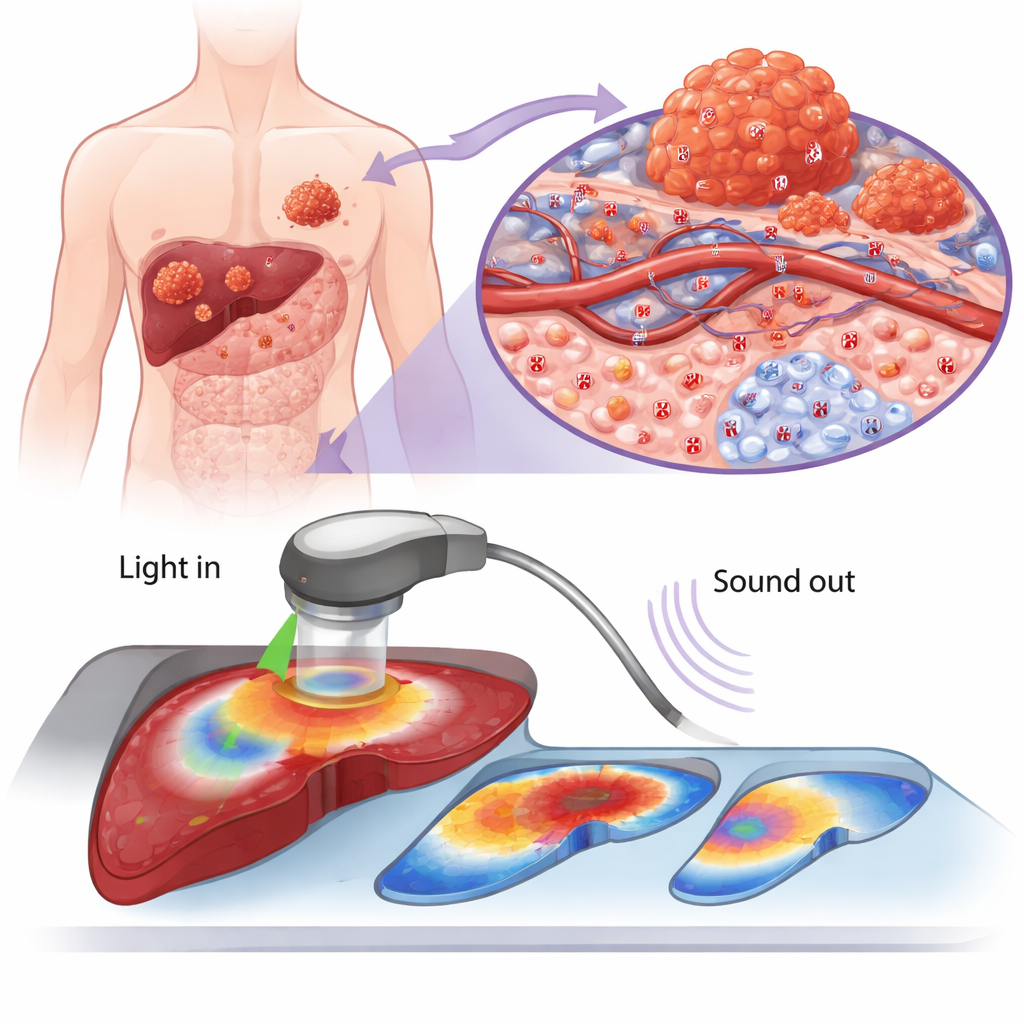
Many tumors, including hepatocellular carcinoma (a common liver cancer), rely on a sugar-hungry metabolism that produces excess acid. Cancer cells use proton pumps in their membranes to push these extra hydrogen ions (H+) out, making the space around the tumor more acidic than normal tissue. The authors identify one such pump component, ATP6V0C, as especially important. In large patient datasets and real tumor samples, levels of ATP6V0C were higher in liver tumors than in nearby healthy tissue, rose as cancers became more advanced, and were linked with worse survival. This suggests that ATP6V0C-driven acid production is not just a side effect of cancer, but a driver of growth, invasion, and spread.
Turning Acidity into an Image
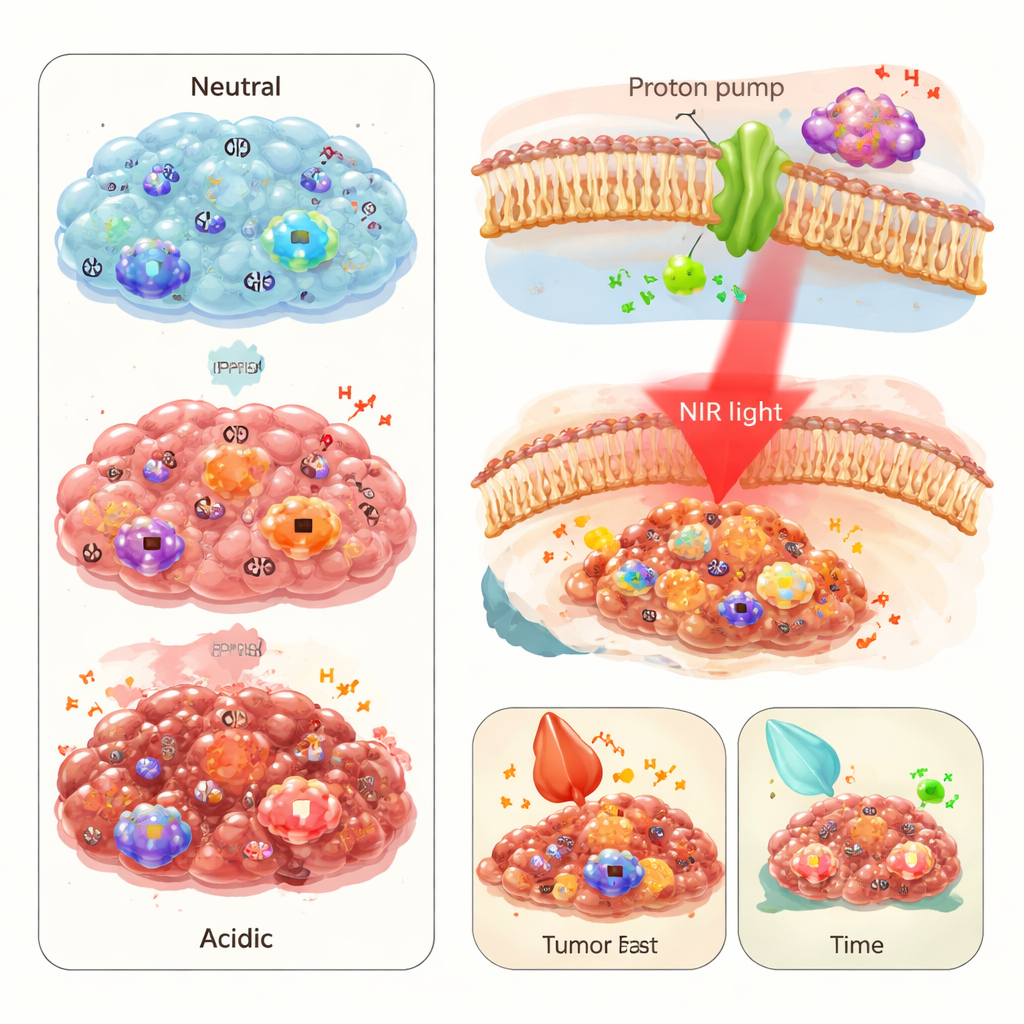
To turn this invisible chemical change into something doctors could see, the team built a tiny sensor called PPS (pH-responsive photoacoustic sensor). PPS is made from a conductive polymer that flips its optical behavior depending on acidity. In neutral conditions, PPS is relatively quiet; in acidic surroundings like those near tumors, it changes form and absorbs near-infrared light strongly. When pulsed light hits PPS, it briefly heats and expands, creating ultrasound waves that can be picked up outside the body. By measuring signals at two different wavelengths and taking their ratio, the researchers created a map of acidity that is both sensitive and less affected by background noise.
Watching Tumors Evolve in Living Tissue
Using this sensor in mice, the authors followed how liver tumors acidify their microenvironment over time. Even when tumors were too small to see by eye, PPS-based photoacoustic imaging detected a gradual drop in local pH as cancer cells multiplied, blood vessels became distorted, and oxygen levels fell. In both implanted liver tumors and liver metastases from pancreatic cancer, PPS highlighted acidic regions that matched tumor locations seen on standard imaging and in tissue slices under the microscope. The same approach could distinguish benign from metastatic lymph nodes in a mouse model and clearly outline the boundaries of human liver tumors in surgical samples, hinting at future use in guiding surgeons to remove all cancerous tissue.
Blocking the Acid Pumps and Heating Tumors from Within
The study goes beyond imaging to test how interfering with proton pumping might slow cancer. The researchers showed that esomeprazole, a common acid blocker used for stomach conditions, can bind to ATP6V0C, reduce its activity in liver cancer cells, and temporarily make the tumor environment less acidic in mice. Cancer cells exposed to this drug became less mobile and less able to invade. At the same time, PPS itself behaves like a tiny heater in acidic conditions: when illuminated with near-infrared light, it warms up more in acidic tumors than in normal tissue, damaging nearby cancer cells. In mouse models, combining PPS-based photothermal treatment with esomeprazole led to stronger tumor shrinkage than either approach alone.
Implications for Future Cancer Care
For non-specialists, the key message is that acidity is an early and actionable warning sign of cancer activity. This work shows that it is now possible to map that acidity in living tissue with high resolution, track how it changes as tumors grow or respond to therapy, and design treatments that are switched on by the very acidity that makes cancers dangerous. While the methods are still at the experimental stage and focused on liver cancer, the approach of imaging and targeting the “acidic soil” that nourishes tumors could eventually help detect cancers earlier, plan surgery more precisely, and fine-tune drug combinations for better outcomes.
Citation: Zeng, S., Chen, J., Ren, Y. et al. Multiscale imaging on proton pump-driven acidity for assessing tumor progression and metastasis. Nat Commun 17, 1785 (2026). https://doi.org/10.1038/s41467-026-68491-4
Keywords: tumor microenvironment, liver cancer, photoacoustic imaging, tumor acidity, proton pump inhibitors