Clear Sky Science · en
Bradyzoite subtypes rule the crossroads of Toxoplasma development
Hidden stages in a common parasite
Toxoplasma gondii is a tiny parasite that quietly infects about one in three people worldwide, usually without them ever knowing. But in people whose immune systems are weakened—such as cancer patients on chemotherapy or individuals with AIDS—the parasite can wake up from a dormant state and cause serious, sometimes fatal brain disease. This study looks inside that dormant stage to ask a simple but crucial question: are all “sleeping” parasites the same, or are there different kinds with different jobs?
Why dormant parasites matter
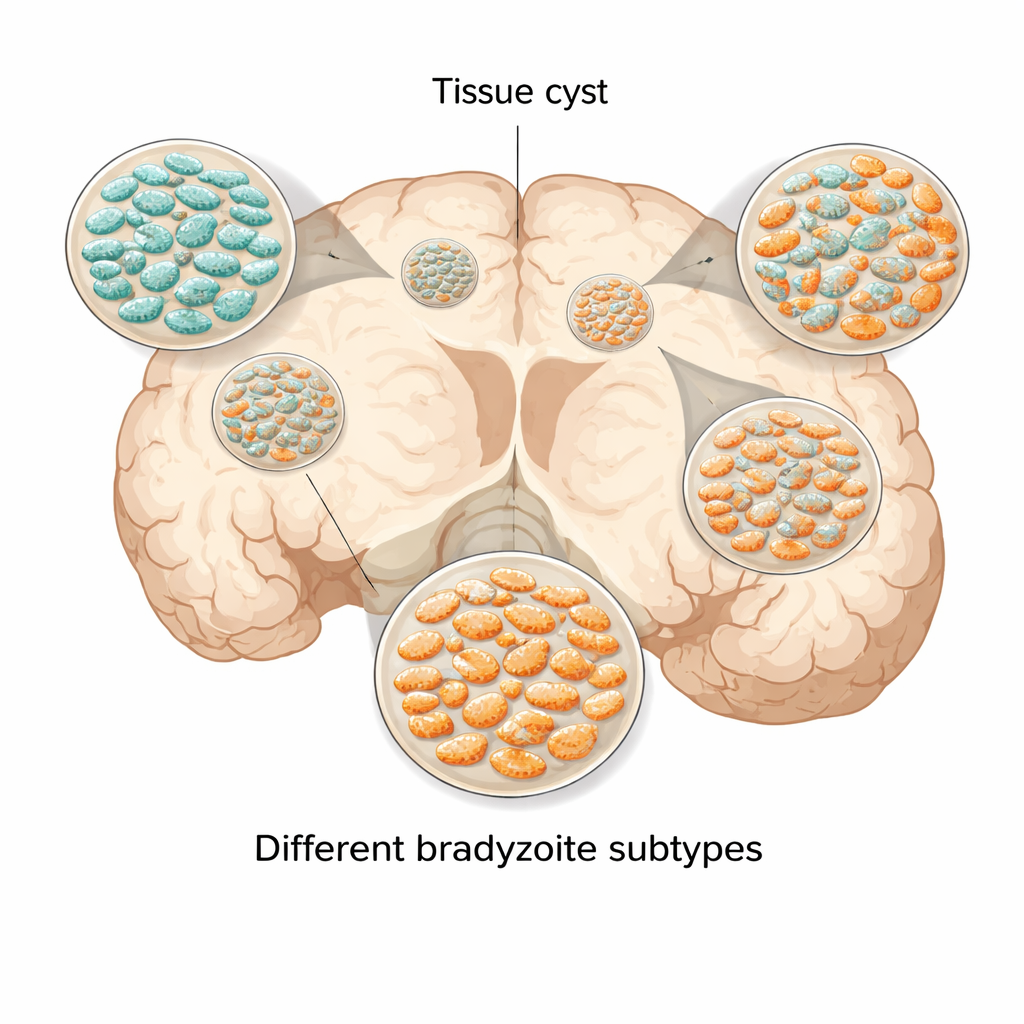
During long-term infection, Toxoplasma hides inside tough, microscopic bubbles in the brain and muscles called tissue cysts. Inside each cyst live hundreds of bradyzoites, the slow-growing, resting form of the parasite. These bradyzoites are the reservoir that fuels lifelong infection and can suddenly switch back into a fast-growing form, called tachyzoites, that damages tissue and spreads through the body. Because current drugs do not clear these cysts, understanding exactly what is going on inside them is key for preventing reactivation in vulnerable patients.
Discovering different “personalities” inside cysts
The researchers focused on a surface molecule called SRS22A, found on some bradyzoites in mice but strangely missing in standard lab-grown cysts. Using specially made antibodies as molecular “highlighters,” they showed that brain cysts from infected mice are not uniform. Some cysts are packed almost entirely with SRS22A-positive parasites, some lack this marker altogether, and many contain a mixture of both. These patterns change over the course of infection, revealing that cysts grow, rupture, and reform while keeping a rich internal diversity rather than settling into a single, mature endpoint.
Two main fates: spreading versus staying put
To test what these differences mean, the team separated SRS22A-positive and SRS22A-negative bradyzoites from mouse brains and followed what happened when each group infected brain cells in culture and live mice. SRS22A-positive parasites rapidly converted into fast-replicating tachyzoites that spread through cell layers and through mouse organs. Infected mice carried more parasites during the early phase of infection and developed many more brain cysts later on. In contrast, SRS22A-negative parasites tended to stay in the bradyzoite form, slowly multiplying and building new cyst walls. Rather than driving explosive spread, this group seemed geared toward quietly maintaining the long-term reservoir.
Five subtypes revealed by single-cell profiling
Looking even more closely, the scientists used single-cell RNA sequencing, a technique that reads which genes are switched on in thousands of individual parasites. This uncovered at least five major bradyzoite subtypes inside chronic brain cysts, each with its own gene activity “signature.” One group, enriched for SRS22A and other markers usually seen in the parasite’s cat stage, may be primed to restart sexual reproduction when a cat eats infected prey. Other groups switched on genes linked to invasion tools or cyst wall building, suggesting some parasites are preparing to break out and invade new cells, while others reinforce the protective shell around the community.
Rethinking a simple life cycle
Taken together, these findings overturn the simple textbook picture of Toxoplasma slowly marching from fast tachyzoite to a single, stable “resting” bradyzoite stage. Instead, each cyst is more like a small, mixed village of specialists: some parasites are poised to burst out and spread, some to deepen the chronic infection by building new cysts, and others may be ready for the jump into a cat host. This complexity helps explain why lab models that produce only a subset of these types can miss key behaviors seen in real infections, and why drugs that target one stage often fail to cure the disease.
What this means for patients
For people living with Toxoplasma infection, the study’s message is that the “sleeping” parasites in their tissues are not all alike. Certain subtypes appear to be the real engines of dangerous flare-ups, while others sustain silent, chronic infection or prepare the parasite for transmission to new hosts. By identifying surface markers such as SRS22A and gene patterns that distinguish these subtypes, researchers now have a roadmap to design better lab models, vaccines, and drugs that specifically target the forms most likely to cause severe disease. In the long run, this could lead to therapies that not only control symptoms but also prevent the parasite from ever waking up.
Citation: Ulu, A., Srivastava, S., Kachour, N. et al. Bradyzoite subtypes rule the crossroads of Toxoplasma development. Nat Commun 17, 1783 (2026). https://doi.org/10.1038/s41467-026-68489-y
Keywords: Toxoplasma gondii, bradyzoite, tissue cyst, parasite reactivation, single-cell RNA sequencing