Clear Sky Science · en
IFITM3 deficiency drives SARS-CoV-2 adaptation while preserving variant-specific traits
Why this study matters for future pandemics
The COVID-19 pandemic showed how viruses that start in animals can evolve to spread efficiently in humans. This study asks a forward-looking question: which defenses in our bodies make it harder for new coronavirus variants to adapt when they first jump between species? The researchers focus on a natural antiviral protein called IFITM3, which some people produce less of due to genetic differences. By watching how SARS-CoV-2 evolves in normal and IFITM3-deficient mice, they reveal how a weakened frontline defense can speed viral adaptation—while still leaving each variant’s “personality” largely intact.
A built-in shield that some people lack
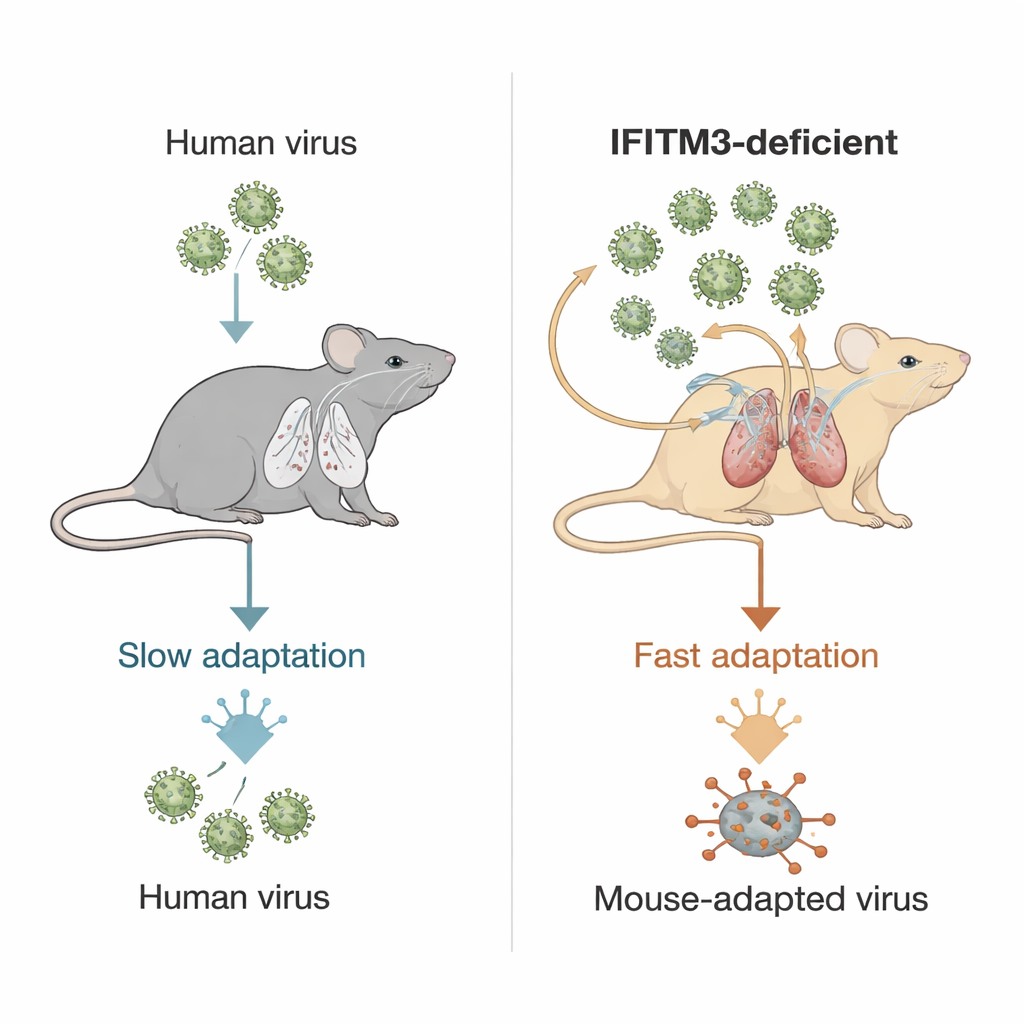
Our first line of defense against new viruses relies on molecules switched on by interferons, a family of immune signals. IFITM3 is one of these molecules. It sits in cell membranes, especially in internal compartments called endosomes, and makes it physically harder for incoming viruses to fuse and deliver their genetic material. Human studies have shown that people with IFITM3 defects are more likely to suffer severe flu or COVID-19. In mice, completely removing IFITM3 worsens disease. Earlier work with influenza suggested that losing IFITM3 not only makes infections harsher, but also lowers the barrier for a virus to adapt to a new host. This study tests whether the same is true for SARS-CoV-2 variants that already circulate widely in humans.
Putting SARS-CoV-2 through a mouse “evolution treadmill”
The researchers focused on two contrasting variants: Beta, which is relatively damaging to lungs, and Omicron BA.4, which tends to favor the upper airways and cause milder disease. Both already carry a Spike mutation, N501Y, that lets them latch onto mouse cells, but they still infect mice only weakly at first. To mimic cross-species evolution, the team repeatedly transferred virus from the lungs of one mouse to the next—20 rounds of infection—in either normal mice or mice lacking IFITM3. Over time, viruses passaged in IFITM3-deficient animals replicated to much higher levels and caused more weight loss and lung inflammation than the original human-derived strains, especially for Beta. Similar but slower adaptation occurred when viruses were passaged in normal mice, showing that IFITM3 does not make adaptation impossible, but acts as a strong speed bump.
New mutations, but the same variant “personalities”
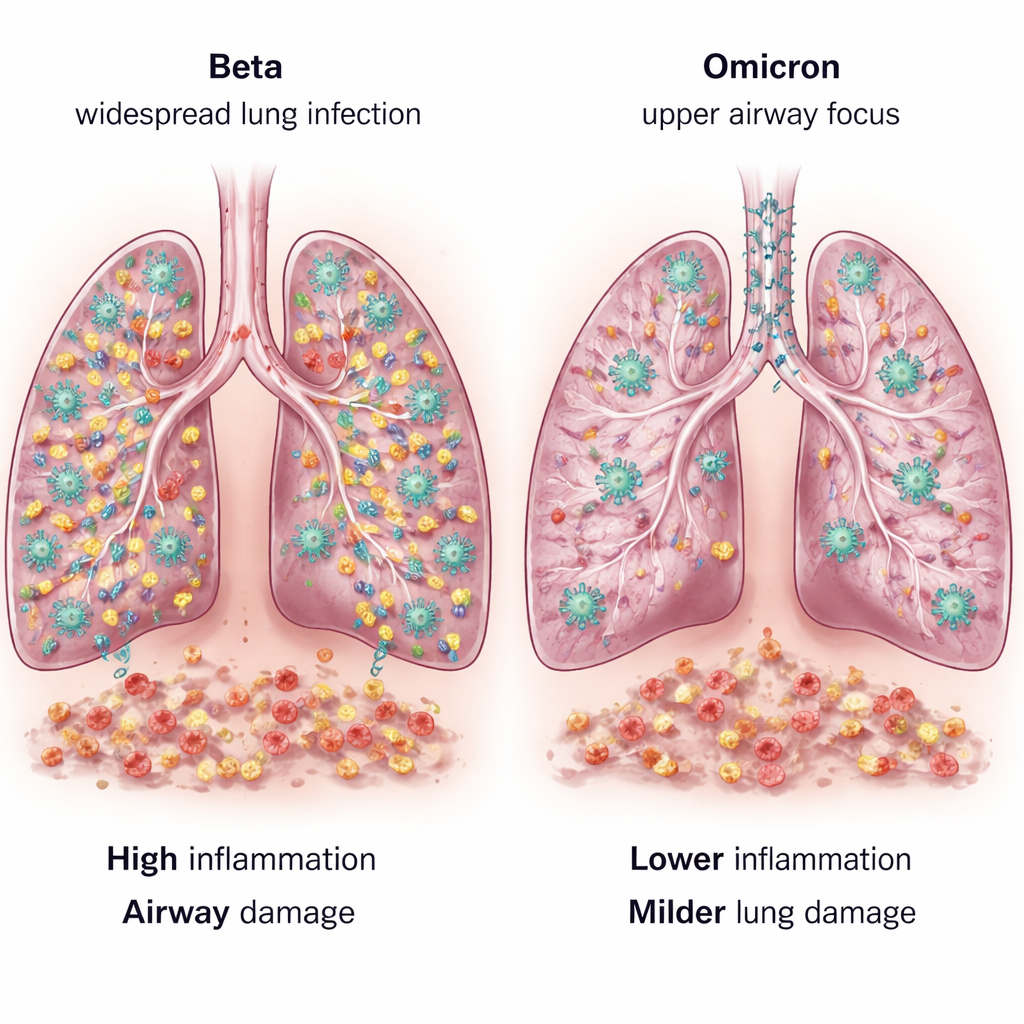
Genome sequencing of the adapted viruses revealed clusters of new mutations scattered across the viral proteins, many of which had not been described before. These changes were associated with better growth in mouse lungs but generally worse performance in human lung cell models—a trade-off between thriving in the new host and losing fitness in the original one. Crucially, adaptation in mice did not erase the core behavioral differences between variants. Mouse-adapted Beta spread widely from large airways into the tiny air sacs, triggered strong inflammatory signals, disrupted genes that keep cilia and lung structure intact, and caused major breathing problems. Mouse-adapted Omicron still preferred the nose and larger airways, infected fewer lung cells, induced milder inflammation, and caused little change in breathing mechanics. Both adapted variants could be found in the heart, offering new tools to study COVID-related heart damage.
What lung responses reveal about severe disease
To understand why some adapted viruses cause more damage, the team examined gene activity patterns in infected lungs. Beta and a classic mouse-adapted early pandemic strain (MA10) triggered broad shifts in thousands of genes, including strong activation of antiviral and inflammatory programs and marked suppression of cilia-related genes that help clear mucus and pathogens. They also altered pathways controlling fat metabolism and tissue structure, and boosted signals linked to neutrophils—white blood cells that can damage lung tissue when over-activated. Omicron caused far fewer changes in these same pathways. When the scientists depleted neutrophils in mice infected with the most virulent Beta strain, disease severity and breathing abnormalities improved, directly tying certain immune responses to lung injury.
Implications for human genetics and spillover risk
This work shows that IFITM3 acts as an important barrier when SARS-CoV-2 variants move into a new host species: without it, the virus accumulates helpful mutations faster and becomes more damaging in that species. Yet adaptation enhances each variant’s fitness without rewriting its underlying traits, such as Beta’s lung-targeting behavior or Omicron’s preference for the upper airways. Because partial IFITM3 defects are relatively common in humans, people with reduced IFITM3 function might provide a more permissive environment for newly spilled-over viruses to adapt. The study also highlights that other antiviral pathways could shape viral evolution in different ways. Overall, the findings deepen our understanding of how host genetics and innate defenses can steer the evolution of emerging coronaviruses and influence the risk of future pandemics.
Citation: Denz, P.J., Speaks, S., McFadden, M.I. et al. IFITM3 deficiency drives SARS-CoV-2 adaptation while preserving variant-specific traits. Nat Commun 17, 1779 (2026). https://doi.org/10.1038/s41467-026-68485-2
Keywords: SARS-CoV-2 adaptation, IFITM3, viral evolution, COVID-19 variants, host antiviral defenses