Clear Sky Science · en
Predictive design of stretchable electrodes with strain-insensitive performance via robotics- and machine learning-integrated workflow
Electronics That Can Stretch Like Skin
From smart shirts that track our heartbeat to soft robots that move like living creatures, tomorrow’s gadgets will need wiring and batteries that can stretch, twist, and bend without failing. This paper describes a new way to design such “stretchable electrodes” so that they keep working even when pulled to several times their original length. By teaming up lab robots, artificial intelligence, and computer simulations, the researchers discover materials and structures that behave more like elastic skin than brittle metal.
Why Stretchable Wires Are Hard to Make
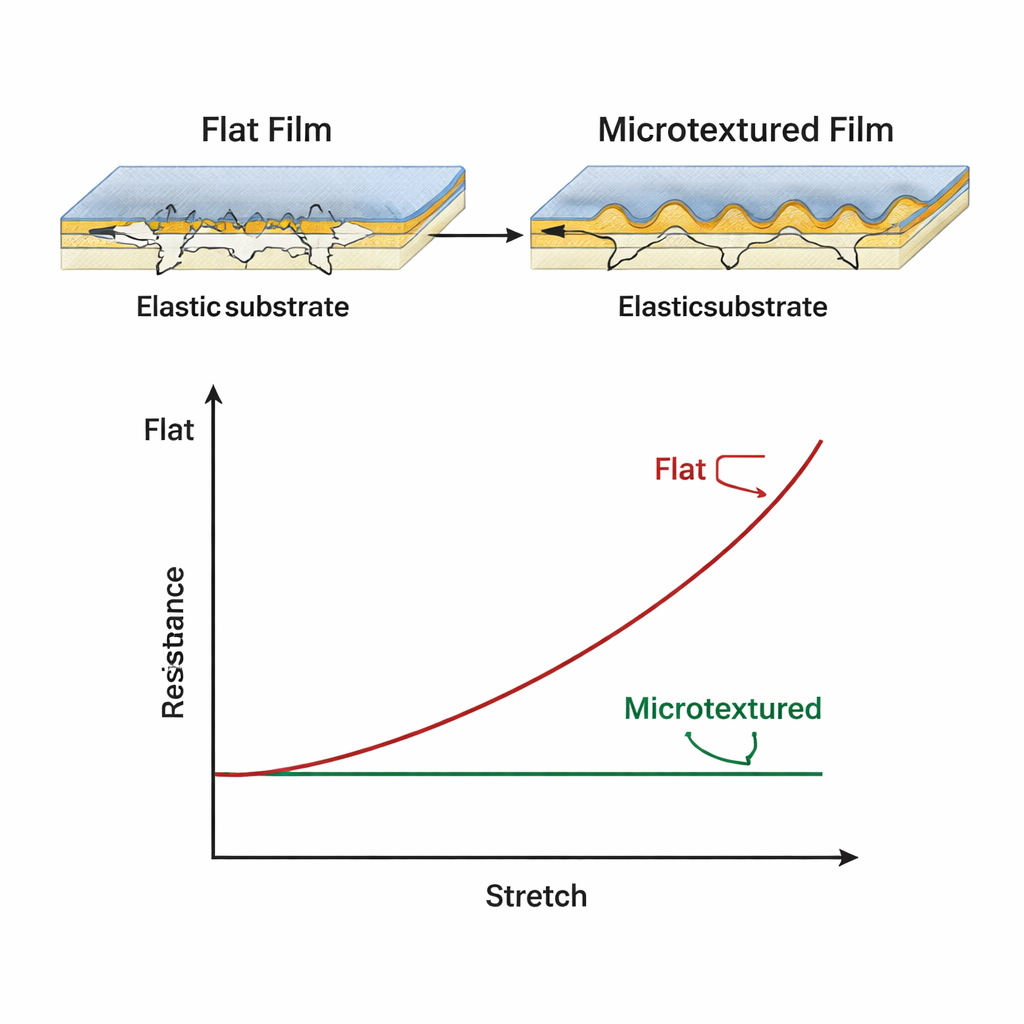
Most metals and battery materials are great at carrying electricity but terrible at dealing with strain. When stretched, thin metal films quickly crack, and their electrical resistance shoots up, causing devices to fail. Engineers have tried liquid metals, networks of nanowires, and clever patterns that spread out stress, but balancing three needs at once—high conductivity, large stretchability, and stable performance under strain—has remained elusive. The usual trial-and-error approach, where one parameter is changed at a time, simply cannot cope with the enormous number of possible recipes and processing steps.
Letting Robots and AI Explore a Huge Design Space
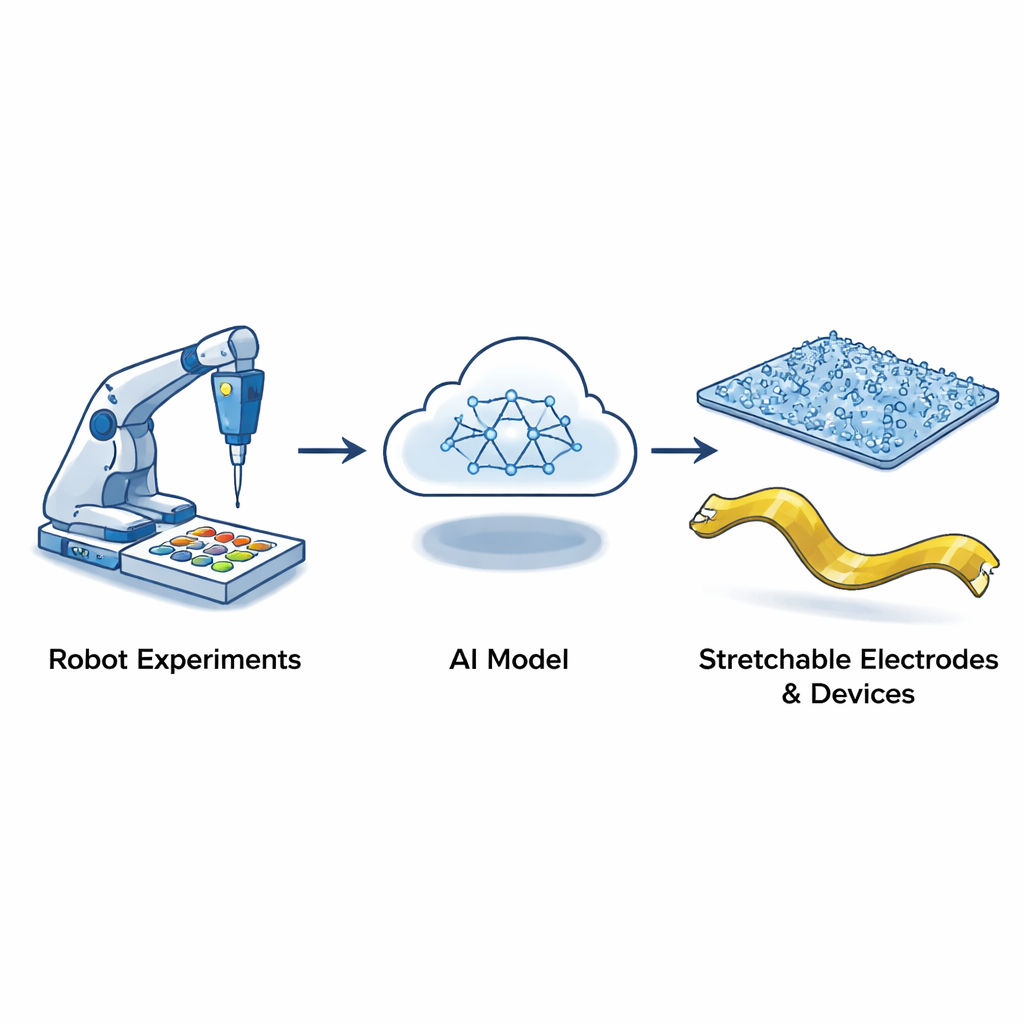
The authors tackle this problem by building an integrated “materials discovery” pipeline. A pipetting robot first mixes hundreds of combinations of four building blocks: conductive MXene sheets, carbon nanotubes, gold nanoparticles, and a flexible polymer. These mixtures are filtered into thin films and tested for how well they conduct electricity. Using these results, a machine-learning model quickly rules out poor performers and maps a smaller, promising region of the design space. Then, in several rounds of “active learning,” the AI proposes the most informative new recipes and processing conditions; the robot makes them, the team measures their properties, and the model is updated. Data-augmentation tricks further boost the model’s reliability without requiring thousands of extra experiments.
Creating Tiny Wrinkles That Tame Big Strains
Beyond composition, the key insight is that the surface shape of the films can be engineered to handle stretching. By shrinking and re-stretching the material on special plastic sheets and sticky tapes, the team creates microtextured films decorated with hierarchical wrinkles and crumples—ridges on top of ripples. Computer simulations reveal how these shapes work: when pulled, the wrinkles straighten out first, absorbing the deformation so that the material itself experiences only small local strains. As long as those strains stay below a certain threshold, conductive paths remain intact and the electrical resistance barely changes, even at several hundred percent elongation.
From Ultra-Stretchy Wires to Soft Batteries
Using its “champion” prediction model, the workflow recommends a specific microtextured nanocomposite to serve as a supportive underlayer for a very thin gold film. This optimized stack produces a gold conductor that behaves almost like bulk metal but can be stretched to over ten times its original length before its resistance increases noticeably, and it survives tens of thousands of stretch–relax cycles. The same design principles are then applied to make a fully stretchable zinc–manganese dioxide battery. Here, the microtextured gold collectors host thick layers of rigid battery materials, yet the finished device can be elongated to 300 percent while delivering nearly unchanged capacity and efficiency over hundreds of charge–discharge cycles.
What This Means for Future Wearable Tech
For non-specialists, the central message is that the team has shown a practical recipe for building soft, durable power and wiring components that can stretch with our bodies or with soft machines. Instead of relying on slow guesswork, their robot-and-AI-guided process quickly finds combinations of ingredients and surface shapes that keep electrical performance steady under extreme deformation. This strategy could speed up the development of comfortable medical wearables, flexible Internet-of-Things devices, and next-generation soft robots, bringing us closer to electronics that move as naturally as the skin and muscles they are meant to work with.
Citation: Yang, H., Chen, Q., Chen, T. et al. Predictive design of stretchable electrodes with strain-insensitive performance via robotics- and machine learning-integrated workflow. Nat Commun 17, 1778 (2026). https://doi.org/10.1038/s41467-026-68484-3
Keywords: stretchable electronics, wearable devices, machine learning design, soft batteries, microtextured materials