Clear Sky Science · en
Distinct magneto-optical response of Frenkel and Wannier excitons in CrSBr
Why this strange crystal matters
Electronics and photonics are steadily shrinking toward the atomic scale, where light and magnetism can intertwine in surprising ways. This study looks at a recently discovered magnetic crystal, CrSBr, that is just a few atoms thick and shows how it hosts two very different kinds of light-driven excitations. Understanding these tiny light–matter hybrids could open routes to ultra-compact sensors, memory elements, or logic devices that read and control magnetism using light instead of electric current.
Light-made partners inside a magnet
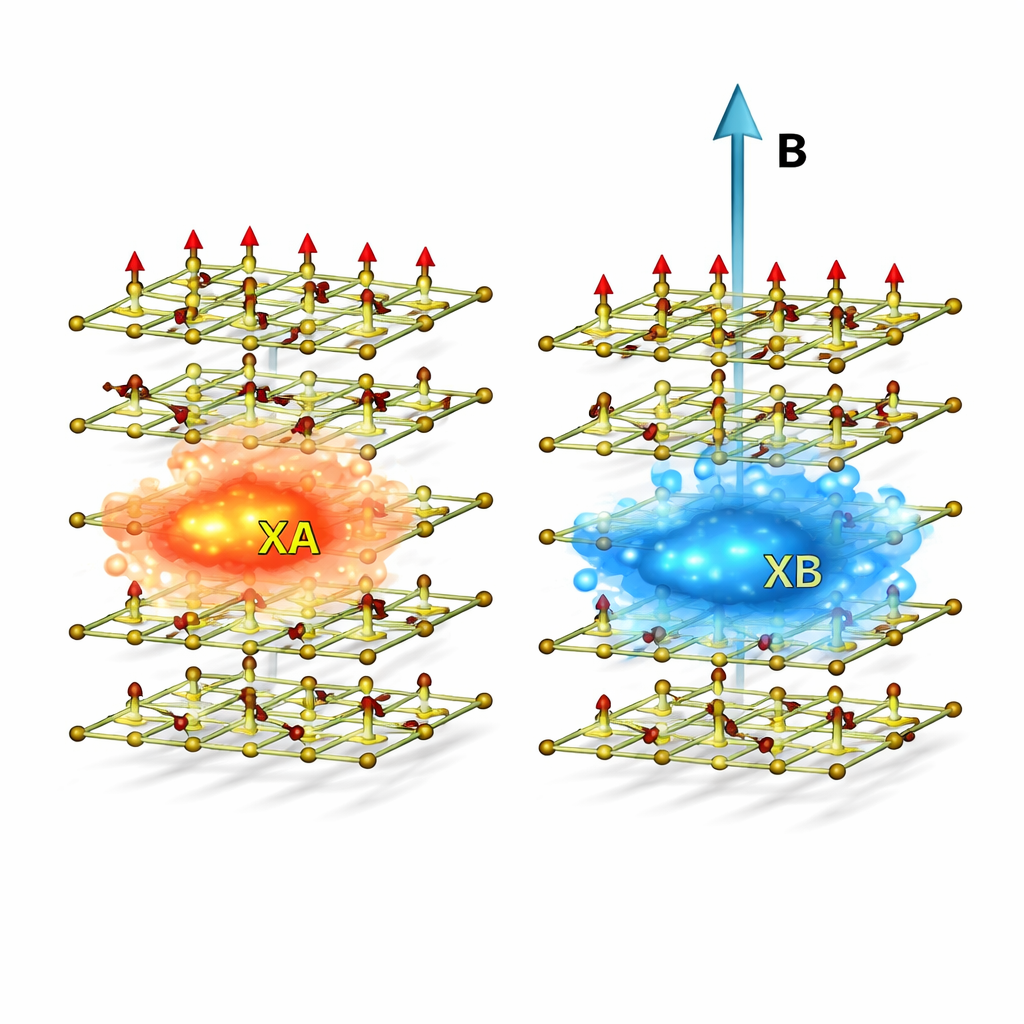
When light hits a semiconductor, it can create a bound pair of an electron and a hole, known together as an exciton. In most familiar materials these pairs are fairly spread out, but in some crystals they can be tightly confined to just one or two atoms. CrSBr, a layered magnetic semiconductor, turns out to host both extremes at once. The authors focus on two strong exciton features in the visible range, called XA (at about 1.38 eV) and XB (around 1.8 eV). Using both high-field optical experiments and advanced quantum calculations, they show that XA behaves like a compact, almost atomic object, while XB is much more extended across the crystal.
Watching excitons feel the magnet
The team shines light on bulk CrSBr while sweeping magnetic fields up to 85 tesla, at very low temperatures. In zero field, the spins in neighboring atomic layers are arranged in opposite directions (an antiferromagnetic state). Around 2 tesla, the field flips them into a fully aligned configuration (a ferromagnetic state). As the magnetic order changes, the optical signals from XA and XB shift to lower energy (a redshift), but by very different amounts: XB moves by about 100 millielectronvolts, whereas XA shifts only about ten times less. This means XB closely tracks changes in the underlying electronic bands caused by magnetism, while XA is comparatively insensitive.
Local versus spread-out excitons
To explain this stark contrast, the authors turn to a state-of-the-art computational approach called QSGWb, which can accurately predict both the basic electronic bands and the exciton states without relying on adjustable parameters. The calculations reveal that CrSBr has a larger band gap than earlier estimates, which implies that both XA and XB are strongly bound. XA is dominated by electronic weight on a single chromium site, making it strongly localized, or “Frenkel-like.” XB, in contrast, spreads over multiple atoms and neighboring sites, making it more “Wannier-like,” that is, extended over the lattice. Because XB is built from states close to the band edge, any magnetically driven change in the band gap shows up directly in its energy. XA, being highly localized, depends less on the band edges and more on local atomic arrangements, so magnetic changes barely nudge it.
How big these excitons really are
At higher magnetic fields, both excitons move slightly to higher energy (a blueshift) in a way that grows with the square of the field, a signature of the so-called diamagnetic effect. This shift essentially “measures” how big each exciton is in the plane of the crystal. From the data, XB appears more than four times larger than XA. Calculated maps of the exciton wavefunctions support this picture: in the low-field antiferromagnetic state, both excitons are largely confined within a single layer, but when the layers become ferromagnetic, XB starts to extend between layers while XA remains trapped within one. This change in shape makes XB especially sensitive to how spins line up from layer to layer.
When the lattice starts to shake
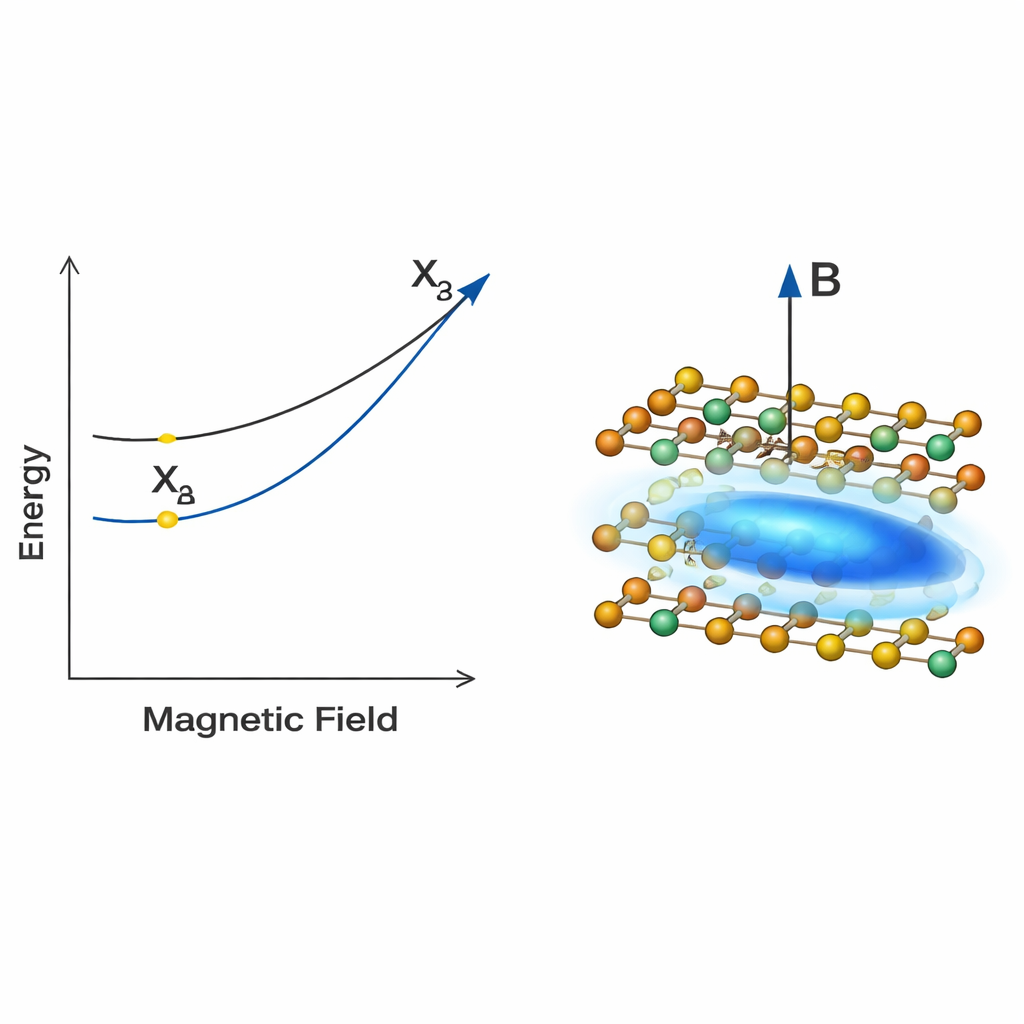
The authors also probe what happens as the crystal warms up. Temperature not only disturbs magnetic order but also excites vibrations of the atoms (phonons). They find that the energy shift of XA between low and high magnetic field remains nearly constant with temperature, echoing its localized nature and weak coupling to the lattice. XB behaves very differently: its magnetic-field-induced redshift steadily shrinks as the crystal warms. By computing how different vibration patterns distort the lattice and affect exciton energies, the authors identify specific out-of-plane vibration modes (Ag phonons) that strongly modify XB but hardly touch XA. This indicates that the more extended, interlayer character of XB naturally couples to lattice motion perpendicular to the layers.
A new playground for light and magnetism
Overall, the work shows that a single 2D magnetic material can host two coexisting excitons with radically different sizes, sensitivities, and ties to magnetism and lattice motion. The tightly bound XA exciton behaves like a mostly local probe of the chromium atoms, while the more spread-out XB exciton acts as a powerful detector of changes in band structure, magnetic order, and certain vibrations. For non-specialists, the key message is that by carefully tailoring how such excitons are localized or delocalized, researchers can design crystals where light cleanly reads out or even controls magnetic states, pointing toward new concepts for optical memory, quantum technologies, and ultralow-power spin-based devices.
Citation: Śmiertka, M., Rygała, M., Posmyk, K. et al. Distinct magneto-optical response of Frenkel and Wannier excitons in CrSBr. Nat Commun 17, 1777 (2026). https://doi.org/10.1038/s41467-026-68482-5
Keywords: 2D magnetic semiconductors, excitons, CrSBr, magneto-optics, light–spin coupling