Clear Sky Science · en
Exposure of western United States bird communities to predicted high severity fire
Why Wildfire Matters for Birds and People
Across the western United States, wildfires are growing larger and hotter. That is worrying not only for homes and forests, but also for the rich birdlife that depends on these landscapes. This study asks a forward-looking question: where are bird communities most likely to collide with unusually intense, stand-replacing fires, and where might they instead find natural safe havens as the climate warms and fire behavior shifts?
Mapping Where Birds Live
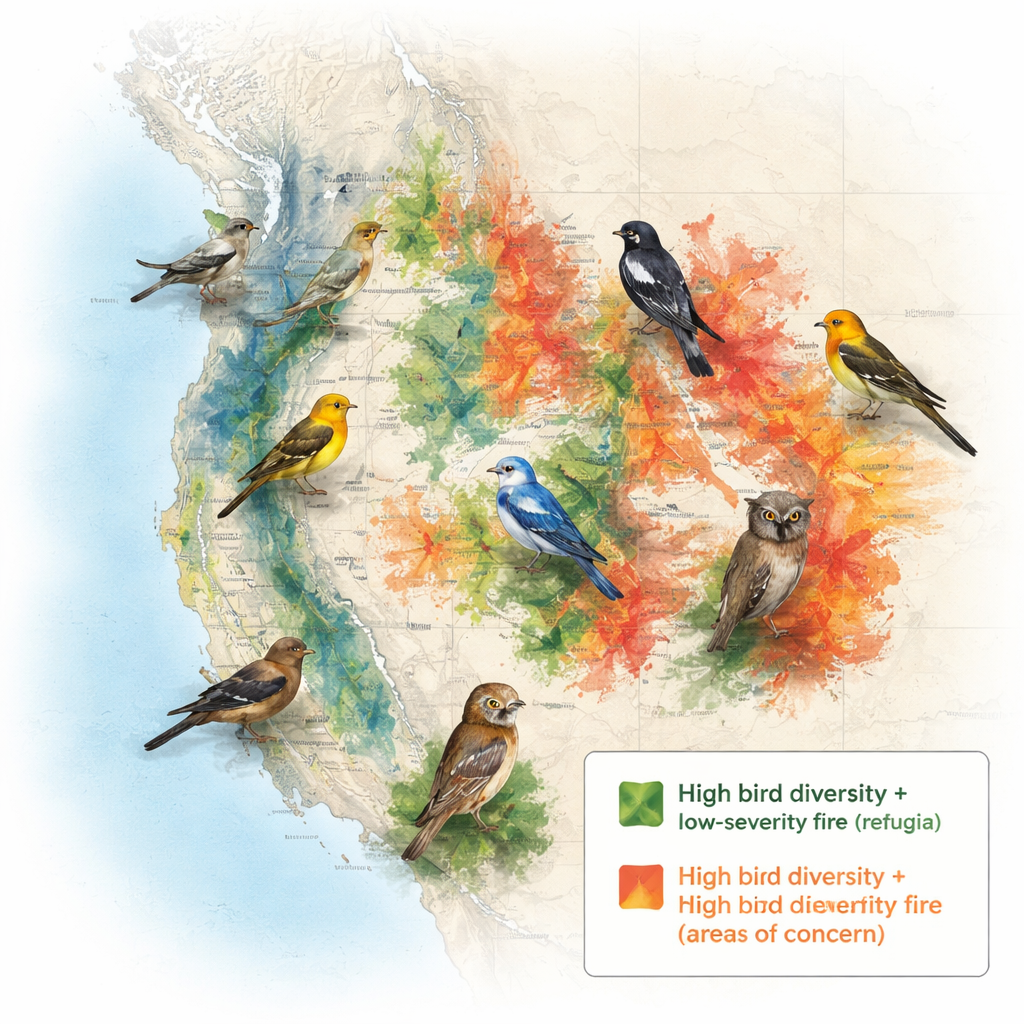
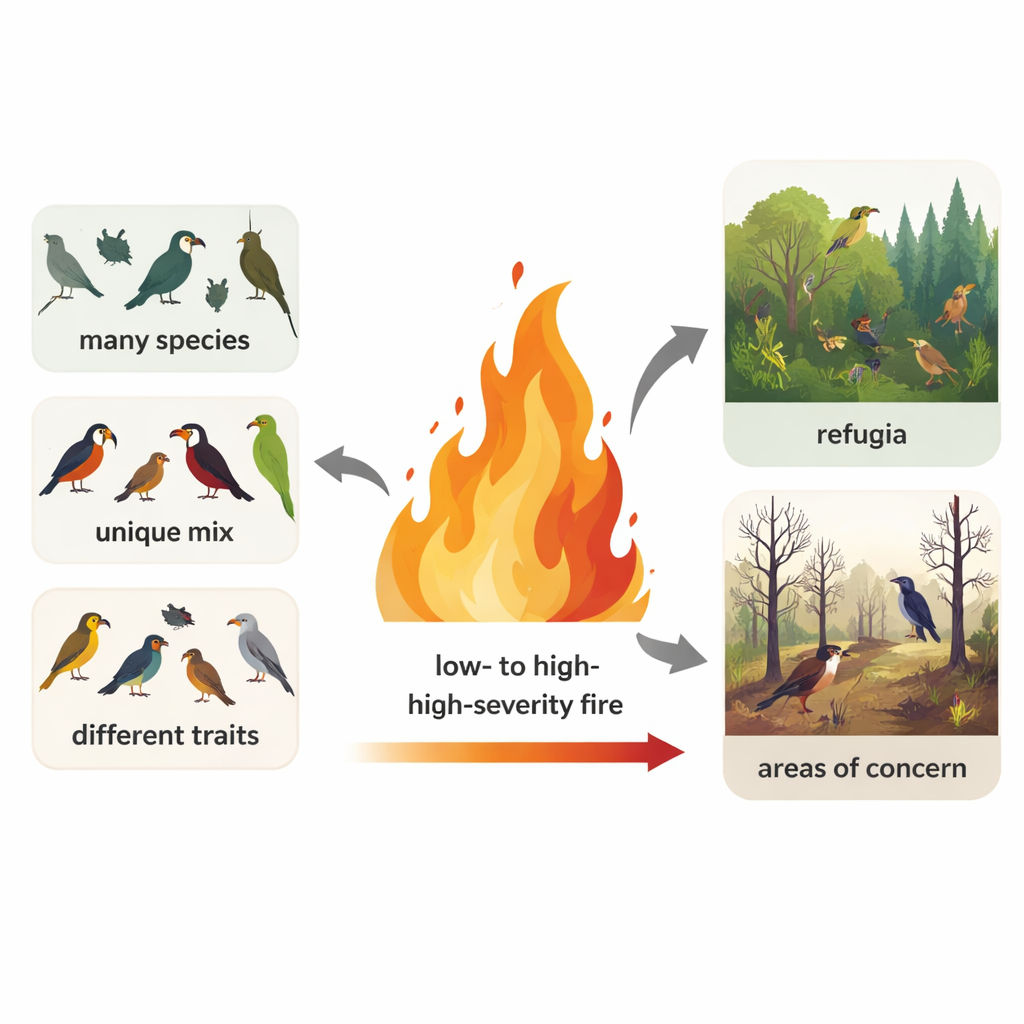
The researchers began by assembling some of the most detailed bird maps ever created. Using millions of volunteer bird sightings from the eBird project, combined with advanced computer models, they estimated which bird species occur in each 3-by-3 kilometer square of forest across the western U.S. From these maps they calculated three key views of bird life: how many species occur in a place (species richness), how different each community is from its neighbors (community uniqueness), and how varied birds’ bodies and lifestyles are (functional diversity), which captures traits such as body size, beak shape, habitat use, and migration behavior.
Overlaying Birds and Future Fire
Next, the team turned to cutting-edge fire forecasts that predict, at fine scale, whether any future fire in a given forest location is more likely to burn gently or with severe, stand-replacing intensity. They then overlaid the bird diversity maps on these fire predictions. Watersheds (small drainage basins used in land management) with the highest bird diversity were tagged as “hotspots.” Each hotspot was classified as a “refugium” when low-severity fire was more likely, an “area of concern” when high-severity fire dominated, or “mixed” when both fire types were about equally likely.
Safe Havens and Danger Zones
The results bring a mix of good and bad news. More than half—about 55–58%—of bird diversity hotspots fell into refugia, places where rich bird communities are expected to experience mostly lower-intensity fire that forests and birds are more likely to withstand. However, roughly a quarter to nearly a third (24–30%) of hotspots were areas of concern, where high bird diversity coincides with a high likelihood of intense, stand-replacing fires. Many of these danger zones are in regions such as the Sierra Nevada, Cascades, Colorado Rockies, and parts of Utah and California, which already show signs of shifting fire behavior.
When Fire Breaks the Historical Pattern
A critical finding is that over half of the areas of concern lie in forests that historically experienced mostly low-intensity fire. In other words, bird communities that evolved with frequent, mild surface fires now face the risk of rare but devastating crown fires that can kill nearly all trees in a stand. In some places, repeated high-severity fires, combined with warmer, drier conditions, may prevent forests from growing back at all, converting them into shrublands or grasslands. That threatens birds that depend on dense, mature forests, including species with a strong preference for thick vegetation and those with relatively shallow beaks, such as certain hummingbirds and small insect-eating birds, which the study found to be especially exposed to severe fire.
What This Means for Conservation
For land managers and the public, the study offers a map of both promise and peril. It highlights refugia where maintaining natural, lower-intensity fire—through practices like thinning and prescribed burning—could help safeguard rich bird communities. It also pinpoints high-diversity areas where future severe fires are most likely to be disruptive, especially where they would mark a sharp break from the historical fire pattern and raise the risk of permanent forest loss. By combining bird data, species traits, and fire forecasts at continental scale, the work provides a powerful tool for deciding where proactive management could do the most to keep western forests—and the birds that animate them—thriving in a hotter, more fire-prone future.
Citation: Norman, K.E., Stillman, A.N., Parks, S.A. et al. Exposure of western United States bird communities to predicted high severity fire. Nat Commun 17, 1775 (2026). https://doi.org/10.1038/s41467-026-68480-7
Keywords: wildfire, bird diversity, biodiversity hotspots, forest conservation, western United States