Clear Sky Science · en
Episodic events are flexibly encoded in both integrated and separated neural representations
Why your memories can both blend and stay separate
Everyday life is full of overlapping experiences: you might meet the same friend at work one day and at a café the next. Somehow your brain can both connect these moments into a bigger story and still remember the details of each meeting. This study asks how the brain pulls off that balancing act in real time, using brainwave recordings while people watched short, lifelike movies.
Movies that mimic real-life encounters
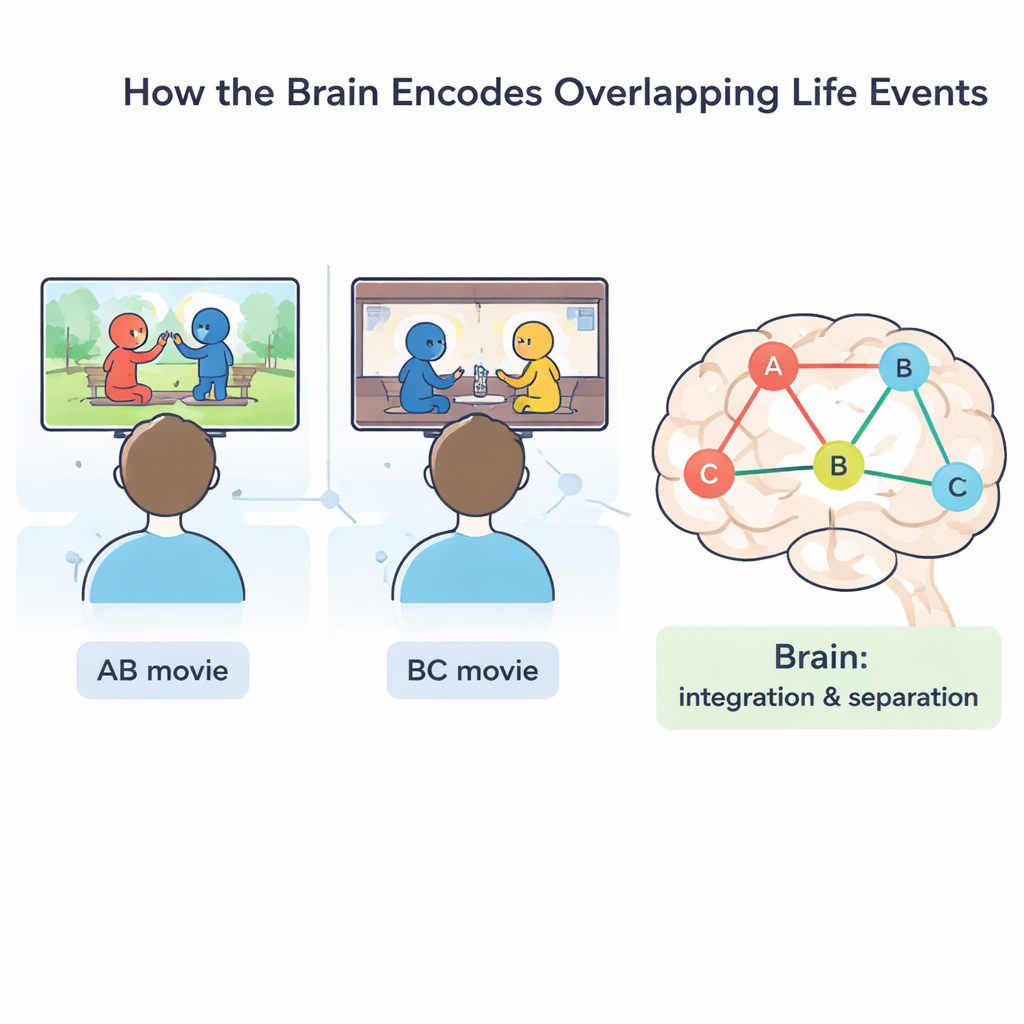
To capture natural memory, volunteers watched computer-generated videos of cartoon-like characters interacting, much like scenes from a life‑simulation game. In one set of movies, character A met character B (AB movies). Later, a new set showed character B meeting a new character C (BC movies). Other movies featured pairs of completely new characters (XY movies), serving as a comparison where nothing overlapped. Later on, participants took memory tests: they had to remember who had met whom directly (AB, BC, XY) and also infer links that were never shown, such as whether A was connected to C through their shared acquaintance B (AC). They were also asked whether specific pairs had ever actually appeared together on screen, a test of detailed, event‑specific memory.
Tracking brain patterns as events unfold
While people watched the movies, researchers recorded their brain activity with electroencephalography (EEG), which measures tiny electrical signals from the scalp with millisecond precision. Instead of looking only at overall activity levels, the team used a technique called representational similarity analysis. In simple terms, they compared the brain’s activity patterns from earlier AB movies with patterns recorded during later BC movies. If the patterns looked more alike than expected, it suggested the brain was integrating the events; if they looked more different, it suggested the brain was actively separating them. The researchers also examined specific brainwave rhythms, especially slower “theta” waves and somewhat faster “alpha–beta” waves, which have been linked to memory formation and control.
When the brain chooses to link or to separate
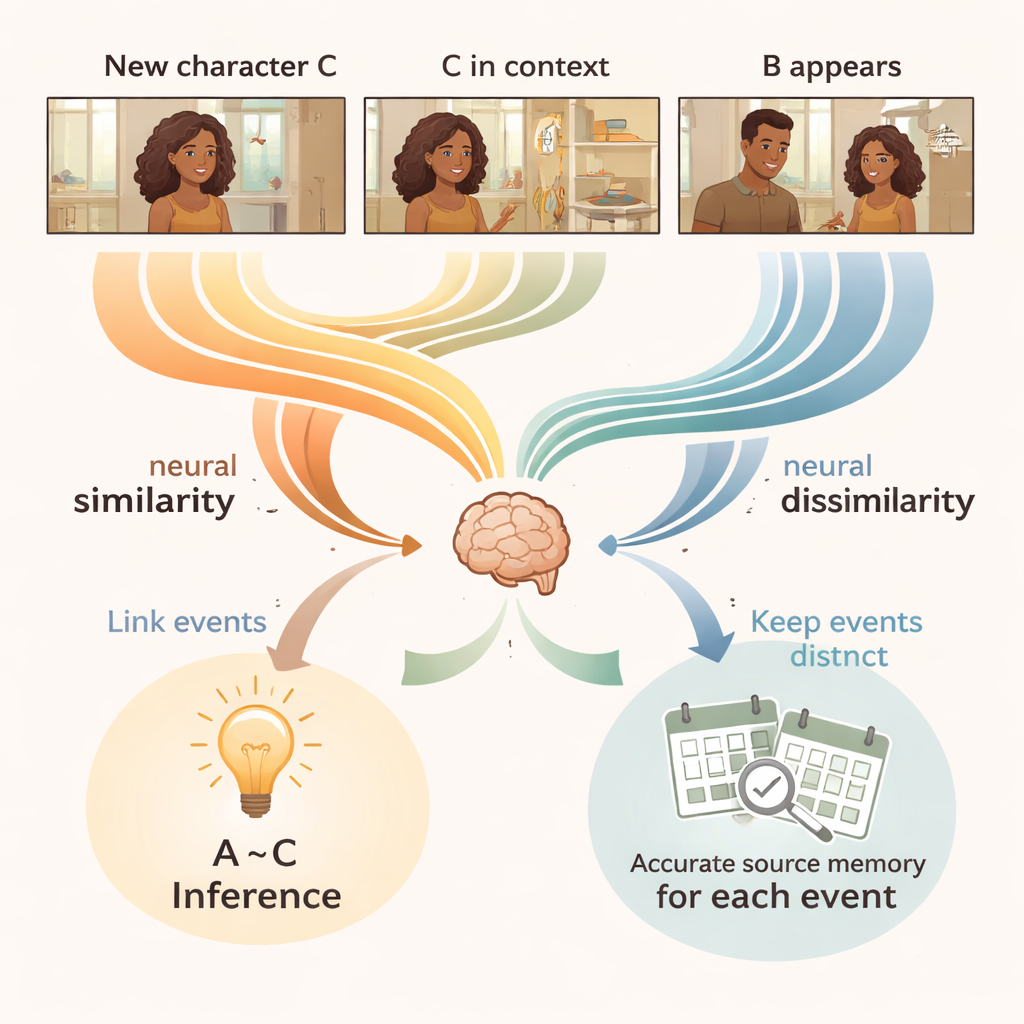
The results showed that the brain does not treat overlapping events in a single, uniform way. When the new character C appeared and was shown in context during the BC movies, brain patterns became more similar to those from the earlier AB movies. This suggested that the brain was weaving the new experience into an existing memory network, effectively building a bridge between A, B, and C. Later in the same BC movies, when the shared character B reappeared, the brain patterns shifted in the opposite direction, becoming more distinct from the AB patterns. This hinted that the brain was working to keep the two events—A with B, and B with C—separate enough to avoid confusion.
Brain rhythms behind connecting and protecting memories
These shifts in similarity and difference went hand in hand with changes in brain rhythms. During segments where memories looked more integrated, alpha–beta power tended to dip, a pattern previously linked to active information processing and successful remembering. When patterns became more distinct, alpha–beta power rose alongside increases in theta activity, consistent with the brain exerting control to suppress interference between similar events. Importantly, the degree of similarity and dissimilarity predicted later behavior. Stronger similarity during the C‑in‑context segments was tied to better AC inference—people were more likely to correctly link A and C, even though they had never appeared together. By contrast, stronger dissimilarity when B appeared predicted better source memory—participants were more accurate at remembering which characters had actually been seen together.
How this explains everyday remembering
Taken together, the findings suggest that the brain builds two types of memory traces at once when events overlap. One integrated trace links related experiences, helping you draw new conclusions and make decisions—like realizing that two people probably know each other because you have seen each of them with the same friend. Another, more separated trace keeps episodes distinct, so you can still recall where and when each meeting happened. Rather than choosing between blending memories or preserving details, the brain seems to do both in parallel, flexibly supporting our ability to generalize from the past while holding on to the specific stories that make up our lives.
Citation: Liu, Z., Johansson, M. & Bramão, I. Episodic events are flexibly encoded in both integrated and separated neural representations. Nat Commun 17, 752 (2026). https://doi.org/10.1038/s41467-026-68473-6
Keywords: episodic memory, memory integration, memory separation, EEG brainwaves, associative inference