Clear Sky Science · en
Rejection-based choices discourage people from opting out of voting
Why some people sit out elections
In many elections, a large share of eligible voters stay home or tell pollsters they are “undecided,” even when they dislike one candidate more than the other. This paper explores a simple idea: maybe it is not that these people lack opinions, but that the way we ask them to choose—“Who will you vote for?”—feels wrong when both options seem bad. The authors test whether flipping the question to “Who would you vote against?” can draw out hidden preferences and give a more accurate picture of what the public really wants.
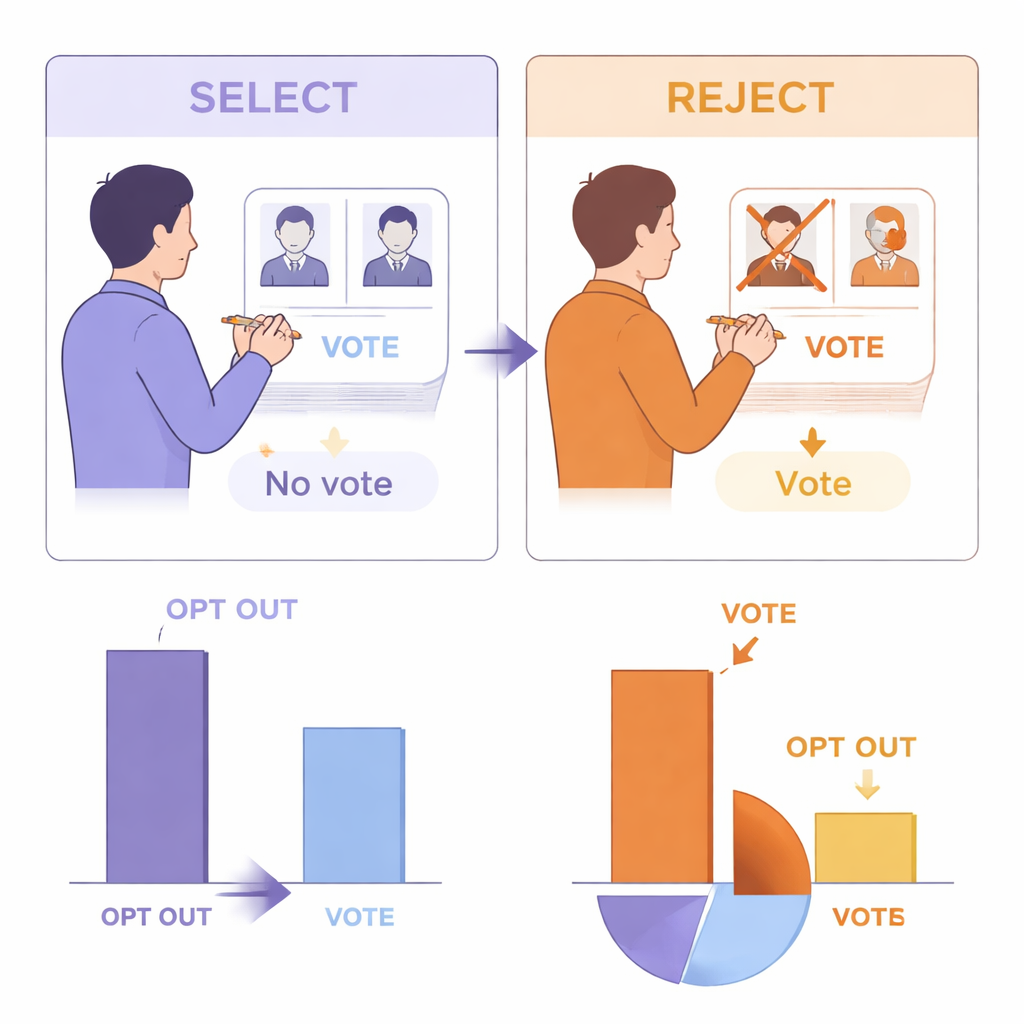
From choosing favorites to rejecting the worst
The researchers built a laboratory voting task that mimics real political choices while allowing tight control. First, participants reported their views and issue priorities on topics like abortion, gun policy, and health insurance. The team used these answers to construct fictional candidates whose positions could be more or less aligned with each participant’s own views, and to pair them into “ballots” that ranged from clear win–win choices (two good options) to lose–lose choices (two bad options). Participants were randomly assigned to one of two instructions: either select the candidate they liked more (the usual “vote for” framing) or reject the one they liked less (a “vote against” or rejection framing). On every ballot, people could either take part in the vote or opt out by choosing “no vote.”
When voting feels like a lose–lose choice
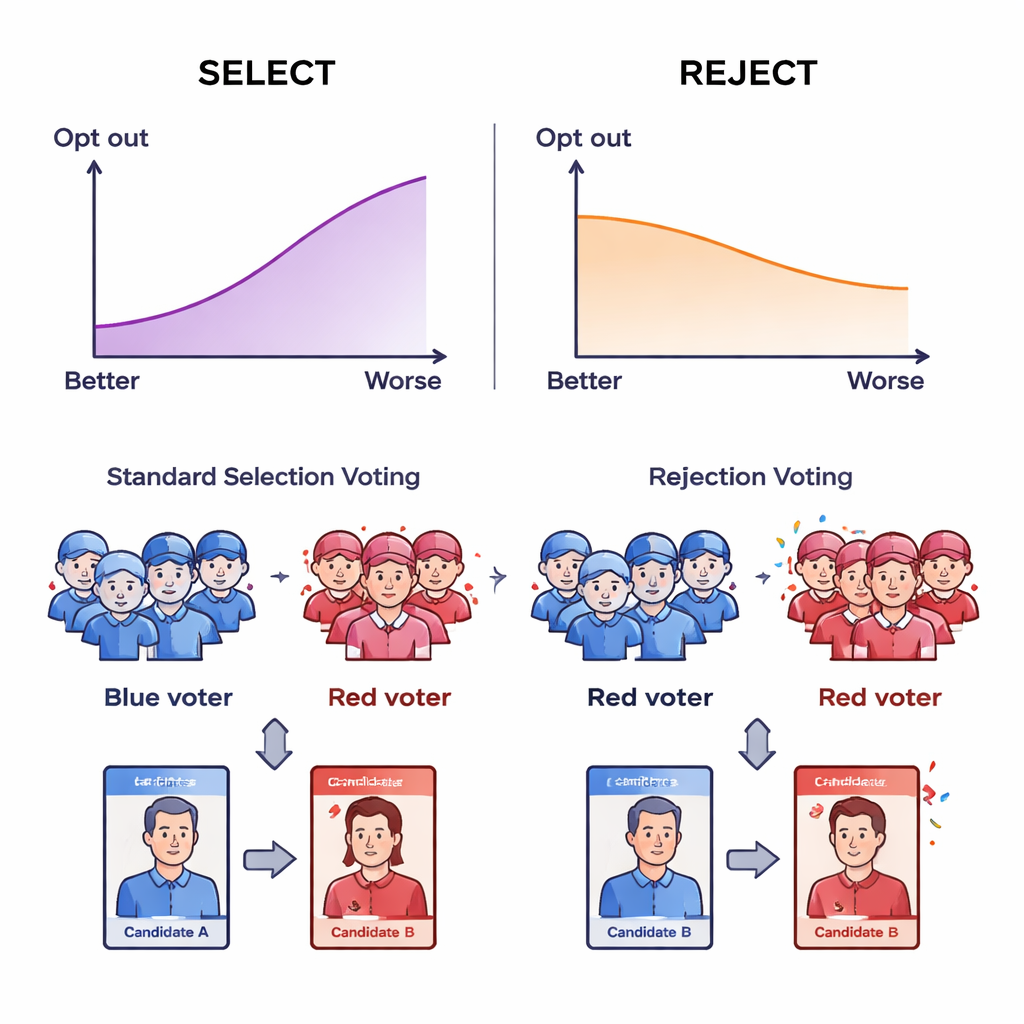
Under the standard “vote for the better candidate” framing, people behaved in line with two intuitive patterns. When one candidate clearly matched their views better than the other, they tended to vote and chose that candidate. But when both candidates looked similarly undesirable—classic “lesser of two evils” decisions—participants opted out at strikingly high rates. In the bottom quarter of ballots, where both options were especially misaligned with a participant’s views, people declined to vote more than 80 percent of the time. This shows that abstention is not just about having no preference; it strongly reflects alienation from the available choices.
How rejecting candidates keeps people engaged
Changing only the decision frame had a powerful effect. When participants were asked to reject the worse candidate instead of selecting the better one, opt-outs dropped sharply for the same lose–lose ballots. In comparable “two bad options” situations, abstention rates fell from more than four out of five ballots under selection framing to roughly one out of four under rejection framing. People still sometimes opted out, but now mostly when both candidates looked similarly good and deciding whom to reject felt harder. A follow-up study that forced a single choice among “Candidate A,” “Candidate B,” and “no vote” found the same pattern: rejection framing substantially reduced the tendency to choose “no vote,” especially when all options were unappealing. Reaction-time data supported a deeper mechanism from decision science: people decide faster when their task (selecting best or rejecting worst) matches the overall quality of the options. Asking voters to reject a bad candidate makes a lose–lose choice feel more straightforward and less aversive.
Simulated elections and real-world polls
Using their laboratory data, the authors simulated two-candidate elections with voters who varied both in which candidate they preferred and in how much they liked the candidates overall. In standard “vote for” elections where abstention is allowed, alienated voters—those who dislike both options but slightly prefer one—were predicted to sit out more often. This means outcomes can be skewed toward groups who feel better about the candidates, even if they are not the numerical majority. Under rejection-based rules, however, turnout became much less sensitive to overall likeability and more closely tied to who was actually preferred; simulated winners more accurately reflected the majority’s underlying preferences. To test real-world relevance, the researchers surveyed more than 1900 self-identified US Independents before the 2024 presidential election. When asked whom they would vote for, 23–33 percent said they were undecided. When a separate, randomly assigned group was asked whom they would vote against, that “undecided” figure dropped by roughly 40 percent, even though the candidates and response options were the same.
What this means for elections and opinion polls
The study suggests that many non-voters and “undecided” respondents are neither indifferent nor uninformed—they simply resist positively endorsing candidates they dislike. Reframing the choice as rejecting the worst candidate can unlock these hidden preferences, reduce abstention in lose–lose situations, and make election results and polls better reflect the true will of the electorate. While the authors note that rejection-based systems could have downsides (for example, amplifying negative feelings in politics), their work shows that a small change in how we pose the question—“Who would you vote against?” instead of “Who would you vote for?”—can meaningfully change who speaks up and whose preferences are counted.
Citation: Su, YH., Shenhav, A. Rejection-based choices discourage people from opting out of voting. Nat Commun 17, 1768 (2026). https://doi.org/10.1038/s41467-026-68472-7
Keywords: voter turnout, negative voting, political psychology, election framing, undecided voters