Clear Sky Science · en
The Camellia sinensis var. sinensis cv. Fuding Dabaicha genome unveils structural variation-driven metabolic innovation
Why the Genetics of Tea Leaves Matter to Your Cup
Every cup of tea holds a chemical orchestra of flavors and health‑related compounds, from soothing aromas to antioxidant-rich molecules. Yet until now, scientists did not fully understand how the tea plant’s DNA gives rise to this remarkable chemical diversity. This study decodes, in unprecedented detail, the genome of a classic Chinese tea cultivar called Fuding Dabaicha, revealing how large-scale DNA differences within a single plant help shape the taste, quality, and potential health benefits of the tea we drink.
Peering Under the Hood of the Tea Plant
Tea plants have unusually large and complex genomes, with two parental copies of each chromosome that differ a great deal from one another. Earlier reference genomes blended these two copies into a single “consensus,” which hid many important differences. In this work, the researchers went further: they separated and assembled both full chromosome sets—called haplotypes—for Fuding Dabaicha. To do this, they combined ultra-accurate long DNA reads, ultra-long nanopore reads, and single-cell sequencing from 107 individual sperm cells of the tea plant. This combination allowed them to stitch together nearly gap-free chromosomes and tell apart the two parental DNA versions with very high accuracy.

Hidden Structural Changes in DNA
With both haplotypes in hand, the team compared them and uncovered an unexpectedly large amount of structural variation—big insertions, deletions, duplications, and inversions of DNA that go far beyond simple single-letter mutations. About one quarter of the genome differed in structure between the two copies, far more than had been seen when comparing different tea varieties using older methods. Many of these structural changes arose from the activity of “jumping genes,” or transposable elements, that can copy and move themselves around the genome. Two such elements, called Gypsy retrotransposons and tiny DNA elements known as MITEs, were especially important in reshaping the tea plant’s chromosomes over recent evolutionary time.
From DNA Structure to Uneven Gene Activity
These structural changes are not just passive scars in the genome—they actively change how genes work. The researchers showed that thousands of genes sit near or inside these rearrangements. When they measured gene activity across nine different tea tissues and in a family of Fuding Dabaicha offspring, they found many genes where one parental copy was consistently more active than the other, a pattern called allele-specific expression. Structural variants near gene start sites were especially likely to tilt expression toward one haplotype, effectively giving one parental version of a gene more “volume” than the other and creating functional imbalances that can influence plant traits.
Linking DNA Differences to Tea Metabolites
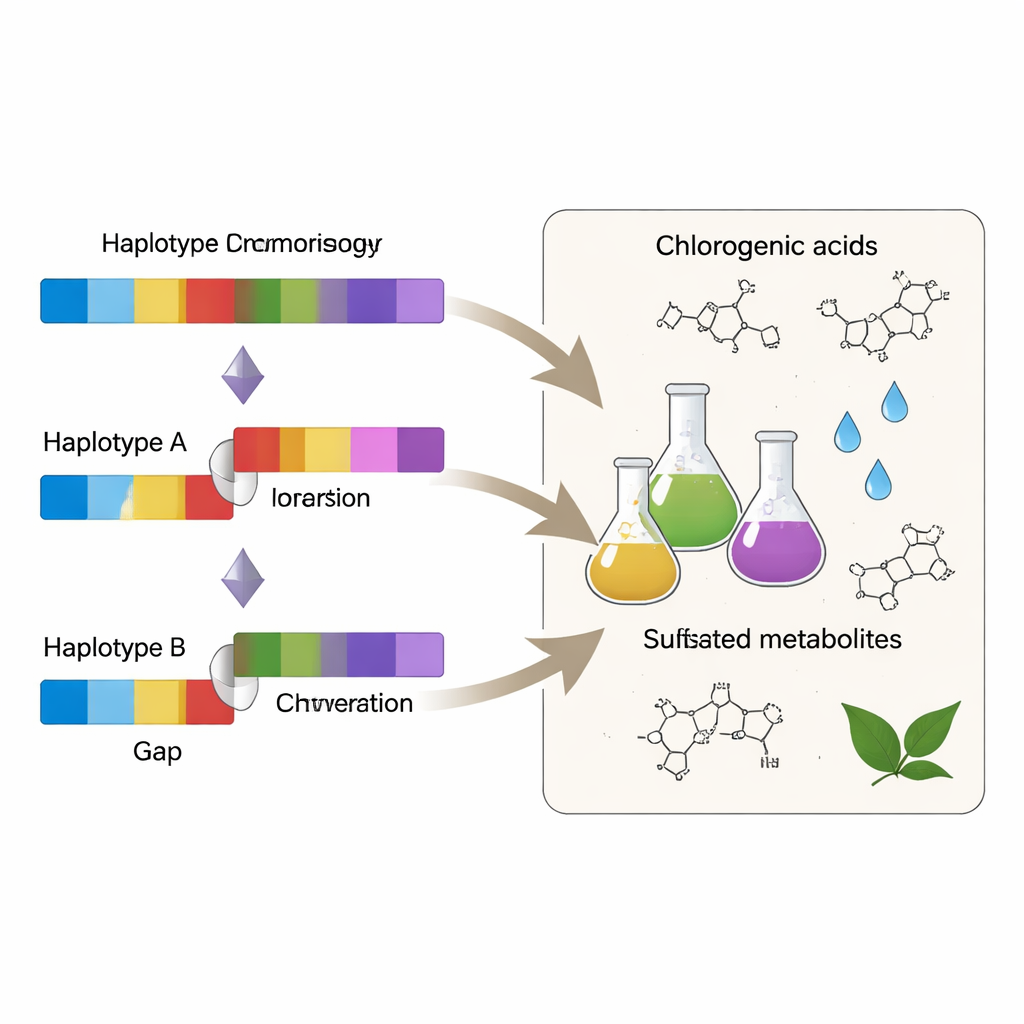
To connect genome structure to what ends up in the cup, the team combined their new genome with large-scale chemical profiling of thousands of metabolites in tea leaves. Using both family-based mapping and genome-wide association across 215 diverse tea accessions, they linked specific DNA regions to variation in 2,837 metabolites. One striking example involved a gene called CsDFRb, part of the flavonoid pathway. In one haplotype, a large Gypsy element had inserted into the gene’s promoter region and became heavily methylated, dampening gene activity. This lowered the expression of CsDFRb and, through a shared chemical precursor, led to increased levels of a compound called p-coumaroylquinate in young leaves. In other regions, they pinpointed genes that control chlorogenic acids and sulfated metabolites, both important for flavor and potential health properties.
A Better Genome Map for Better Tea
By showing that a high-quality, haplotype-resolved genome can reveal far more metabolite-linked DNA regions than an older reference, this study provides a powerful new blueprint for tea breeding. For non-specialists, the key message is that large-scale DNA rearrangements within a single tea plant strongly influence which beneficial and flavorful compounds accumulate in its leaves. With this detailed genetic map, breeders can now more precisely select or combine plant lines to tune flavor, aroma, and health-related metabolites, helping to craft future teas that are both tastier and potentially better for you.
Citation: Zhang, W., Jiang, X., Luo, S. et al. The Camellia sinensis var. sinensis cv. Fuding Dabaicha genome unveils structural variation-driven metabolic innovation. Nat Commun 17, 1754 (2026). https://doi.org/10.1038/s41467-026-68463-8
Keywords: tea plant genomics, structural variation, metabolite diversity, haplotype-resolved genome, tea breeding