Clear Sky Science · en
Rainfall sustains multiyear La Niña
Why long‑lasting La Niña matters to everyday life
La Niña is famous for reshaping weather across the globe—bringing droughts to some regions, floods to others, and disrupting farming, water supplies, and fisheries. In recent decades, La Niña has not only appeared more often, it has also tended to linger for two or even three years in a row. This study asks a deceptively simple question with big practical consequences: how does tropical Pacific rainfall, by slowly changing the saltiness of surface waters, help lock the ocean–atmosphere system into these prolonged cool phases?
The puzzle of stubborn cool years
Scientists have long understood that El Niño and La Niña arise from a dance between winds, ocean temperatures, and large‑scale currents in the tropical Pacific. Classic theories explain why a strong El Niño can be followed by one La Niña, but they struggle to account for back‑to‑back or triple‑year La Niñas. Observations since 1980 show that these multiyear events have become more common and are expected to increase further this century. The new work focuses on a slower, often overlooked ingredient—changes in mixed‑layer salinity (the saltiness of the upper tens of meters of the ocean), which responds both to rainfall and to how currents move water around.
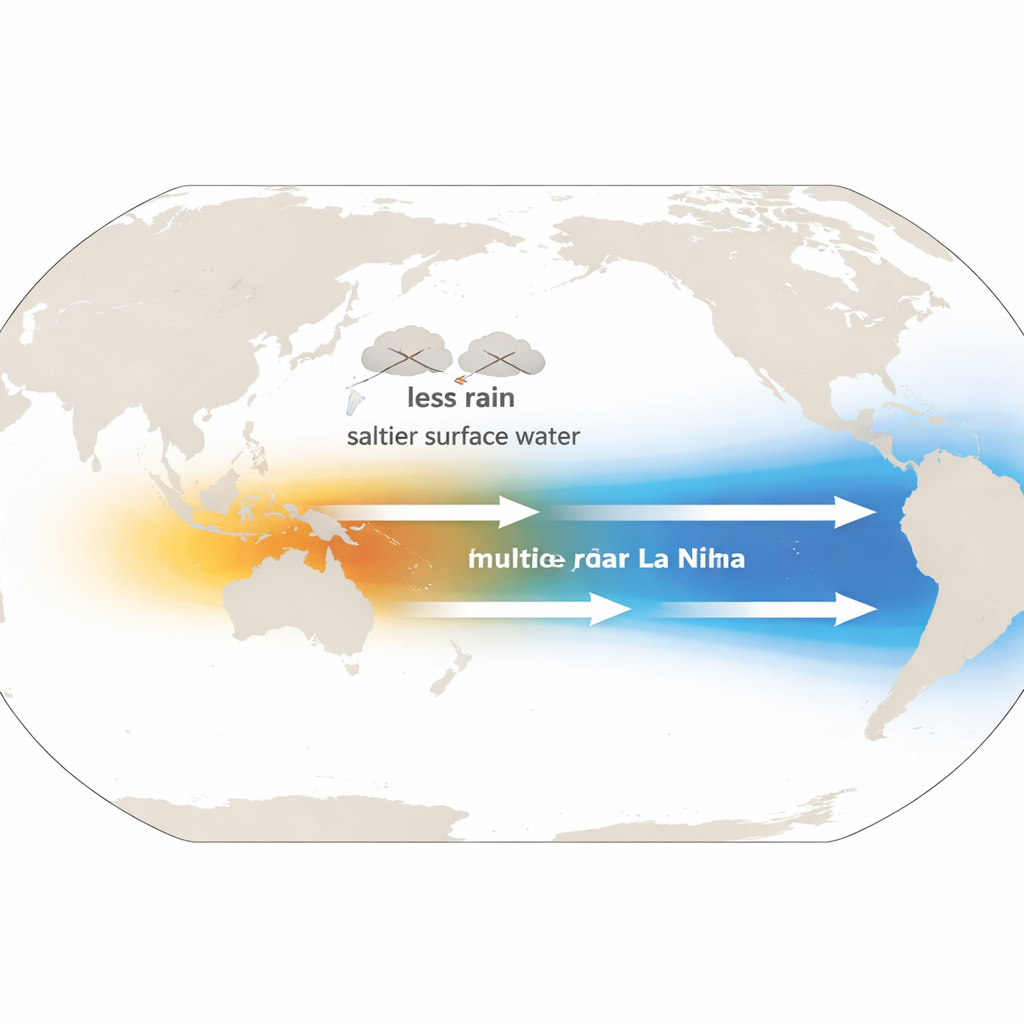
How less rain makes the surface ocean saltier
Using several global datasets and six well‑observed multiyear La Niña events, the authors find a tight link between rainfall and surface salinity in the central‑western equatorial Pacific. When La Niña cools the central and eastern Pacific, rainfall shifts away from the central basin, leaving a broad region with less rain than usual. Normally, heavy tropical downpours freshen the surface there. During multiyear La Niña, that fresh lid weakens: with fewer raindrops adding freshwater, the surface layer gradually becomes saltier and denser. In the first year, ocean dynamics—westward currents and deeper mixing driven by stronger trade winds—start this salting process. In the second year, continuing rainfall shortages become the dominant driver, maintaining and amplifying the salty patch.
From salty surface to deeper mixing and wider cooling
Why does a saltier surface keep La Niña going? Denser, saltier water is harder to keep floating above the cooler water beneath. The study’s model experiments show that as salinity builds up in the western–central Pacific, the density contrast between surface and subsurface weakens, making the upper ocean more easily stirred. The mixed layer deepens and vertical mixing strengthens, pulling cold water up from below and pushing heat downward. This reduces the usual thermal “stratification” that would otherwise insulate the surface from the deeper ocean, allowing the cool signal to grow and persist. The authors find that this salinity‑driven mixing helps cool the western and central Pacific, and that the cooling then spreads eastward along the equator, reinforcing the basin‑wide La Niña pattern.
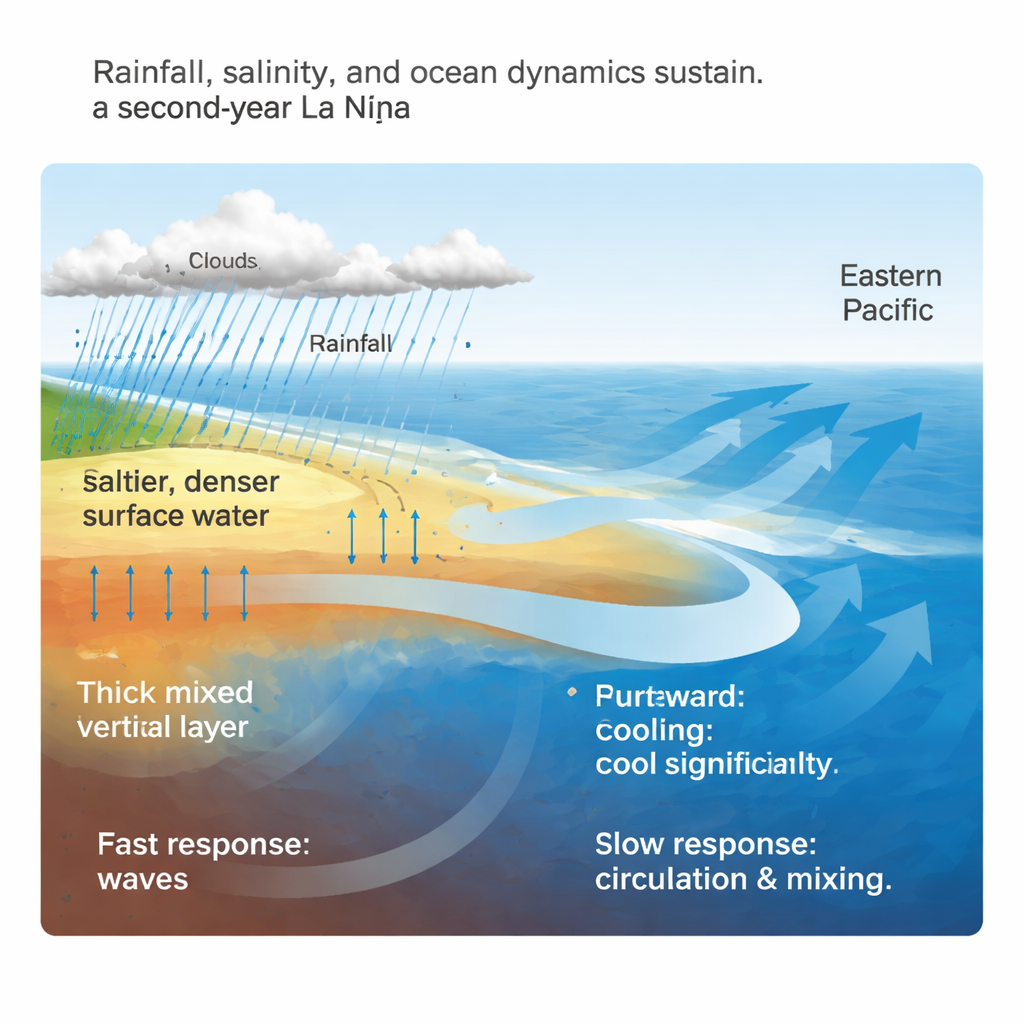
Fast waves, slow circulation, and a feedback loop
The models reveal two distinct stages in the ocean’s response to reduced rainfall. Within a few months, the denser, deeper mixed layer in the west generates internal waves (equatorial Kelvin waves) that carry a cool signal eastward beneath the surface, where it quickly emerges as cooler water at the surface of the eastern Pacific. Over one to two years, a slower adjustment takes over: the altered salinity pattern changes sea level and current patterns, strengthening westward surface flow and upwelling of cold water. Together, these fast and slow responses amount to a positive feedback: less rain makes the surface saltier, which makes mixing stronger and currents more favorable for cooling, which in turn helps sustain La Niña into a second or even third year.
What this means for forecasts and our future
By comparing experiments with realistic rainfall, constant rainfall, and artificially intensified rainfall deficits, the authors estimate that rainfall‑driven salinity changes can boost La Niña’s strength by roughly 14% in its first winter and 32% in its second. In other words, rain (or the lack of it) does not just react to La Niña—it actively helps keep it alive. This rainfall–salinity feedback offers a missing piece in the puzzle of why recent La Niñas have lasted so long, and highlights a pathway that climate models must represent well if they are to predict these events and their impacts on droughts, floods, and water resources. As the climate warms and rainfall patterns shift, understanding how changes in ocean salinity shape multiyear La Niña events will be crucial for anticipating the world’s evolving climate risks.
Citation: Tian, F., Zhang, RH., Liu, C. et al. Rainfall sustains multiyear La Niña. Nat Commun 17, 1744 (2026). https://doi.org/10.1038/s41467-026-68451-y
Keywords: La Niña, tropical Pacific, rainfall, ocean salinity, ENSO