Clear Sky Science · en
Giant unusual anisotropic magnetoresistance enabled by hole-electron resonance in van der Waals heterostructures
Why this strange electrical behavior matters
Today’s electronics mostly move and control electric charge. Spintronics aims to go a step further by using the tiny magnetic “spin” of electrons to store and process information, promising faster, more efficient memory and logic devices. This article explores an unusual way to move spin across an interface between two ultra-thin materials, by taking advantage not just of electrons but also of their positively charged counterparts, holes. The result is a record‑large and highly directional change in electrical resistance, opening new routes to low‑power spin‑based technologies.
Two kinds of charge working in harmony
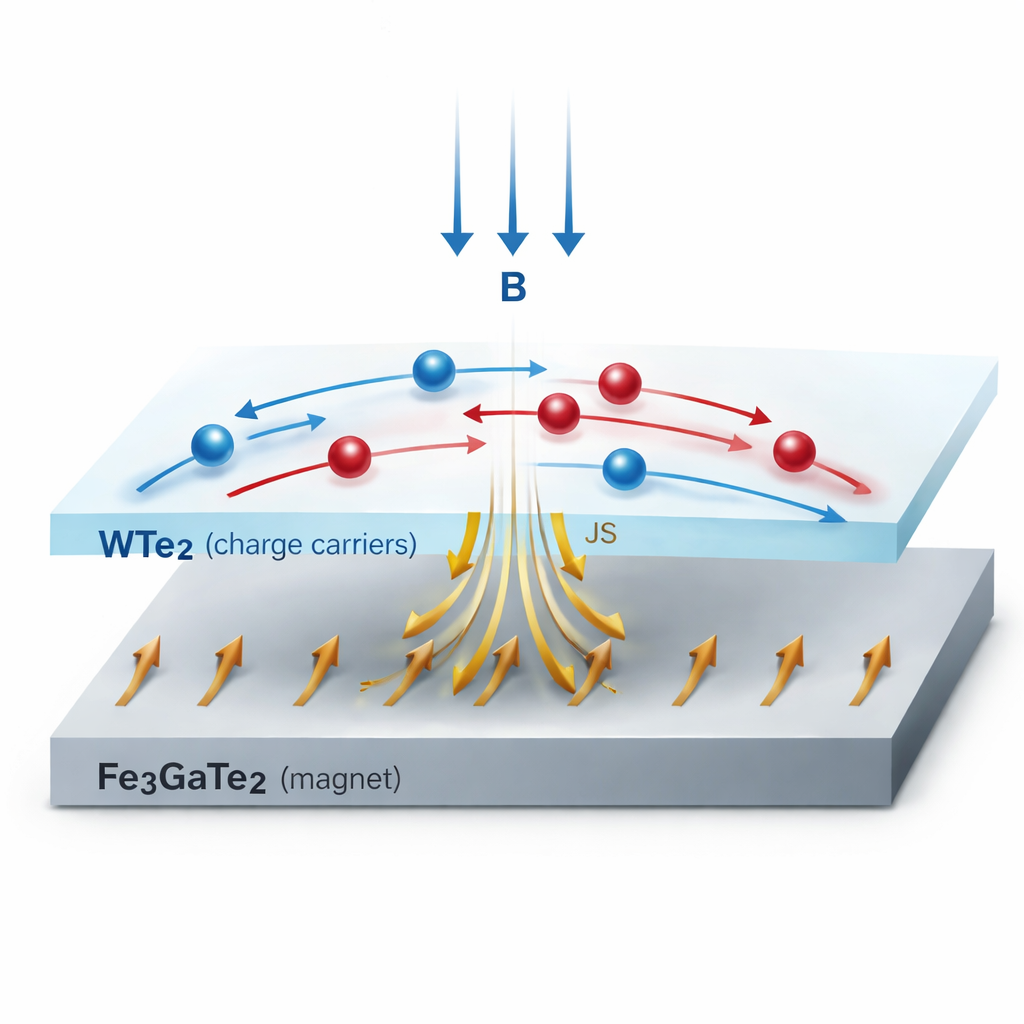
In most conductors, transport is dominated by electrons. In the layered material WTe2, however, electrons and holes coexist in almost perfect balance at low temperatures. When a magnetic field is applied, electrons and holes are pushed sideways in opposite directions. Because their charges cancel, little net charge builds up, and the internal electric field that would normally oppose further deflection never fully develops. This “hole–electron resonance” allows scattering to keep growing with field strength, producing an unusually large and non‑saturating magnetoresistance—meaning the resistance keeps increasing as the magnetic field is ramped up.
Building a spin-active sandwich
The researchers stack WTe2 on top of a two‑dimensional ferromagnet called Fe3GaTe2, forming an all–van der Waals heterostructure, where individual atomic layers adhere weakly like pages in a book. Fe3GaTe2 supplies a robust magnetic layer whose tiny magnetic moments tend to point out of the plane. At their shared interface, moving charges in WTe2 can exchange spin angular momentum with the magnet. Because the hole–electron resonance in WTe2 suppresses the usual internal electric fields that limit scattering, spin can be transferred across the interface without the usual Coulomb “braking,” enabling a stronger and more unusual spin‑dependent electrical response than seen in conventional metals.
A giant, highly directional resistance effect
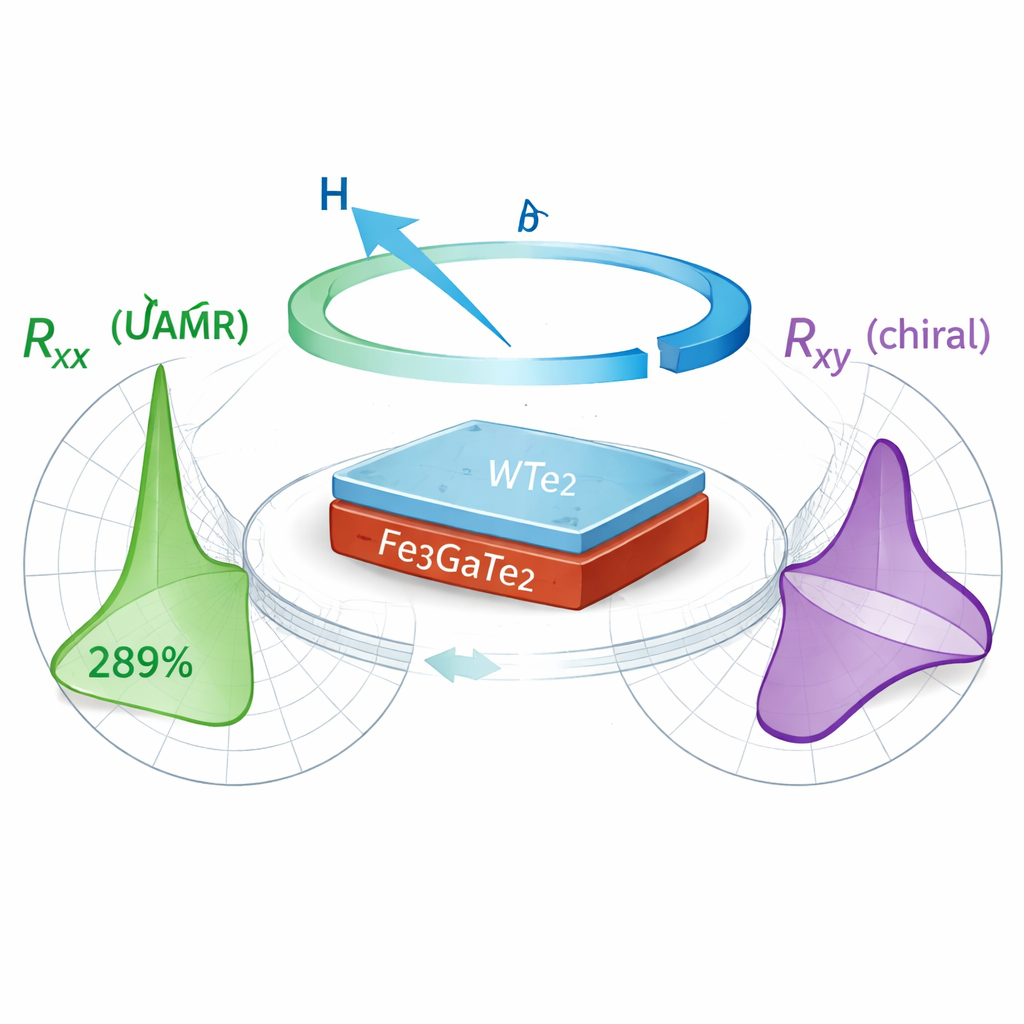
By sending a small current through the stack and rotating a strong magnetic field around it, the team measures how the electrical resistance depends on the direction of the magnetization. They observe an “unusual anisotropic magnetoresistance” (UAMR) of about 289%—far larger than typical spin Hall magnetoresistance in standard magnetic bilayers. Moreover, the angular pattern of this resistance does not follow the simple cosine‑squared curve expected from textbook models. When the authors correct for the fact that the magnetization in Fe3GaTe2 does not always line up with the applied field, the data more closely resemble the simple form, confirming that the orientation of the magnet’s moments is central. Yet important deviations remain, signaling richer underlying physics at the interface.
When symmetry breaks, currents turn chiral
The team also examines the transverse, or sideways, voltage that develops as the field rotates. In the temperature range where electrons and holes in WTe2 are nearly balanced, this transverse response becomes “chiral”: its angular pattern is no longer mirror‑symmetric with respect to the crystal plane. As temperature rises and electrons begin to dominate over holes, the pattern smoothly evolves toward more conventional behavior, eventually resembling the ordinary anomalous Hall effect of the Fe3GaTe2 layer alone. First‑principles calculations reveal that strong, uneven spin–orbit coupling in WTe2, combined with structural asymmetry at the interface, allows higher‑order angular components and multipole contributions to the Hall current, naturally giving rise to chiral transport.
What this means for future spintronics
Together, these experiments and calculations show that carefully balancing electrons and holes in a layered material can dramatically amplify and reshape how spins flow across a magnetic interface. The giant, direction‑dependent resistance and chiral sideways currents observed here cannot be captured by theories that treat only electron carriers. For non‑experts, the take‑home message is that by exploiting both types of charge carriers and the special symmetries of atomically thin stacks, researchers can gain new control over spin currents. This could ultimately help designers create more efficient, non‑volatile memory and logic devices that use less power and operate at high speed, moving us closer to practical spin‑based electronics.
Citation: Chen, Q., Tian, Y., Wang, L. et al. Giant unusual anisotropic magnetoresistance enabled by hole-electron resonance in van der Waals heterostructures. Nat Commun 17, 1736 (2026). https://doi.org/10.1038/s41467-026-68438-9
Keywords: spintronics, magnetoresistance, van der Waals materials, electron-hole resonance, WTe2 heterostructure