Clear Sky Science · en
Extreme rainfall over land exacerbated by marine heatwaves
Why hot oceans matter for life on land
In recent years, long-lasting marine “heatwaves” – patches of ocean that stay much hotter than usual for days or weeks – have become more common. They are known for bleaching corals and disrupting fisheries, but this study shows they also reach across the shoreline to affect people on land. By strengthening nearby rainstorms, these ocean hot spots can make already extreme downpours even heavier, raising the risk of floods for hundreds of millions of coastal residents.
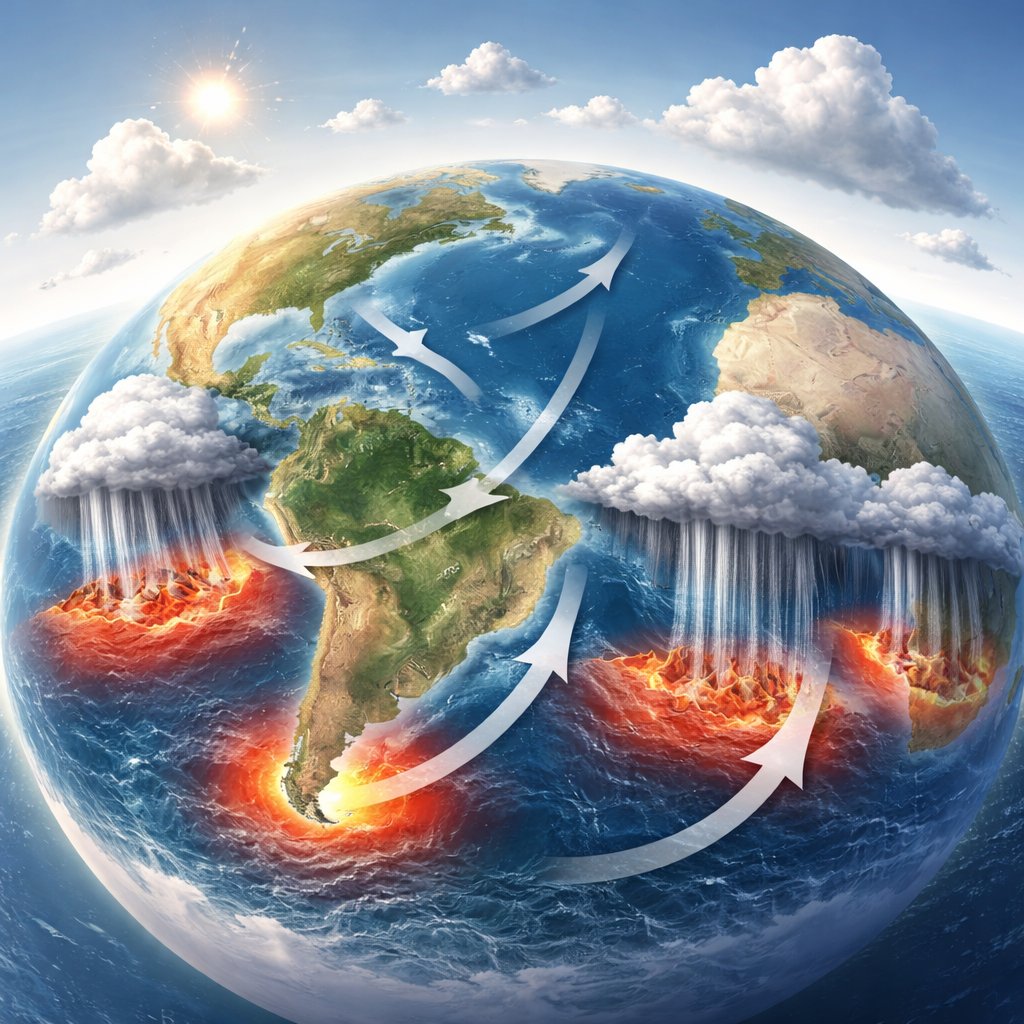
Hidden link between sea hot spots and cloudbursts
The authors analyzed more than two decades of satellite, ocean, and weather data to trace how marine heatwaves shape rainfall. They first mapped where and when these heatwaves appeared, defining them as several days in a row when local sea surface temperature shot above a high threshold. Each heatwave has a warm “core” and sharp temperature changes around it, like a hill of hot water surrounded by cooler seas. The team then looked at the rain patterns and winds around thousands of these events worldwide, aligning them so that the local wind always blew from left to right. This let them see how rainfall changed upwind and downwind of the hot patch.
How warm seas pump up storms
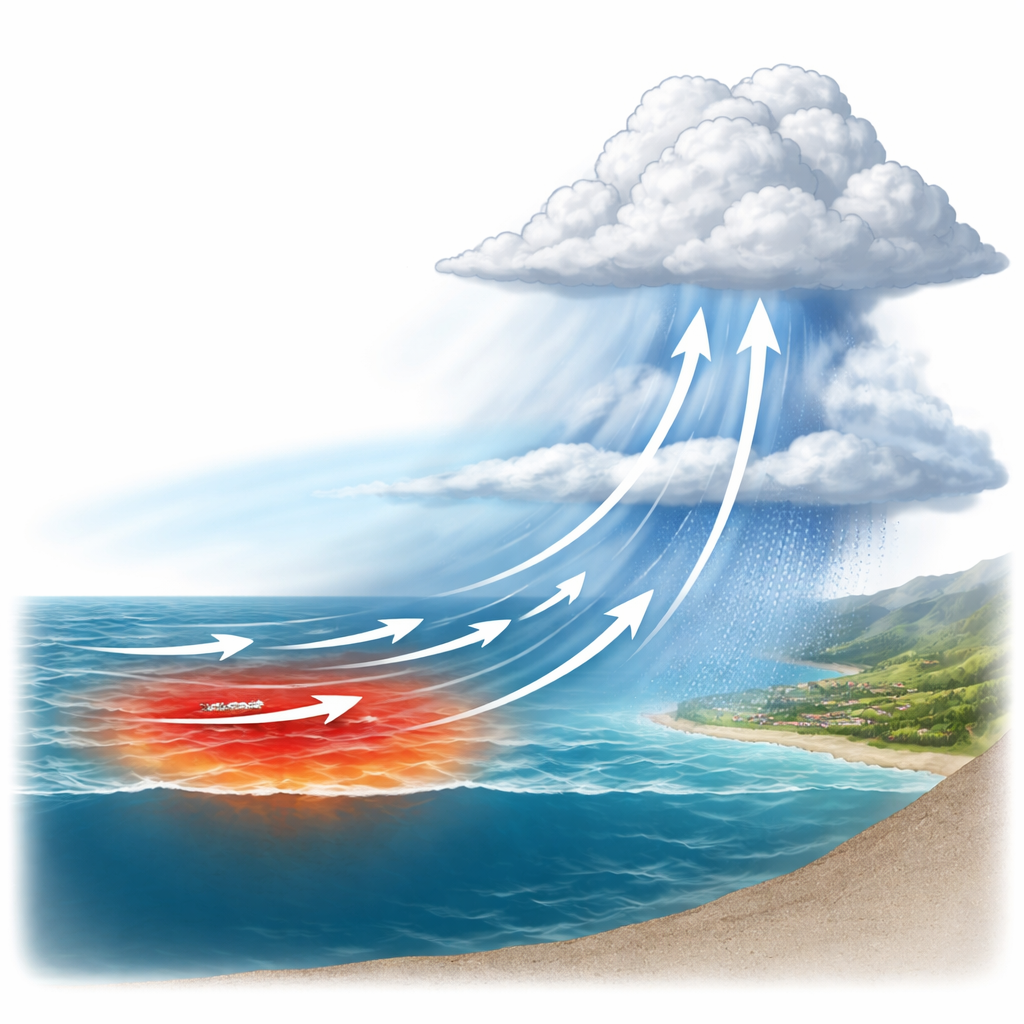
The results show a clear fingerprint: marine heatwaves boost rainfall mainly in the downwind direction – the path the air takes after passing over the hot water. As air moves across the warm patch, it heats from below and becomes more turbulent. This turbulence brings faster-moving air from higher up down toward the surface, strengthening the surface winds directly above the heatwave. Those stronger winds speed up over the hot spot, then slow down just beyond it, causing air to pile up, converge, and rise. At the same time, the warmer ocean surface adds more water vapor to the air. The combination of extra moisture and stronger upward motion creates a sweet spot for heavy showers and thunderstorms downwind of the marine heatwave.
From offshore heat to onshore extremes
Because nearly half of humanity lives within 200 kilometers of the coast, the team paid special attention to what happens when these ocean hot spots form near land. They found that in many coastal regions, about 5–25% of the most extreme rain days over land – the top 1% of wet days – occur when there is a nearby marine heatwave located upwind. During such events, the downwind land areas receive, on average, 20–30% more rain than comparable extreme events without a marine heatwave influence, adding roughly 4–8 millimeters of extra rainfall per day. The extra rain tends to peak one to two days after the heatwave, strengthening the case that the hot ocean surface is helping to fuel the deluge rather than just coinciding with it.
Real-world impacts on floods and lives
This extra punch in rainfall is not just a detail on a weather map; it shows up in human impacts. By comparing flood records with marine heatwave events, the authors found that 10–30% of recorded flood disasters occurred downwind of a recent nearby marine heatwave. On average, floods that happened under the influence of these ocean hot spots caused about 30% more deaths than floods without such a connection. While many factors shape flood damage – from land use to warning systems – this pattern suggests that marine heatwaves can load the dice toward more destructive flood outcomes.
A warning from a warming ocean
The study concludes that marine heatwaves do not only harm life in the sea; they also intensify some of the most dangerous rainstorms over land. As climate change continues, these heatwaves are expected to become longer, stronger, and more frequent, especially in mid-latitude regions rich in swirling ocean eddies that help create them. At the same time, the temperature contrasts at the ocean surface are sharpening. Together, these trends point to a future where coastal communities face a higher risk of sudden, extreme downpours triggered or amplified by offshore ocean hot spots. Recognizing this ocean-to-land link can help improve flood forecasting and guide adaptation efforts for vulnerable coastal areas.
Citation: Wang, H., Cai, W., Zhang, Z. et al. Extreme rainfall over land exacerbated by marine heatwaves. Nat Commun 17, 943 (2026). https://doi.org/10.1038/s41467-026-68431-2
Keywords: marine heatwaves, extreme rainfall, coastal flooding, climate change, ocean–atmosphere interaction