Clear Sky Science · en
Vegetation greening drives long-term dust mitigation in Eastern Asia
Why dust and plants matter to everyday life
Huge dust storms that turn skies yellow over China and beyond are not just dramatic weather—they carry health risks, damage crops, and even alter climate. This study asks a simple but crucial question: over the long run, what really tames these dust storms in Eastern Asia—changes in the wind, or changes in the land, especially growing vegetation? By tracing four decades of data and projecting forward to 2100, the authors show that while winds drive year-to-year swings, steady greening of drylands is quietly becoming the main brake on dust.
Dust highways across Eastern Asia
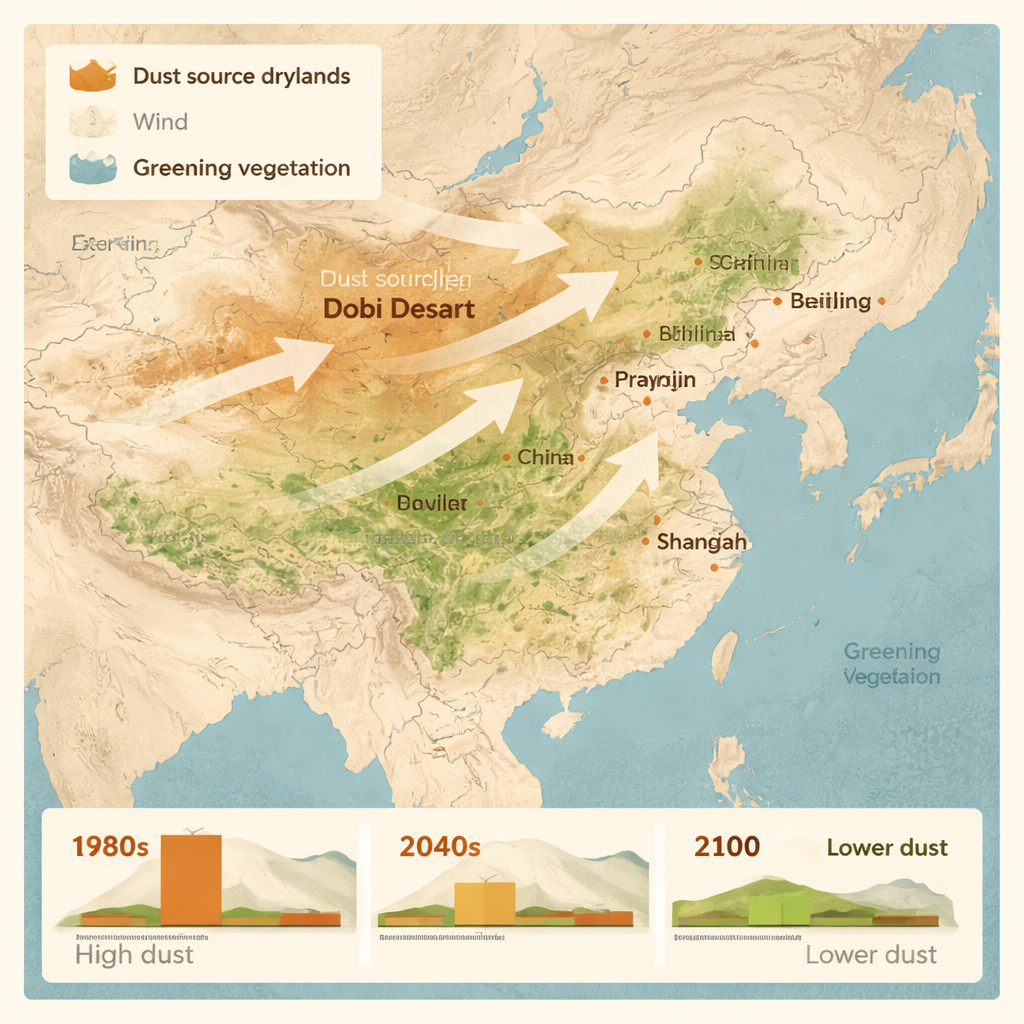
Sand and dust storms release up to two billion tonnes of particles into the air every year, affecting more than 150 countries. In Eastern Asia, much of this dust comes from the Gobi Desert and surrounding drylands before blowing toward densely populated areas such as the Beijing–Tianjin–Hebei region. Using satellite-based measurements of dust in the air and a detailed physical model of how dust is picked up by the wind, the researchers mapped where emissions start and how they travel. They found that more than 95% of dust originates in areas with very sparse vegetation—less than 15% of the ground covered by plants—where bare, dry soil is easiest for winds to lift.
Winds shape the noisy ups and downs
The team first examined what controls dust from one year to the next. They combined weather reanalyses, vegetation indices, soil moisture, and snow cover in machine-learning and statistical models. Near-surface wind speed emerged as the strongest driver of short-term dust changes, especially in places with little vegetation and low soil moisture. Large-scale climate patterns, including La Niña events and shifts in the Arctic and Pacific, modulate these surface winds. During certain phases of these climate modes, stronger northerly and northwesterly winds sweep across Mongolia and northern China, intensifying dust storms. Thus, the dramatic spikes in dusty years tend to trace back to the atmosphere’s shifting circulation rather than sudden changes on the ground.
Greening drylands quietly cuts long-term dust
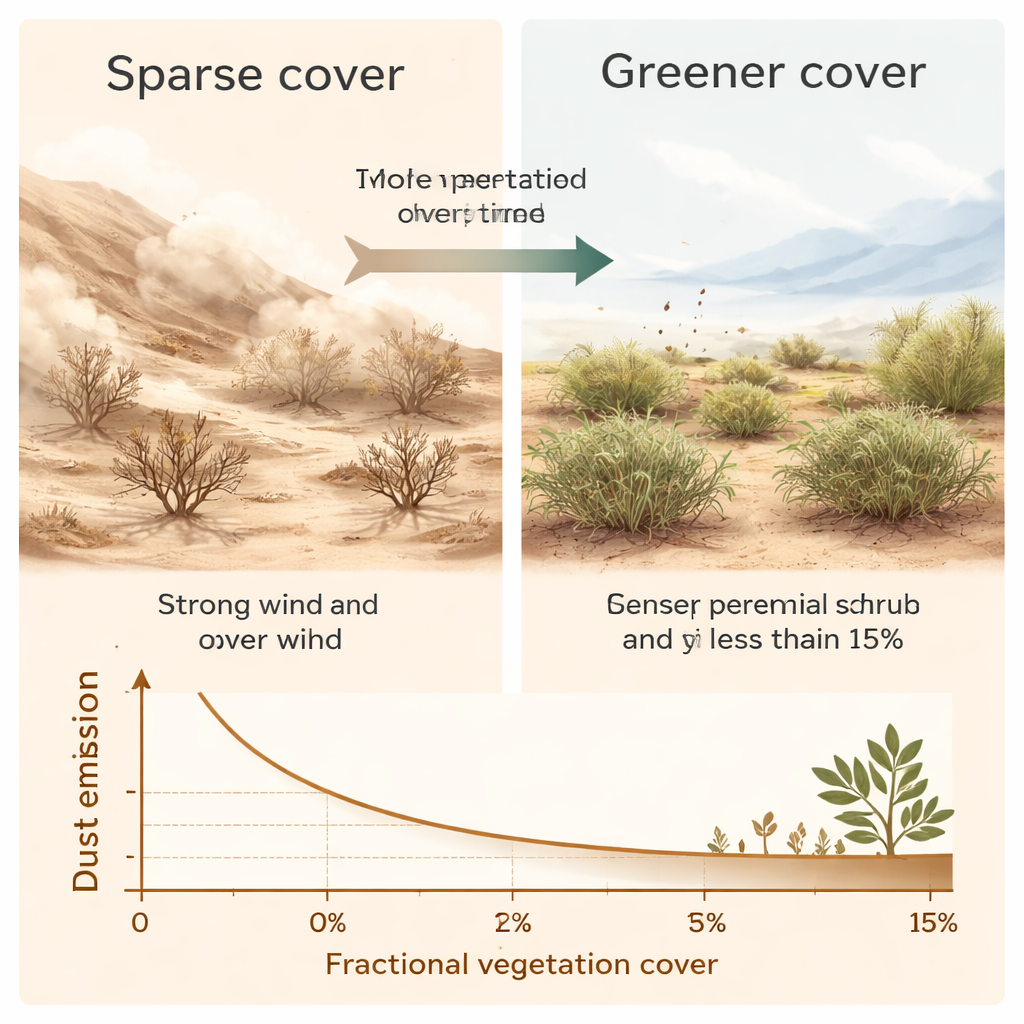
When the authors looked over several decades, a different picture emerged. From the early 1980s to about 2000, dust emissions rose, driven mainly by stronger winds and some soil drying. Since the early 2000s, however, modeled dust emissions have declined sharply. Comparing simulations with real, time-varying vegetation to simulations that held vegetation fixed at its initial state, they found that greening has reduced dust emissions by roughly one-third. Much of this greening comes from barren lands turning into grassland and from the spread of hardy desert shrubs in key source regions such as the Alashan Plateau. Although these plants still leave most of the ground bare, their deep roots and stems help bind the soil and roughen the surface, making it harder for wind to lift particles even when cover remains below 15%.
Small gains in plant cover, big payoffs for dust control
The study reveals a threshold-like behavior: in the sparsest zones—below about 15% plant cover—even modest increases in greenery greatly reduce dust, whereas above that level, extra cover brings smaller additional benefits. Over 95% of dust comes from that low-cover band, so focusing restoration there yields the biggest returns. Model experiments suggest that if vegetation had not increased, dust would have stayed high or even grown under many future climate scenarios, despite changing winds. Instead, under plausible projections for plant growth driven by climate, rising carbon dioxide, and land management, dust from Eastern Asian sources is expected to keep declining through the late 21st century, even as year-to-year variations continue. In other words, slow, persistent greening can more than compensate for occasional windy, dusty years.
Guiding smarter land restoration
For a layperson, the takeaway is straightforward: planting and protecting the right kinds of vegetation in the right dryland areas is a powerful, long-term way to curb dust storms. The work highlights three practical ideas for policy. First, long-term trends in vegetation matter more than any single storm season, so restoration programs should be judged over decades, not just years. Second, efforts should prioritize extremely sparse, dusty regions where small increases in shrubs or grasses yield outsized benefits. Third, certain "hotspot" ecoregions, such as parts of the Gobi and Alashan Plateau, punch far above their weight in generating dust and deserve special attention. Together, these insights show that carefully managed greening of drylands is not only about making deserts less harsh—it is a key strategy for cleaner air, healthier communities, and more stable regional climate.
Citation: Fu, Y., Wu, C., Gao, S. et al. Vegetation greening drives long-term dust mitigation in Eastern Asia. Nat Commun 17, 1729 (2026). https://doi.org/10.1038/s41467-026-68427-y
Keywords: dust storms, dryland vegetation, desert greening, East Asia climate, land restoration