Clear Sky Science · en
Phase-controlled growth of 2D crystals of the MB2T4 family via a flux-assisted method
Why ultra-thin magnets matter
New generations of electronics aim to use not just the charge of electrons, but also their spin, to store and move information with almost no energy loss. This vision—called spintronics—demands special materials that are both magnetic and "topological," meaning they guide electrons along protected paths on their surfaces. The MB2T4 family of crystals, which can be peeled into sheets only a few atoms thick, are leading candidates. But until now, reliably making such ultra-thin, high-quality crystals has been extremely difficult.
Building designer crystals, layer by layer
The authors focus on a compound called MnSb2Te4, a member of the MB2T4 family where M is manganese, B is antimony, and T is tellurium. These materials naturally stack in repeating units of seven atomic layers, forming flat sheets that can, in principle, be isolated down to a few nanometers in thickness. What makes them exciting is that they host surface states where electrons behave as if they are massless, while the manganese atoms supply built-in magnetism. This rare combination is precisely what is needed for exotic quantum effects that could power future low-energy devices.
A salty solution to a tricky growth problem
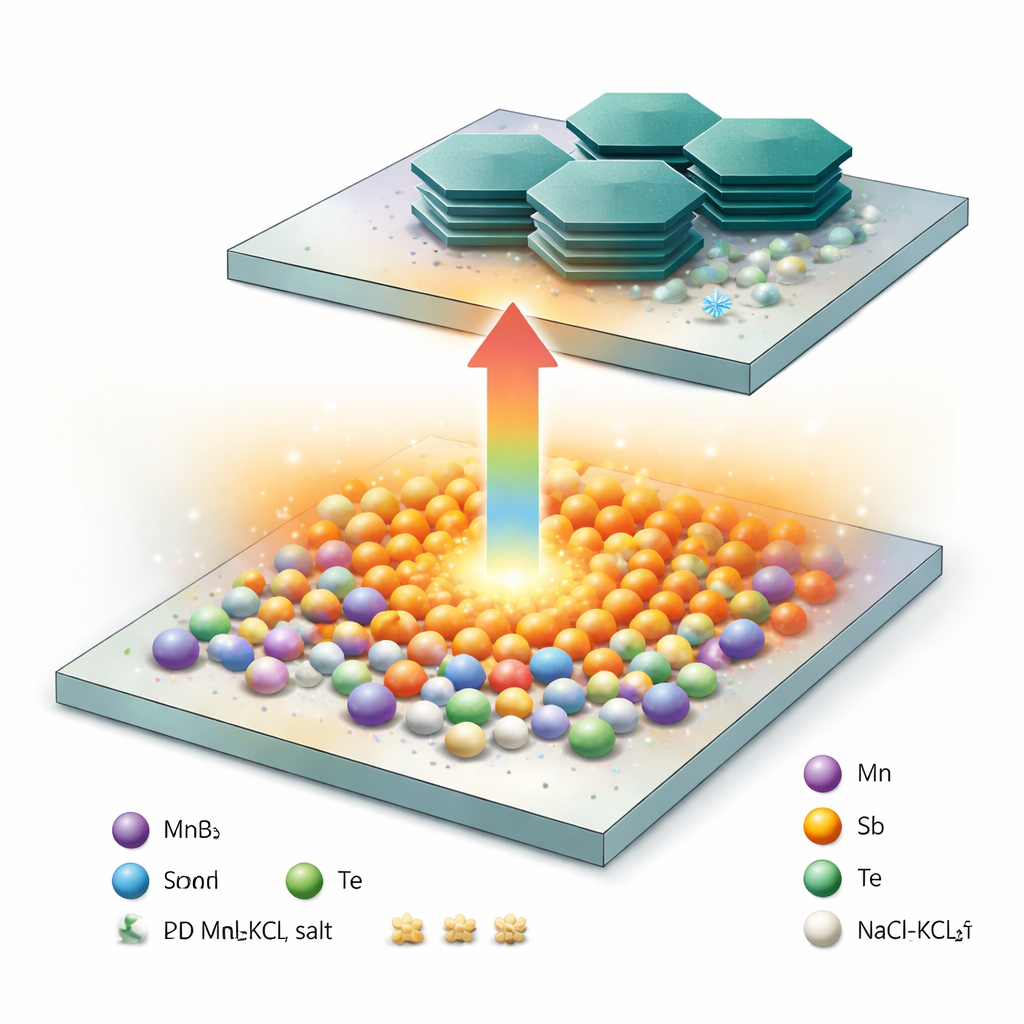
Growing such crystals directly in two-dimensional form is challenging because the atoms can easily rearrange into the wrong phases or separate into simpler compounds. To solve this, the team devised a "flux-assisted" growth method that uses common salts—sodium chloride and potassium chloride—as a liquid medium. They first crush bulk MnSb2Te4 into powder and mix it with the salt, then sandwich this mixture between two sheets of mica and clamp the stack in a metal frame. When heated to about 650–700 °C, the salt melts and gently dissolves the powder, creating a well-mixed atomic solution that keeps the manganese, antimony, and tellurium in the correct proportions.
Tuning temperature to steer crystal phases
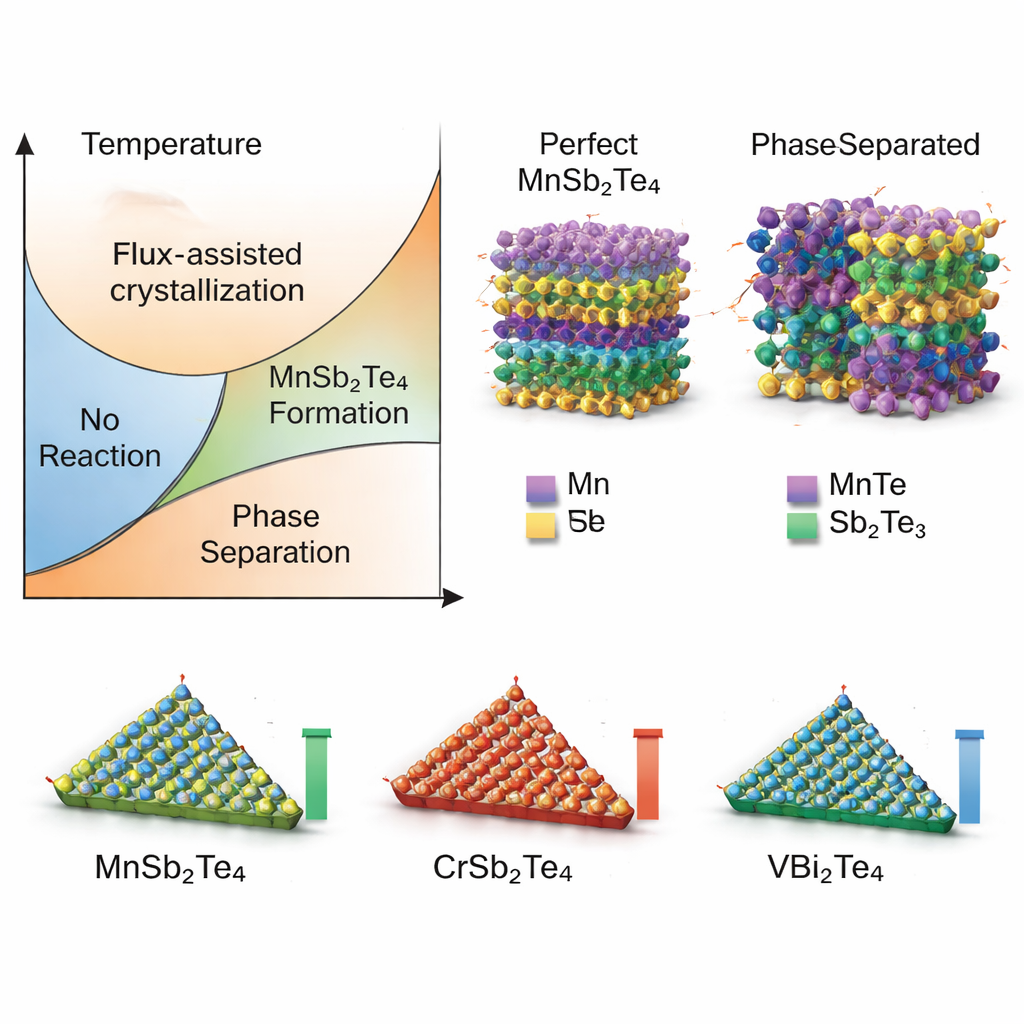
By carefully adjusting temperature and the salt-to-precursor ratio, the researchers found a narrow window where thin, well-shaped MnSb2Te4 nanosheets crystallize directly on the mica. Below the salt’s melting point, almost nothing happens; above about 730 °C, the desired compound starts to break apart into separate MnTe and Sb2Te3 regions. Within the sweet spot around 700 °C, however, the thermodynamics and the rate of atomic motion are balanced so that the atoms assemble predominantly into the target phase. Microscopy and chemical mapping confirm that most of the resulting triangular or hexagonal flakes have the ideal 1:2:4 composition, with thicknesses down to about 2.4 nanometers—just two stacked septuple layers.
A toolkit for a broader material family
The same salt-assisted recipe is not limited to MnSb2Te4. By tweaking the salt mixture and growth temperature, the authors successfully extended the method to five other related compounds, swapping antimony for bismuth and tellurium for selenium. Despite differing stabilities, each material could be grown as flat, micrometer-scale flakes only a few atomic layers thick. Detailed electron microscopy reveals orderly atomic stacking without unwanted intergrowth of competing structures, underscoring that the approach offers precise control over both composition and layer arrangement across this complex materials family.
Hidden magnetism in ultra-thin sheets
To probe the magnetic behavior of their nanosheets, the team used highly sensitive magnetometry and an optical technique called reflective magnetic circular dichroism, which detects how the material differently reflects left- and right-circularly polarized light in a magnetic field. Surprisingly, instead of the purely antiferromagnetic behavior expected from ideal MnSb2Te4, the nanosheets behave as ferromagnets at low temperatures, showing clear hysteresis loops. The transition temperature at which this magnetism appears ranges from about 12 to 34 kelvin and increases with thickness. The authors trace this to tiny atomic swaps between manganese and antimony—defects that introduce extra magnetic moments and tip the balance toward ferromagnetism while leaving the crystal lattice largely undistorted.
From lab-grown crystals to future spin devices
In essence, this work provides a practical recipe for cooking up ultra-thin, compositionally complex magnetic crystals with reliable control over their phase and thickness. For a non-specialist, the key message is that the researchers have found a way to "tune" how atoms assemble, much like controlling the setting of a 3D printer, but at the scale of individual atoms and layers. Their method opens the door to a wider library of two-dimensional magnets with built-in topological behavior—ideal playgrounds for exploring unusual quantum effects and, eventually, for building energy-efficient, spin-based electronics and dissipationless transport devices.
Citation: Wang, X., Yang, S., Huang, X. et al. Phase-controlled growth of 2D crystals of the MB2T4 family via a flux-assisted method. Nat Commun 17, 1728 (2026). https://doi.org/10.1038/s41467-026-68426-z
Keywords: 2D magnetic materials, topological insulators, flux-assisted crystal growth, spintronics, MnSb2Te4