Clear Sky Science · en
Human prestige psychology can promote adaptive inequality in social influence
Why some voices matter more than others
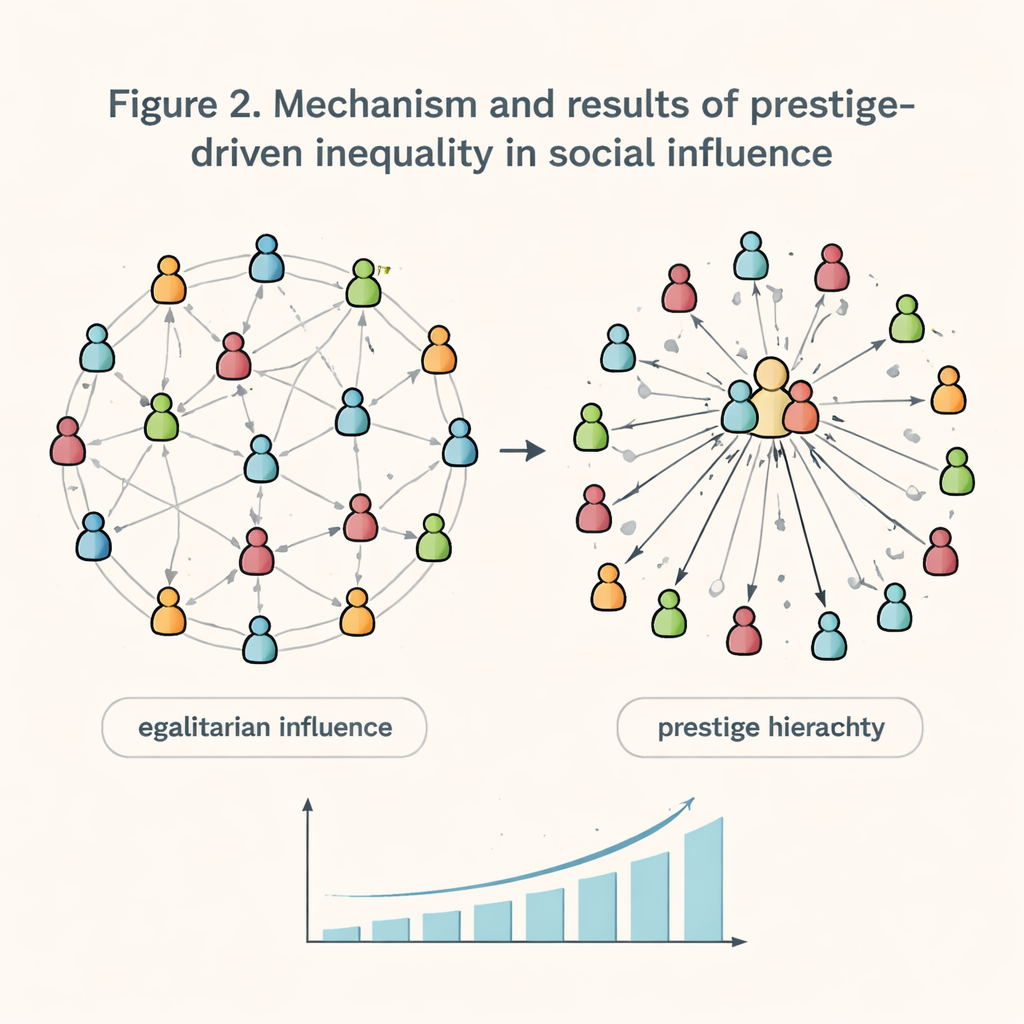
In everyday life we constantly decide who to listen to: a seasoned colleague, a popular online reviewer, a confident friend. This study asks a deceptively simple question: when people voluntarily follow the advice of those they see as skilled or admirable, does that tendency itself create social hierarchies? Using computer models, online experiments, and evolutionary simulations, the authors show that our instinct to honor prestige can, all by itself, build strong and lasting inequalities in who has influence—yet without anyone needing to threaten or coerce anyone else.
From equal groups to towering influencers
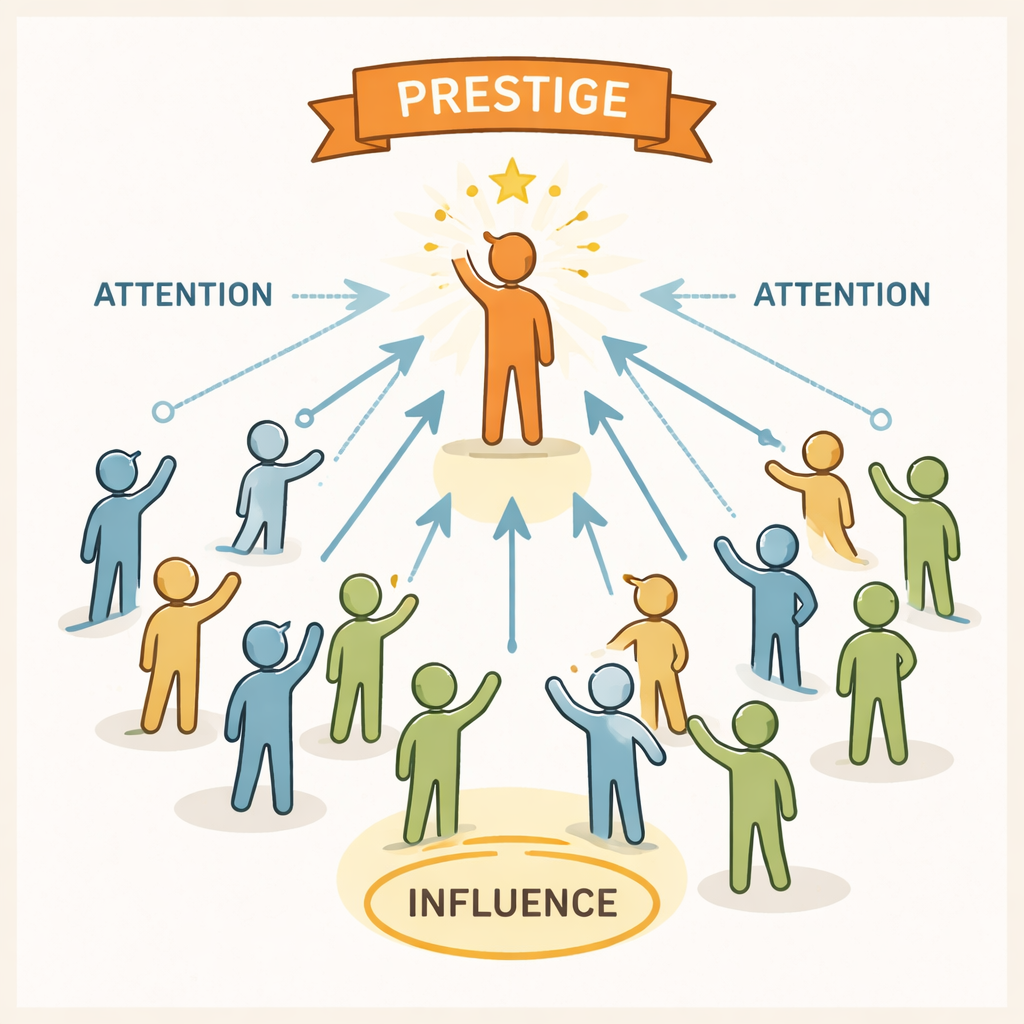
The researchers begin with an abstract world populated by many identical individuals scattered across a grid. At each step, everyone either comes up with their own new idea or chooses someone else to copy. Crucially, each time an individual is copied, they gain a bit of "prestige," which makes others more likely to copy them in the future. By tuning a single factor—how strongly people prefer high-prestige individuals—the model moves smoothly from flat, egalitarian groups to sharply unequal ones. When prestige matters only a little, influence is broadly shared. When prestige matters a lot, nearly everyone ends up copying the same few people, and the whole population can effectively become a single “follower crowd” orbiting one star.
How real people choose whom to follow
To see whether these model settings resemble human behavior, the team ran a large online experiment with 800 volunteers. Participants repeatedly judged whether blue or yellow dots were more numerous on a screen—a deliberately tricky task. After a few solo rounds, they could see, for each person in their group, two pieces of information: how accurate that person had recently been and how often others had copied them so far (their prestige). Participants then chose whose answer to adopt. The data show that people did not copy randomly. They were extremely sensitive to both accuracy and prestige, and they funneled a disproportionate amount of attention toward a small number of high-prestige individuals. Within each group, influence became quite unequal, on par with the income inequality of some modern nations.
When fame reflects skill—and when it doesn’t
The study also probes whether prestige is a good shortcut for finding genuinely skilled people. When participants had rich information about how accurate others were, prestige tended to track true ability: the more correct someone had been, the more prestige they had accumulated. But when information about accuracy was very limited, prestige sometimes drifted away from skill. In those cases, some relatively poor performers still attracted many followers, simply because early, somewhat lucky attention snowballed over time. This highlights a double-edged nature of prestige: it often helps communities discover good leaders, but when feedback is noisy or sparse, it can amplify accidents into entrenched influence.
Why prestige may be built into human nature
Finally, the authors let the tendency to care about prestige itself evolve inside a simulated population. Individuals who chose better advisers did better in the task and left more “offspring” in the model, passing on their decision rules. Over thousands of generations, the simulated evolution reliably produced levels of prestige sensitivity strikingly similar to those measured in the real experiment. This suggests that our strong responsiveness to prestige is not just a cultural fashion but may be an adaptation: a built-in mental shortcut that usually helps us find valuable sources of information in complex social worlds.
Unequal yet voluntary hierarchies
Put together, these results challenge the idea that early human groups were naturally flat and only became hierarchical with the rise of agriculture and formal chiefs. The authors argue that even small, mobile communities could have developed strong influence hierarchies simply through individuals freely seeking out the most respected and apparently competent people. Unlike dominance hierarchies in many animals, which rely on threat and force, prestige hierarchies arise from willing followers who believe they benefit from the guidance they receive. This means that inequality in who shapes group decisions may be both ancient and, in many contexts, mutually beneficial—though the same psychological machinery can also, under the wrong conditions, lock in misguided leaders and reinforce broader social inequalities.
Citation: Morgan, T.J.H., Watson, R., Lenfesty, H.L. et al. Human prestige psychology can promote adaptive inequality in social influence. Nat Commun 17, 947 (2026). https://doi.org/10.1038/s41467-026-68410-7
Keywords: prestige, social hierarchy, influence inequality, cultural evolution, social learning