Clear Sky Science · en
Tailoring polarization homogeneity in discontinuous-columnar Bi(Fe,Mn)O3 thin films via dislocation engineering with controlled self-assembly
Making tiny memory materials more reliable
Our phones, computers, and future wearable gadgets all rely on materials that can remember an electric state, much like how a light switch stays on or off. This paper explores how to make one such promising material—an ultra-thin ferroelectric film—far more stable and reliable over time by carefully organizing its internal defects rather than simply trying to get rid of them.
When flaws become useful tools
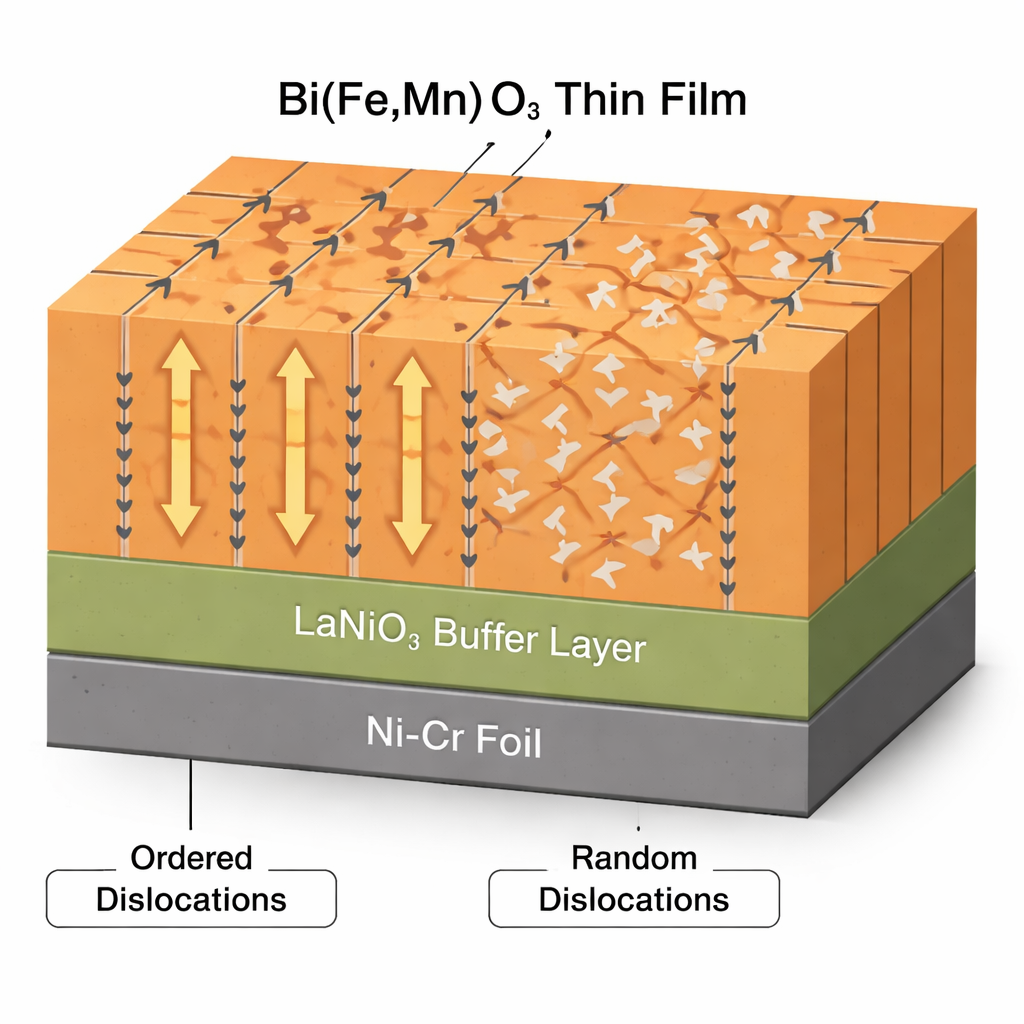
Inside crystals, the atoms are arranged like bricks in a wall. Real materials, however, are never perfect: some “bricks” are shifted, creating line-like defects called dislocations. Traditionally, these have been seen as harmful imperfections that should be minimized. In ferroelectric materials, which store information using tiny built-in electric polarizations, dislocations can disturb how regions of uniform polarization—called domains—switch on and off. Yet recent work has hinted that, if arranged deliberately, these defects could actually be used to tune and improve performance, especially for non-volatile memories that must keep data for long periods.
Designing order in a thin film stack
The researchers focused on a manganese-doped bismuth ferrite thin film, written as Bi(Fe,Mn)O3, grown on a flexible nickel–chromium (Ni-Cr) metal foil. Instead of chasing a perfectly matched, low-defect interface, they intentionally used a metal whose crystal spacing and thermal expansion differ from the ferroelectric film. This mismatch naturally creates many dislocations. To harness this, they inserted a carefully chosen intermediate layer, LaNiO3, between the metal and the active film. This buffer reduces the lattice mismatch, encourages a vertical, column-like grain structure, and gently steers dislocations so that they line up along the boundaries between these columns rather than being scattered randomly throughout the material.
From chaotic strain to smooth polarization
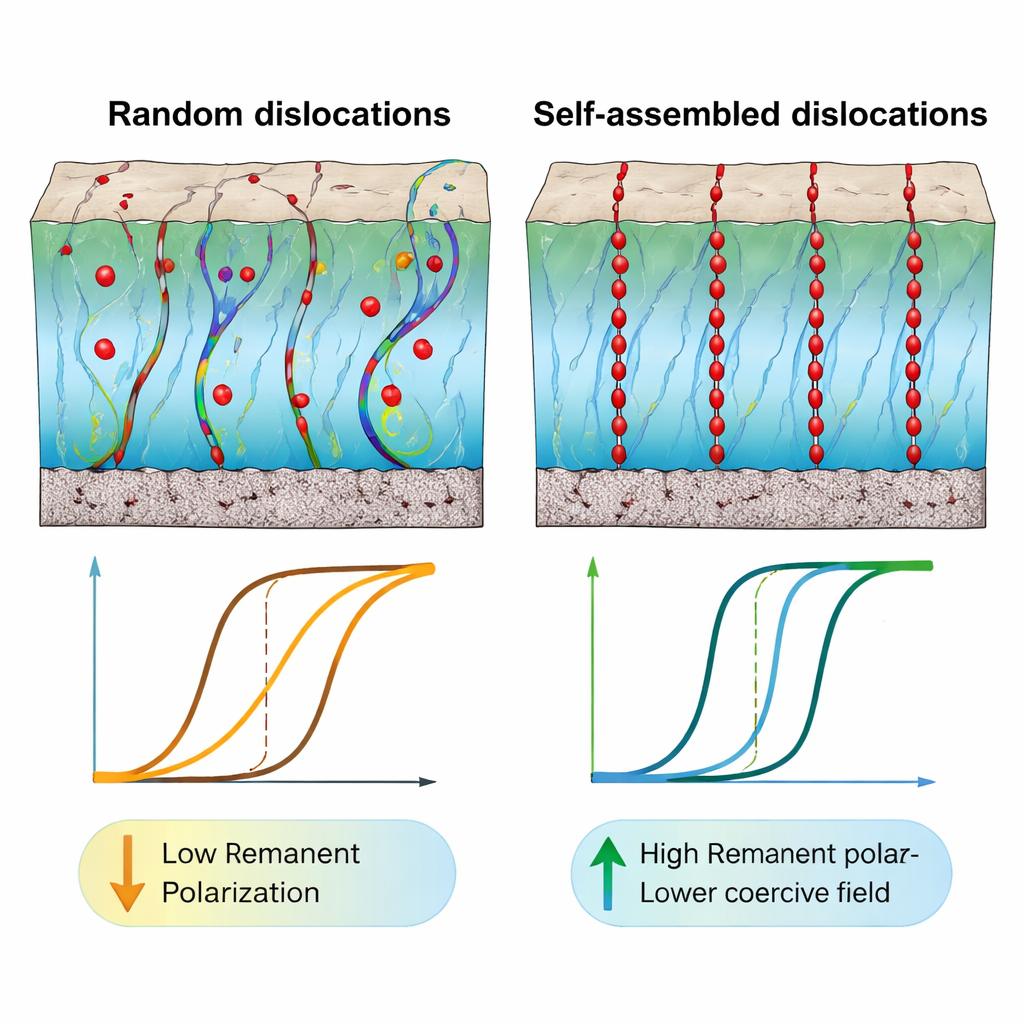
Computer simulations and high-resolution electron microscopy show how this ordering transforms the film’s internal behavior. In films where dislocations are randomly distributed, their strain fields twist and bend domain walls, generate local “vortex-like” polarizations, and create a patchwork of polarization directions. This leads to weaker overall polarization, higher electric fields needed to switch states, and domains that more easily drift back over time. In contrast, when dislocations self-assemble along the column boundaries, the strain field becomes smoother and more uniform. The atomic-scale tilting of oxygen octahedra—the tiny cages surrounding iron atoms—becomes more coherent, and the electric polarization aligns more consistently across the film. Domain walls experience a more regular pinning landscape, making switching easier yet more controlled.
Proving the benefits over time
Electrical tests confirm these structural improvements. Fresh films grown with the LaNiO3 buffer show higher remanent polarization (the “memory” after the field is removed), a lower coercive field (the effort needed to flip the state), and significantly reduced leakage current compared with films grown directly on Ni-Cr. The difference becomes striking under aging tests: after 60 days at 60 °C, the conventional film loses about 90% of its stored polarization and 80% of its switching field, effectively failing as a memory element. The engineered film, with ordered dislocations along the column boundaries, loses only about 20% of its polarization and 35% of its coercive field and continues to function even at 180 °C. Local measurements using nanoscale probes further show that its domains remain stable and resist “back-switching” for much longer times.
What this means for future electronics
For a non-expert, the key message is that this work turns flaws into features. Rather than fighting every defect, the authors show that deliberately arranging dislocations inside a ferroelectric thin film can make its internal electric order more uniform, lower the energy needed to switch it, and dramatically slow down performance loss with time and heat. This design strategy—controlling where defects live instead of simply how many there are—could guide the development of more reliable, flexible, and energy-efficient memory and sensing devices built from complex oxide materials.
Citation: Sui, H., Lou, W., Xiao, S. et al. Tailoring polarization homogeneity in discontinuous-columnar Bi(Fe,Mn)O3 thin films via dislocation engineering with controlled self-assembly. Nat Commun 17, 1699 (2026). https://doi.org/10.1038/s41467-026-68406-3
Keywords: ferroelectric thin films, defect engineering, dislocations, bismuth ferrite, non-volatile memory