Clear Sky Science · en
Aperiodic 1/f noise drives ripple activity in humans
Why tiny brain waves matter for memory
When we sleep or concentrate, our brains produce brief high‑frequency bursts of activity called ripples, thought to help store and replay memories. But what if many of these supposed ripples are illusions created by background noise in brain recordings? This study asks a simple but important question: how many of the ripples reported in human brains are real signals, and how many are artifacts of the noisy electrical hum that is always present in our neural wiring?
The brain’s quiet hiss behind the signals
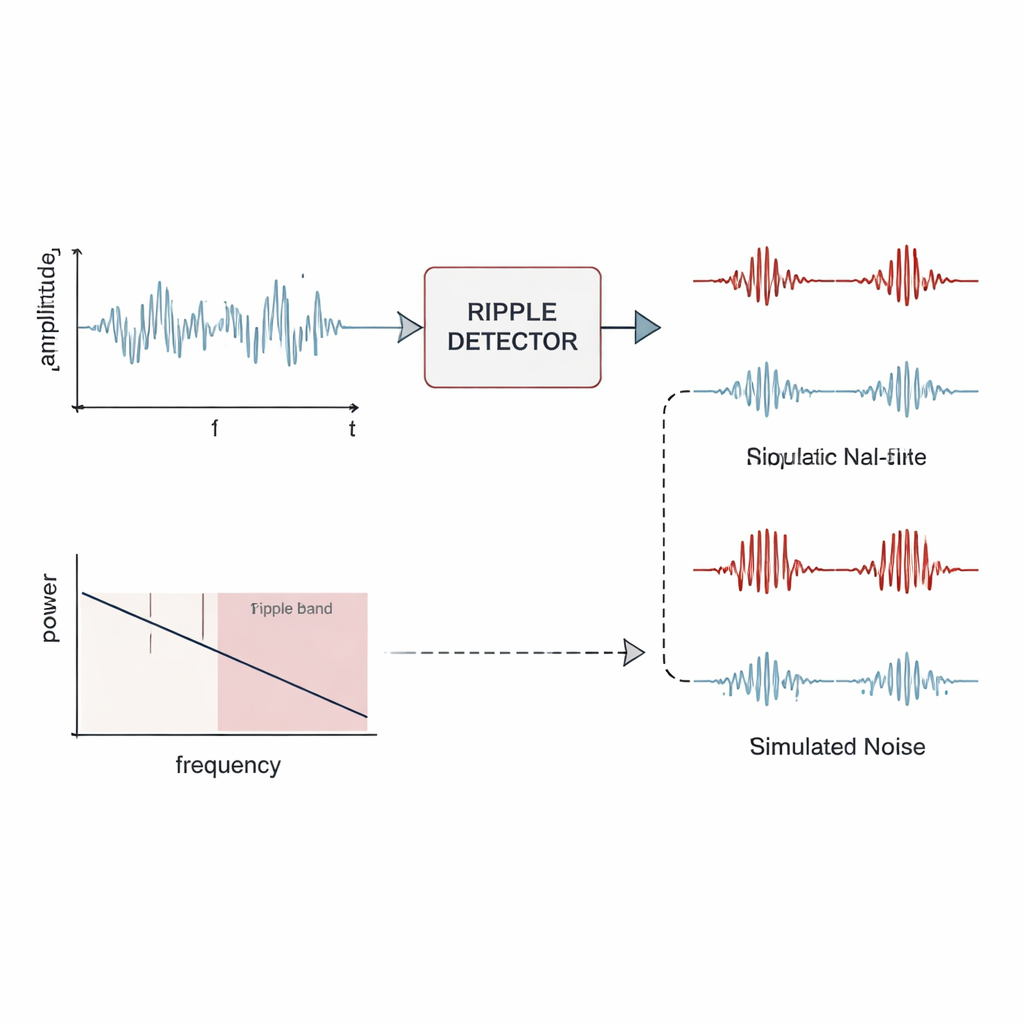
Electrical recordings from the brain are never perfectly clean. Beneath recognizable rhythms like alpha waves or sleep spindles lies a constant “hiss” that follows a 1/f pattern: slow fluctuations carry more power than fast ones, and the exact steepness of this slope changes with brain state. During focused tasks, the slope is shallower; in deep sleep it is steeper. The authors argue that this aperiodic background—often dismissed as mere noise—can itself generate short high‑frequency bursts that look just like ripples once we run them through standard detection algorithms.
Testing ripple detectors with synthetic noise
To probe this idea, the researchers first created fully artificial signals made only of 1/f noise, with no genuine ripples added. They then fed these synthetic traces into five commonly used ripple‑detection methods. Strikingly, every detector “found” many ripple‑like events in the pure noise. The waveforms and time‑frequency patterns of these false ripples looked physiologically convincing, closely matching ripples seen in real sleep recordings. Moreover, the number of detected events depended systematically on the steepness of the 1/f slope: as the slope changed, ripple counts rose or fell in predictable ways, revealing that the detectors were highly sensitive to background noise structure.
Real sleep data show noise can mimic ripples
Next, the team turned to overnight recordings from patients with electrodes implanted in deep memory structures and the frontal cortex. For each 30‑second segment of real data, they built a matching synthetic signal with the same 1/f slope but no genuine oscillations. Comparing ripples found in the real recordings to those found in the matched noise, they estimated how many events could be explained purely by background activity. In the medial temporal lobe—a key memory hub that includes the hippocampus—about 77% of ripples seen during quiet wakefulness fell within the level expected from noise alone. During deep sleep, where the 1/f slope is steeper, this fraction dropped sharply, suggesting that sleep ripples are less contaminated by noise and thus more likely to reflect true coordinated activity.
Task‑related ripples as echoes of changing noise
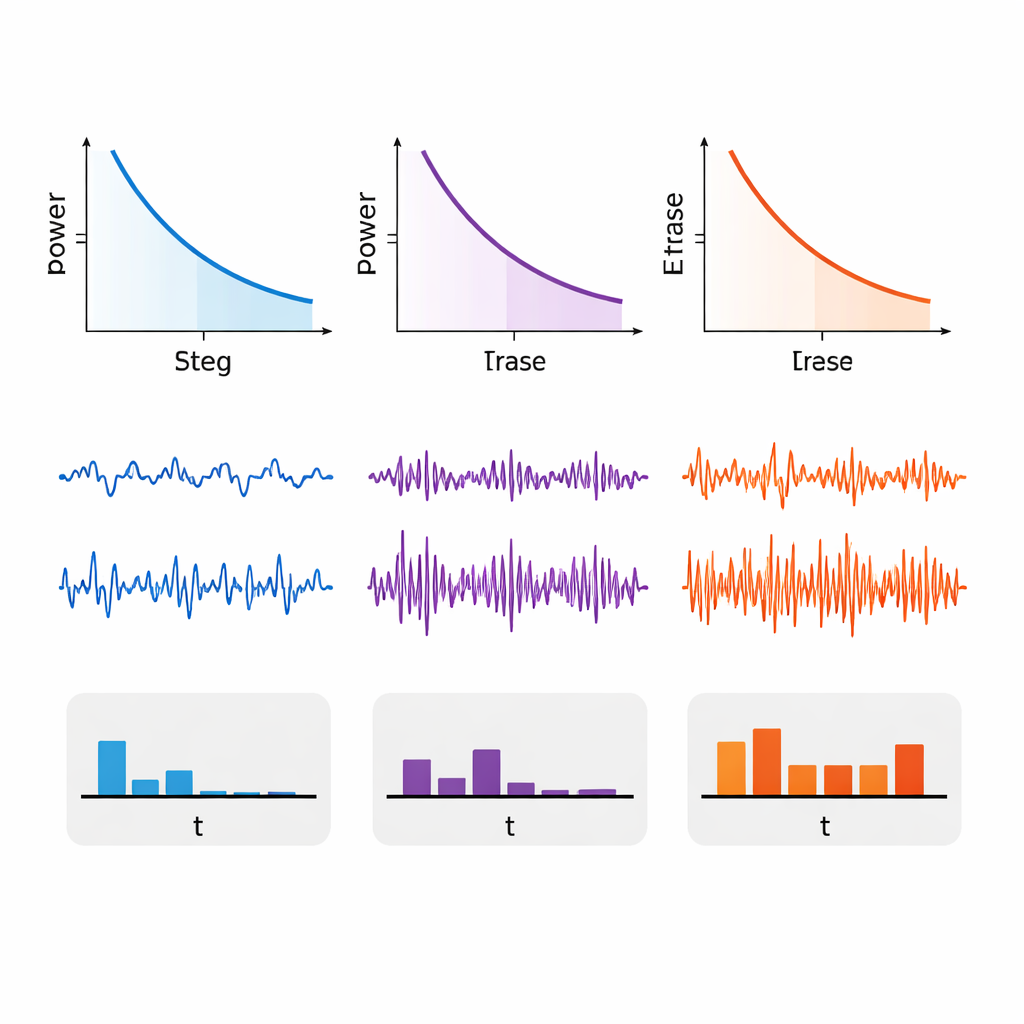
The authors then examined two task datasets from visual and motor cortex, brain regions not traditionally associated with ripples. In both a visual search task and a simple movement task, ripple detections increased during active engagement compared with resting intervals. However, the 1/f background also changed with task demands, becoming shallower and boosting high‑frequency power. When the researchers generated synthetic signals mirroring these slope changes, the same rise in ripple counts appeared, even though no real ripples were present. After statistically accounting for this noise‑driven component, the link between ripples and task engagement largely vanished, implying that many “wake ripples” during tasks may just be side effects of shifting background activity.
Rethinking how we spot meaningful brain ripples
For non‑specialists, the key message is that much of what has been labeled as human ripple activity—especially during waking and complex tasks—may be misidentified noise. The study offers a practical remedy: before interpreting ripples as meaningful memory events, researchers should estimate a noise floor by simulating 1/f signals with the same spectral shape, running the same detection algorithms, and counting how many spurious ripples appear. Only events rising above this baseline are likely to reflect true coordinated firing. In other words, to understand how the brain truly replays and stores memories, we first need to respect and carefully model the noisy background that can so easily fool our tools.
Citation: van Schalkwijk, F.J., Helfrich, R.F. Aperiodic 1/f noise drives ripple activity in humans. Nat Commun 17, 746 (2026). https://doi.org/10.1038/s41467-026-68404-5
Keywords: hippocampal ripples, 1/f neural noise, sleep and memory, intracranial EEG, brain signal detection