Clear Sky Science · en
Pragmatic representations of self- and others’ action in the monkey putamen
How the Brain Knows When to Act with Others
Everyday tasks like passing a cup, shaking hands, or lifting a box together rely on a quiet miracle in the brain: we must decide when to move, when to hold back, and how to fit our actions with someone else’s. This study explores how a deep brain structure called the putamen helps monkeys coordinate their own hand movements with those of a partner, revealing principles that may also shape human social interaction and disorders such as Parkinson’s disease.
A Shared Table for Testing Teamwork
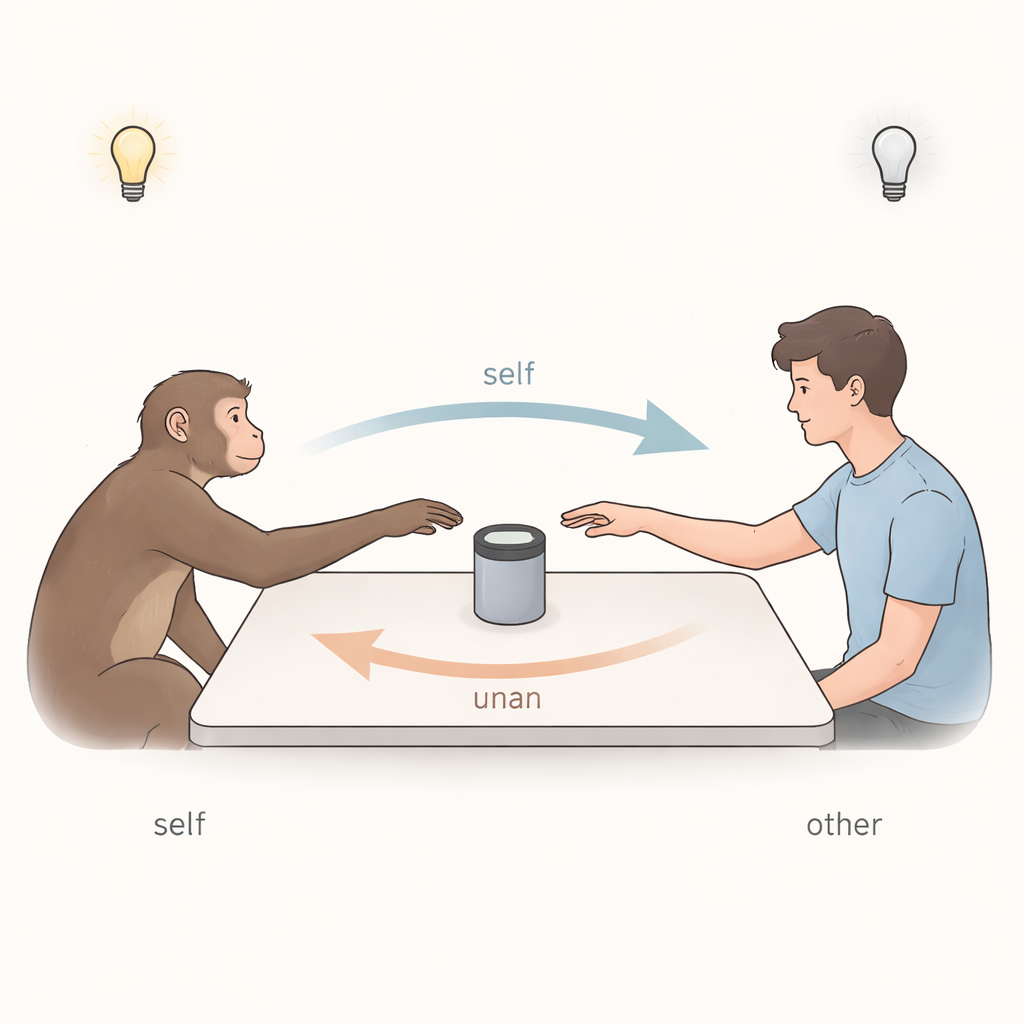
To probe this hidden coordination system, researchers trained two macaque monkeys to perform a “Mutual Action Task” with a human experimenter. Monkey and human sat facing each other across a small table with a shared object between them. On each trial, sounds and visual symbols told them who should act (monkey or human) and which type of grasp to use: a delicate precision grip with thumb and fingertip, or a whole-hand grasp wrapped around the object. Sometimes the movement happened in full light, sometimes in complete darkness, and sometimes the partner’s action was performed behind a transparent barrier. By carefully controlling who moved, how they grasped, and what they could see, the team could tease apart how the putamen responds to one’s own actions versus another’s.
Signals from the Cortex and the Putamen’s Own Voice
The putamen sits deep in the brain and receives dense input from outer brain regions that plan and control hand movements. Using fine multichannel probes, the researchers first confirmed anatomically that they were recording from putamen zones linked to hand and arm control. Then they measured two kinds of activity: slow electrical rhythms (local field potentials), which mainly reflect incoming signals from the cortex, and rapid spikes from single neurons, which represent the putamen’s own output. The slow rhythms echoed known patterns from the outer motor areas: they shifted as instructions arrived about who should act and what grip to use, even before any movement. In contrast, most individual neurons stayed quiet during the instruction period and only changed their firing once an action was actually being prepared or executed.
Neurons for Self, Others, and Both
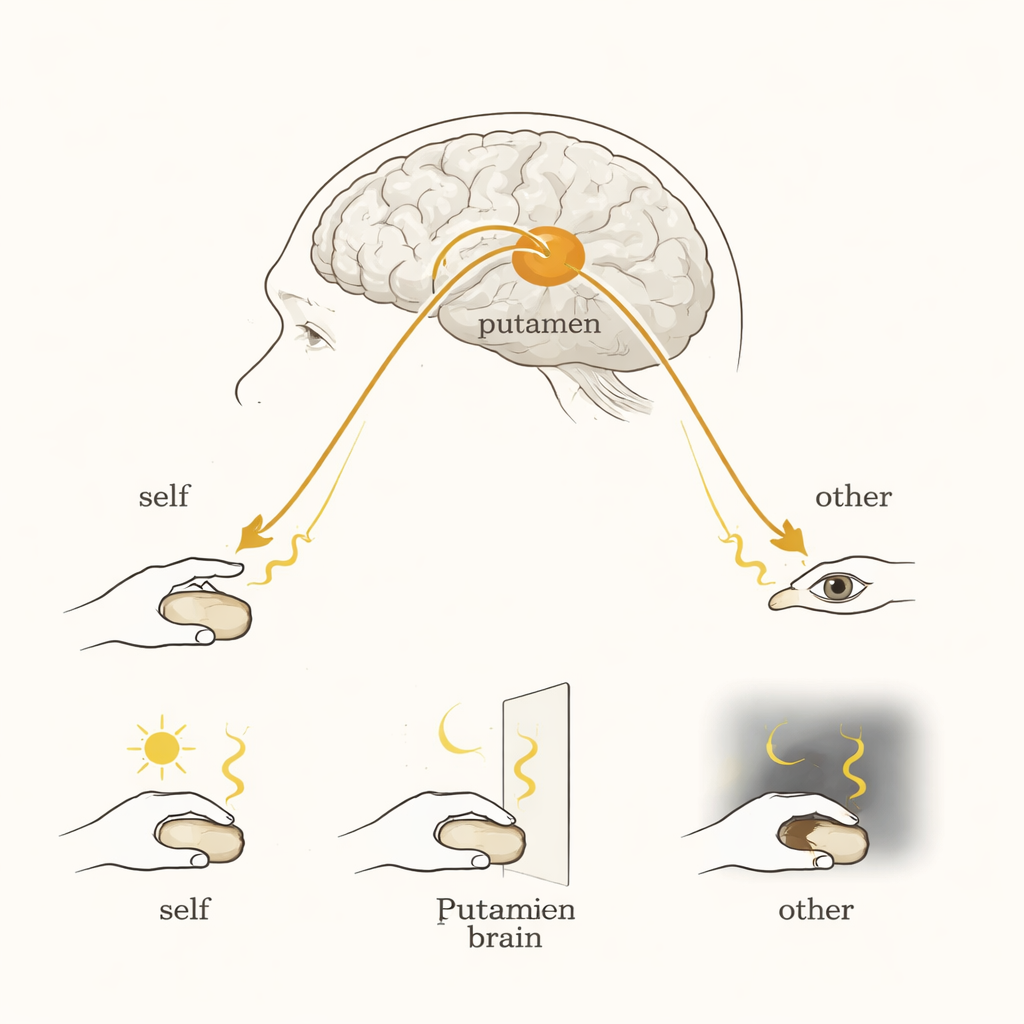
Among hundreds of recorded neurons, the team found distinct groups. Some neurons responded only when the monkey performed the grasp, some only when the human partner acted, and others during both agents’ actions. Many cells fired more strongly (were “facilitated”), while others decreased their activity (were “suppressed”). Neurons that responded to both self and other tended to have very similar timing across the two cases, yet still carried enough subtle differences for a classifier to tell who was acting. Crucially, about a quarter of the neurons active during the monkey’s own movements could distinguish between precision and whole-hand grips, and this grip preference remained even in the dark. This shows that the putamen does not just relay visual information; it encodes detailed aspects of the monkey’s hand actions themselves.
Seeing Is Optional, Sharing Space Is Not
An important surprise emerged when the researchers manipulated visibility. For the monkey’s own actions, most putamen neurons fired just as strongly whether the movement happened in the light or in total darkness, indicating that visual feedback from the hand was largely unnecessary. The same was true for neurons responding to the human partner’s actions: the cells still fired when the partner grasped the object in the dark. However, when the partner performed the very same action clearly in view but behind a transparent barrier that blocked any possible physical interaction with the object, the majority of these “other-related” responses shrank or vanished. The scene looked the same, but because the monkey could not in principle reach the object, the putamen’s response to the partner’s action was greatly reduced.
What This Means for Everyday Social Actions
These findings suggest that the putamen does not merely mirror what is seen; instead, it represents actions—one’s own and others’—in terms of what can actually be done with them in the shared environment. The brain rhythms arriving from the cortex seem to convey a rich set of possible actions, while the putamen focuses on the concrete option that is currently relevant: which hand movement to execute and whether to respond to another’s movement at all. Because the putamen is heavily affected in conditions like Parkinson’s disease, this work offers a new window into why social coordination and cooperative movements can become harder, and points toward a broader “social action” network in the brain that links perception, possibility, and choice.
Citation: Rotunno, C., Reni, M., Ferroni, C.G. et al. Pragmatic representations of self- and others’ action in the monkey putamen. Nat Commun 17, 608 (2026). https://doi.org/10.1038/s41467-026-68403-6
Keywords: social action, motor control, basal ganglia, mirror neurons, Parkinson’s disease