Clear Sky Science · en
A reconfigurable photosensitive split-floating-gate memory for neuromorphic computing and nonlinear activation
Smarter hardware at the edge
Phones, cameras, and tiny internet‑connected gadgets are now expected to see, recognize, and react in real time—but today they usually do this by shuttling raw data back and forth between separate sensors, memory chips, and processors. That traffic costs energy and slows everything down. This paper introduces a new kind of tiny electronic building block that can sense light, remember information, and perform key steps of artificial intelligence inside a single device, promising faster and more efficient smart hardware for everyday technology.
How the brain inspires new chips
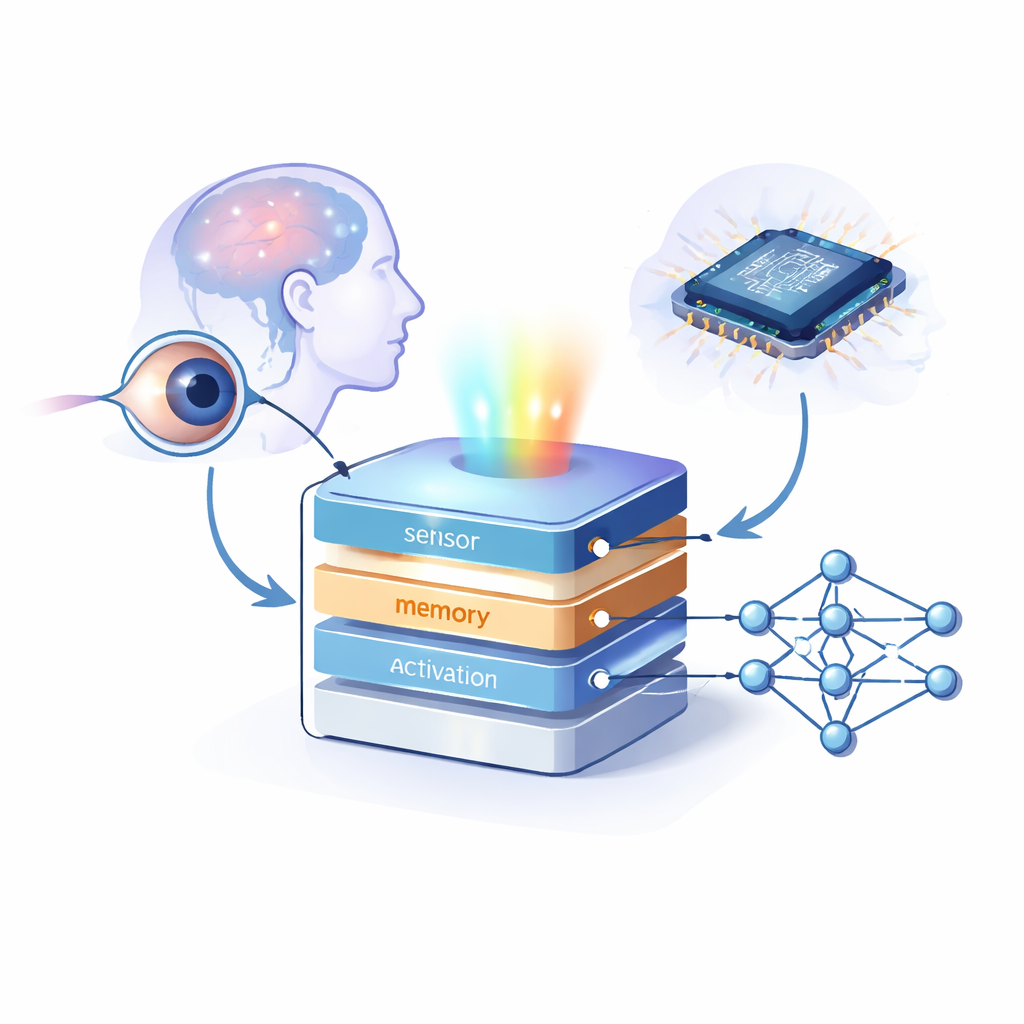
Our eyes and brain handle vision very differently from a digital camera. In the human visual system, the retina does not simply capture pictures; it immediately filters, compresses, and highlights important features before sending compact signals along the optic nerve to the visual cortex. By contrast, most machines first collect full images, store them, and then process them elsewhere, wasting time and power. The researchers set out to mimic the biological strategy in hardware: build devices that can both sense and process information locally, and also apply the nonlinear “activation” steps that modern neural networks rely on to make complex decisions.
One device, three jobs
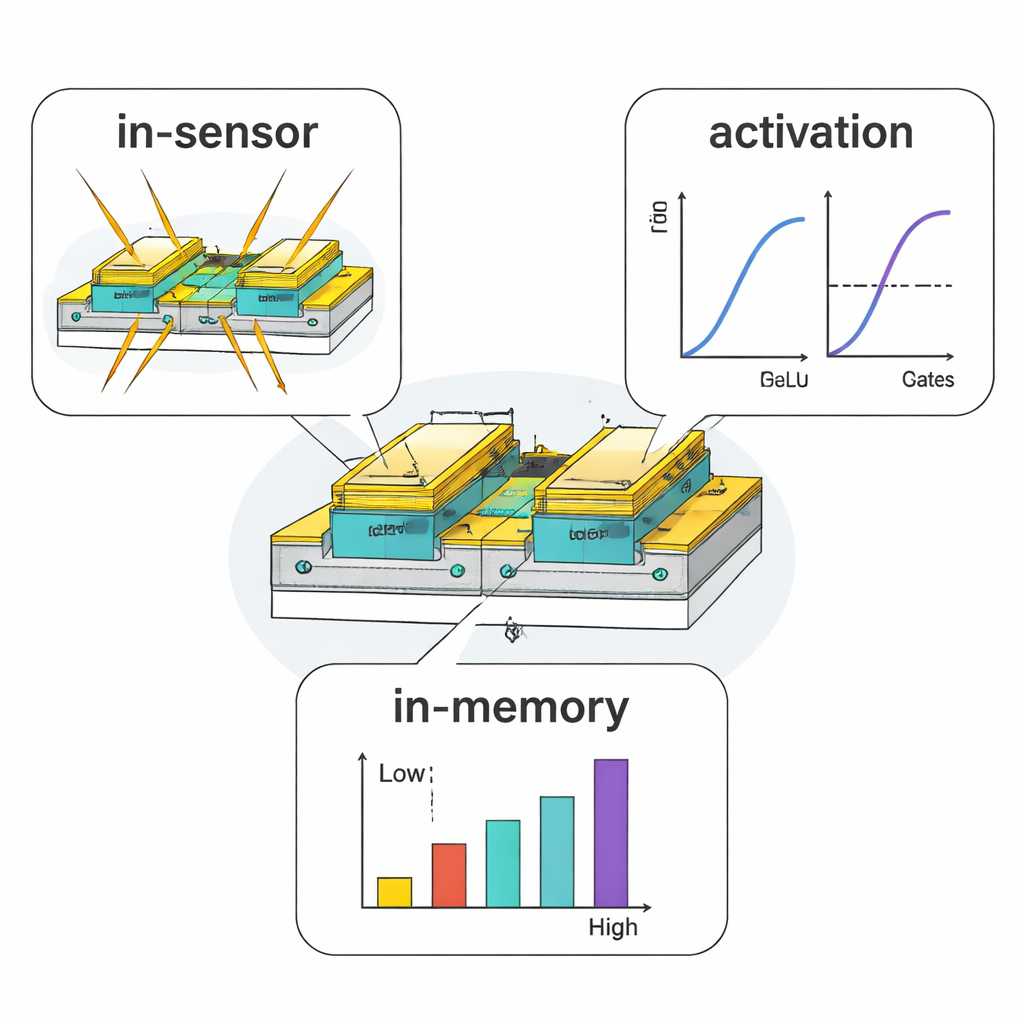
The team developed what they call a multi‑modal split‑floating‑gate memory device. In simpler terms, it is a stack of ultra‑thin materials that behaves like a very flexible transistor with two independently controllable regions. By injecting and trapping tiny packets of electric charge into these regions, the device can be reprogrammed on demand. In one configuration, it acts as a self‑powered light sensor whose sensitivity can be finely tuned and even made positive or negative. In another, it serves as a memory element whose electrical conductance can be set to one of many stable levels, ideal for storing the strengths—or “weights”—of connections in a neural network.
Bringing the neural “spark” on chip
Neural networks do not just add and multiply numbers; after each layer, they run the result through a nonlinear activation step, often functions known as ReLU or Sigmoid. These steps are usually handled by separate, power‑hungry circuits. Here, the same device that senses and stores information can also perform these activations. When programmed into a particular state, it allows current to flow only above a certain input level, mimicking a ReLU. When reprogrammed, its current–voltage curve becomes smooth and S‑shaped, like a Sigmoid. Crucially, switching between these modes is done electrically and quickly, without changing the physical structure of the chip.
A tiny hardware brain for vision tasks
To show what this enables, the authors wired many of these devices into small arrays and used them as a complete, hardware‑based vision system. In so‑called sensor mode, an array of devices directly converted patterns of light into weighted signals, performing the first layer of a neural network inside the image sensor itself. In memory mode, similar arrays carried out matrix‑like calculations typical of deeper network layers. Separate devices in activation mode then applied ReLU and Sigmoid operations. With this setup, the system could classify handwritten digits from the standard MNIST database with accuracy close to that of a software‑only model, and it could also clean up noisy images using an autoencoder, all while keeping the learned weights stored locally in non‑volatile form.
Why this matters for everyday technology
For non‑specialists, the key takeaway is that the researchers have merged sensing, memory, and the nonlinear “decision step” of artificial intelligence into a single reconfigurable device. Because it can be programmed with tiny energy pulses, operate on nanosecond time scales, and remember its settings without power, such hardware could make future cameras, wearables, and other edge devices far more efficient. Instead of sending floods of raw data to a distant processor or the cloud, these systems could extract meaning where the data are born—much like our own eyes and brain do—opening the door to compact, low‑power machines that see and understand the world in real time.
Citation: Zhang, ZC., Li, Y., Yao, J. et al. A reconfigurable photosensitive split-floating-gate memory for neuromorphic computing and nonlinear activation. Nat Commun 17, 1697 (2026). https://doi.org/10.1038/s41467-026-68402-7
Keywords: neuromorphic hardware, in-sensor computing, in-memory computing, nonlinear activation, edge AI