Clear Sky Science · en
Haldane’s law works through X:Autosome incompatibility in Caenorhabditis briggsae/C. nigoni hybrids
Why some hybrids fail while others thrive
When closely related species mate, their offspring are often weak, sterile, or never develop at all. Biologists have long noticed a peculiar pattern in these failures: the sex that carries two different kinds of sex chromosomes (like XY males in mammals) is usually the one that suffers. This pattern, known as Haldane’s rule, helps explain how new species stay separate. In this study, researchers use tiny worms to uncover a surprisingly simple reason for this rule: a mismatch between one sex chromosome and the rest of the genome.
Old puzzle about hybrid offspring
Haldane’s rule was first described over a century ago, yet the genetic cause has remained murky. Two big ideas have dominated. One argues that sex chromosomes evolve quickly, stockpiling hidden genetic conflicts that show up only in hybrids. The other proposes that male traits, especially those required for fertility, change so fast that hybrid males cannot produce functioning sperm. Both theories predict trouble for the “heterogametic” sex, the one with unmatched sex chromosomes (XY, ZW, or XO), but they do not say exactly which pieces of DNA are to blame.
Worms that break and then remake the rules
The authors turn to two closely related nematode worms, Caenorhabditis briggsae and C. nigoni, which can interbreed but usually produce sickly or sterile sons. When a C. nigoni female is crossed with a C. briggsae male, daughters with two X chromosomes (XX) are healthy, but sons with a single X (XO) are sterile. In the reverse cross, XO sons die as embryos. This sharp contrast between healthy XX and failing XO hybrids makes these worms a powerful system for probing Haldane’s rule in action. 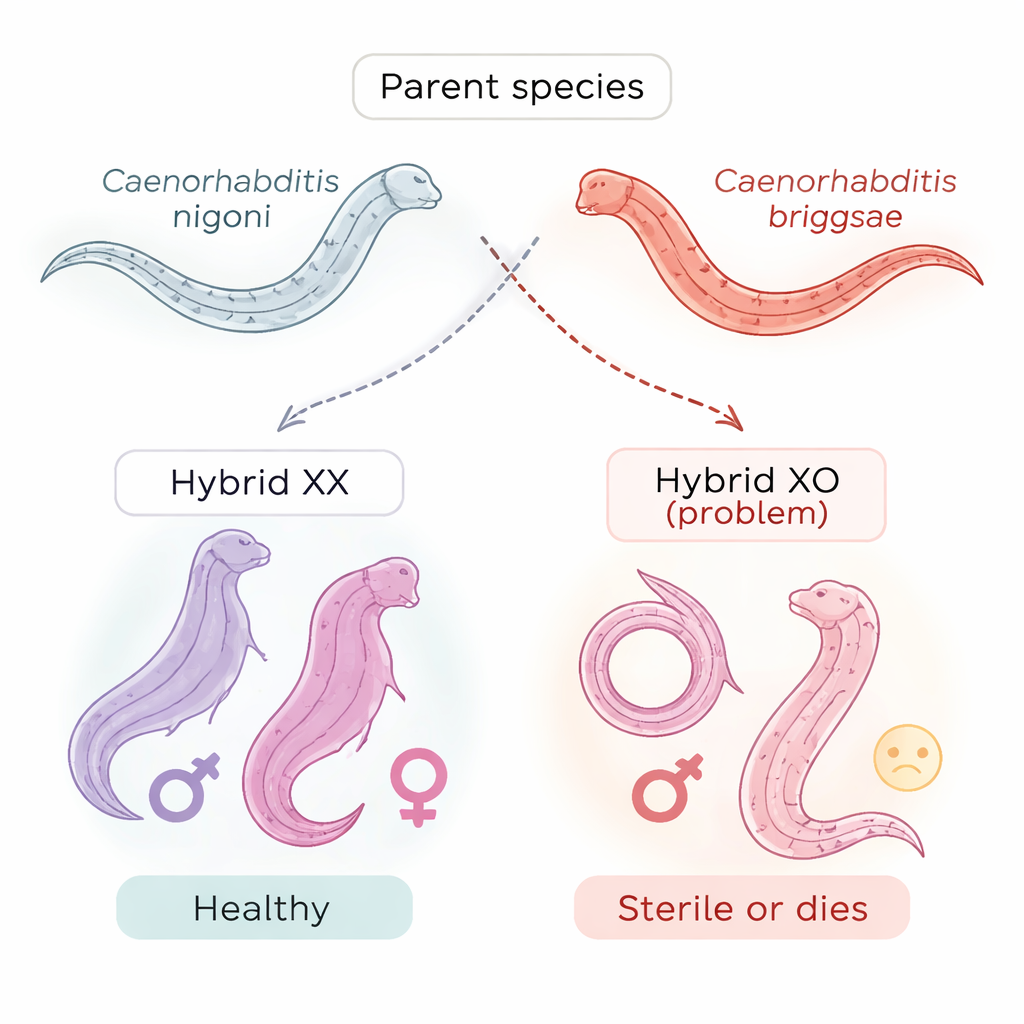
Testing whether "being male" is really the problem
To see if male-specific genes were to blame, the researchers used mutations in a key sex-determining gene called tra-1 to force genetically XX hybrids to develop as males. If the male program itself was incompatible between species, these XX males should have been sterile or malformed. Instead, most developed normal male bodies, made sperm, and even sired offspring. This shows that the basic genetic program for making a male—body form, behavior, and fertility—still works when the two species’ genomes are combined. The issue, therefore, is not simply that “male genes” diverged too quickly.
Stacking extra chromosomes to fix hybrids
The team next asked whether the real difficulty lies in how the single X chromosome in XO hybrids interacts with the other chromosomes, called autosomes. To test this, they produced worms with four sets of chromosomes instead of two—tetraploids. In these tetraploid hybrids, males inherit an X chromosome from each species, along with extra autosomes. Strikingly, these tetraploid hybrid males were healthy, made abundant sperm, and could father offspring, in sharp contrast to the sterile or dead diploid XO males. This result points to a specific problem in the diploid hybrids: a lone X from one species trying to work with mixed pairs of autosomes from both.
How dosage and balance of genes go wrong
The authors propose that subtle shifts in where genes sit—on the X chromosome versus the autosomes—combined with systems that equalize gene activity from the X (called dosage compensation), can unbalance gene expression in XO hybrids. During evolution, each species fine-tunes the activity of its genes so that X-linked and autosomal genes work together smoothly. But in hybrids that inherit a single X from one species and autosomes from both, some genes become too active or not active enough relative to their partners. The cumulative effect of these mismatched levels can disrupt development of the heterogametic sex, leading to sterility or death, while XX hybrids remain largely balanced. 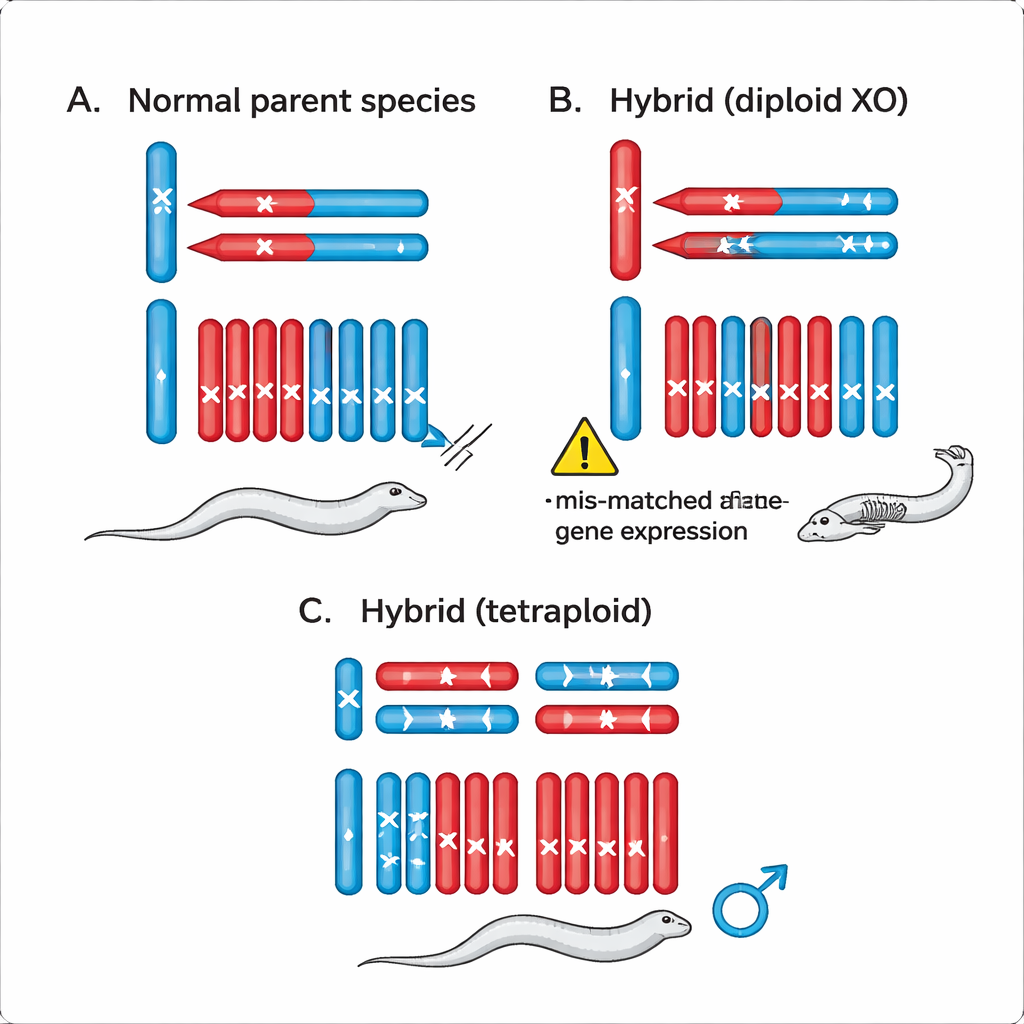
What this means for how new species form
In everyday terms, the study suggests that hybrid failure often comes down to poor coordination between one sex chromosome and the rest of the genome, rather than to an inherently fragile male body plan. In these worms, once the researchers either rewired sex determination or added extra chromosome copies, hybrid males could thrive. This supports a simple, general view of Haldane’s rule: when species diverge, small changes in how genes are distributed and regulated across the X chromosome and autosomes can quietly build up. Those changes are harmless within each species, but they cause trouble when genomes mix, helping to lock in the boundaries between emerging species.
Citation: Harbin, J.P., Shen, Y., Abubakar, A.H. et al. Haldane’s law works through X:Autosome incompatibility in Caenorhabditis briggsae/C. nigoni hybrids. Nat Commun 17, 1679 (2026). https://doi.org/10.1038/s41467-026-68383-7
Keywords: hybrid sterility, sex chromosomes, Haldane’s rule, speciation, nematode genetics