Clear Sky Science · en
Host-guest strategy for full-visible-spectrum piezochromism in halogen-bonded organic frameworks
Color that Changes with Pressure
Imagine a material that changes its glow smoothly from deep blue to bright red, just by squeezing it. Such pressure-sensitive colors could be used to hide and reveal security codes, log how hard something has been squeezed deep inside a machine, or map extreme pressures in scientific experiments. This study reports a new crystal that does exactly that across almost the entire rainbow, doing so more effectively than any similar material reported so far.
Building a Protective House for Glowing Molecules
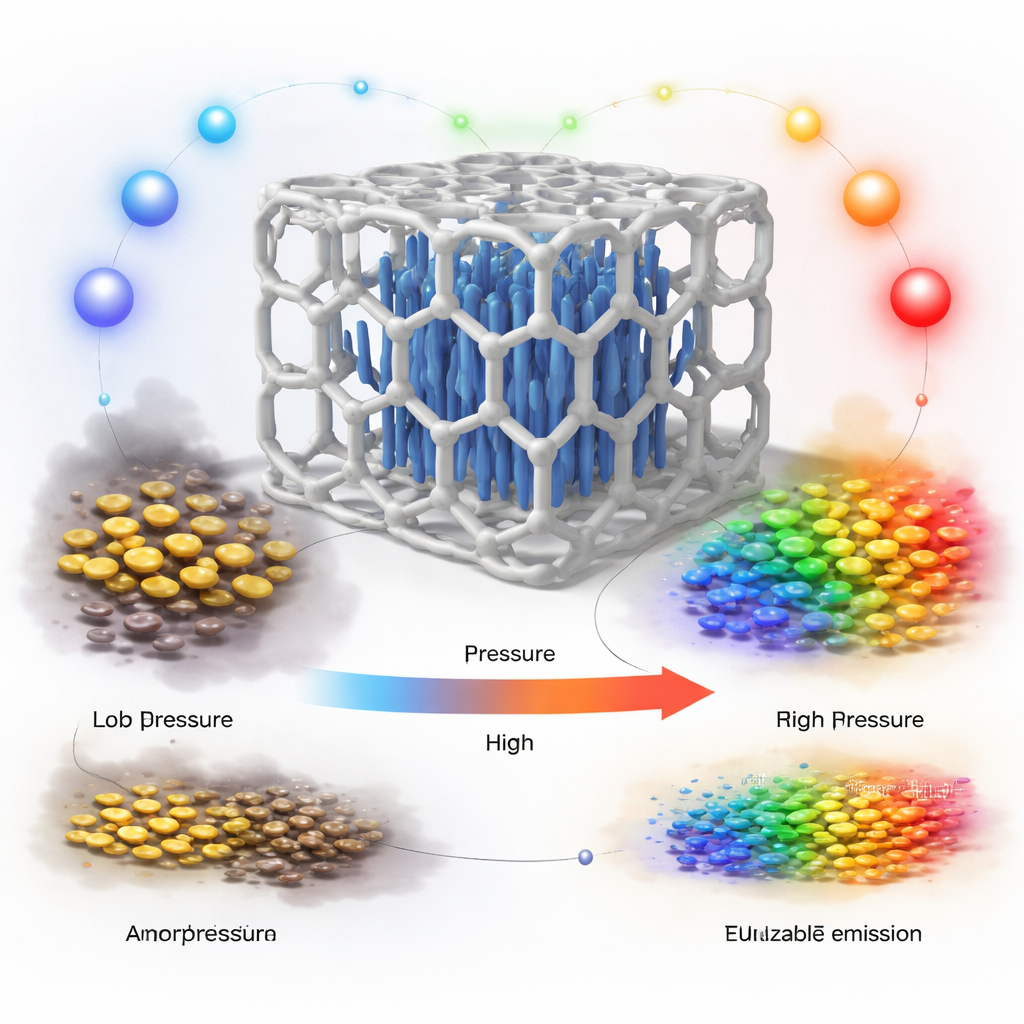
The researchers start from a familiar problem: many organic molecules can glow in beautiful colors, but their neat crystal structures often collapse into a messy, amorphous state under high pressure. When that happens, the light they emit is quenched and their useful color-changing behavior disappears. To get around this, the team used a "host–guest" strategy. They built a sturdy three-dimensional framework from molecules that link together through halogen bonds—attractions involving iodine and oxygen/nitrogen atoms. This framework, called a halogen-bonded organic framework, naturally forms hexagonal channels, like microscopic tunnels. Into these tunnels they inserted guest molecules of acridine, a flat, light-emitting organic compound known for stacking efficiently.
From Deep Blue to Red Under Squeeze
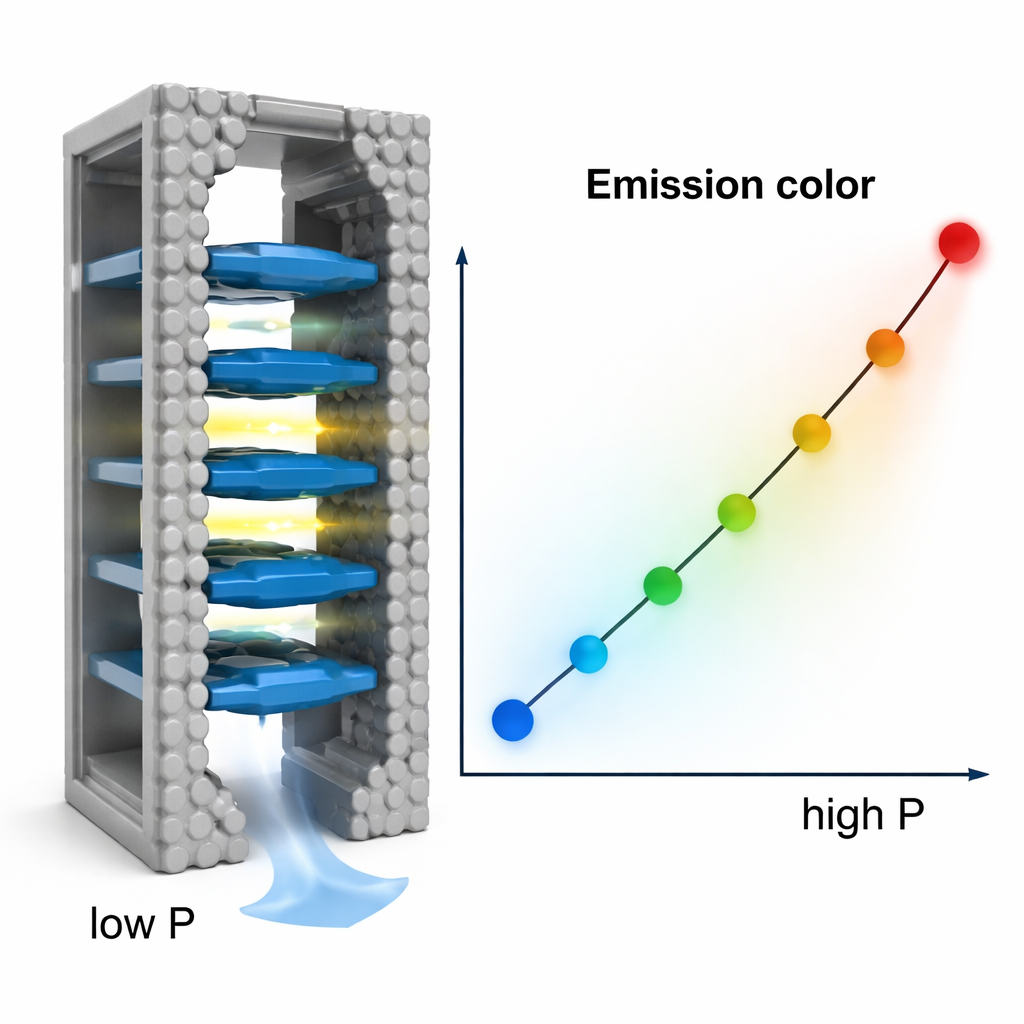
At normal pressure, the resulting material, named XOF@AD, glows deep blue when excited with ultraviolet light. When the scientists compressed it in a diamond anvil cell up to about 23 gigapascals—hundreds of thousands of times atmospheric pressure—the color of its photoluminescence shifted steadily toward red. The total shift in emission wavelength was 237 nanometers, taking the light from deep blue to red and covering nearly the entire visible spectrum. This shift followed an almost perfectly linear relationship with pressure, allowing a specific color to be tied directly to a specific pressure. Notably, the material survived repeated cycles of compression and decompression with its color-changing behavior largely intact, suggesting it could serve as a reliable pressure sensor.
How the Framework Keeps Order and Enhances Light
What makes XOF@AD special is how the host framework keeps the guest molecules in a tidy, light-friendly arrangement even under extreme squeeze. X-ray diffraction measurements showed that the crystal volume shrinks smoothly with pressure but does not undergo abrupt structural transitions. The channels of the framework compress most along one axis, which forces the acridine molecules to move closer together in a controlled way instead of becoming disordered. Detailed analysis revealed that two types of non-covalent attractions grow stronger as the material is compressed: halogen bonds that stiffen the framework itself, and stacking interactions between the flat acridine molecules. These tighter stacks narrow the material’s electronic band gap, which is directly linked to the shift from blue to red light.
Balancing Vibrations and Glow
Besides color tuning, the team observed an unusual boost in brightness at modest pressure (around 1.2 gigapascals). Time-resolved measurements and infrared spectroscopy showed that, at these pressures, certain molecular vibrations are restricted. This reduces pathways where excited energy is lost as heat (non-radiative decay) and instead favors radiative decay, meaning more of the absorbed energy comes out as light. As the pressure rises further, however, the increasingly strong stacking interactions eventually promote new non-radiative pathways, and the light intensity starts to drop. Calculations using quantum mechanical methods confirmed that the electronic states responsible for emission remain localized on the acridine guests, and that pressure strengthens specific interactions in the framework that lock the guests in their efficient stacking pattern.
Why This Matters for Real-World Uses
In everyday terms, the authors have created a tiny, robust scaffold that holds glowing molecules just far enough apart—and then tunes that spacing with pressure—to sweep their color smoothly across the rainbow. Because the relationship between pressure and color is nearly linear and highly reversible, this material could serve as a visual pressure gauge in extreme environments, an advanced anti-counterfeiting feature that changes color only under a defined squeeze, or a component in smart optical storage devices. More broadly, the work shows that carefully designed host–guest frameworks are a powerful way to stabilize delicate light-emitting molecules and control their color with mechanical force.
Citation: Yang, B., Wang, Y., Liang, J. et al. Host-guest strategy for full-visible-spectrum piezochromism in halogen-bonded organic frameworks. Nat Commun 17, 1682 (2026). https://doi.org/10.1038/s41467-026-68381-9
Keywords: piezochromism, pressure sensing, luminescent materials, organic frameworks, host–guest chemistry