Clear Sky Science · en
A nano-structured reporter for high-sensitivity contaminant detection in groundwater
Why hidden pollution in groundwater matters
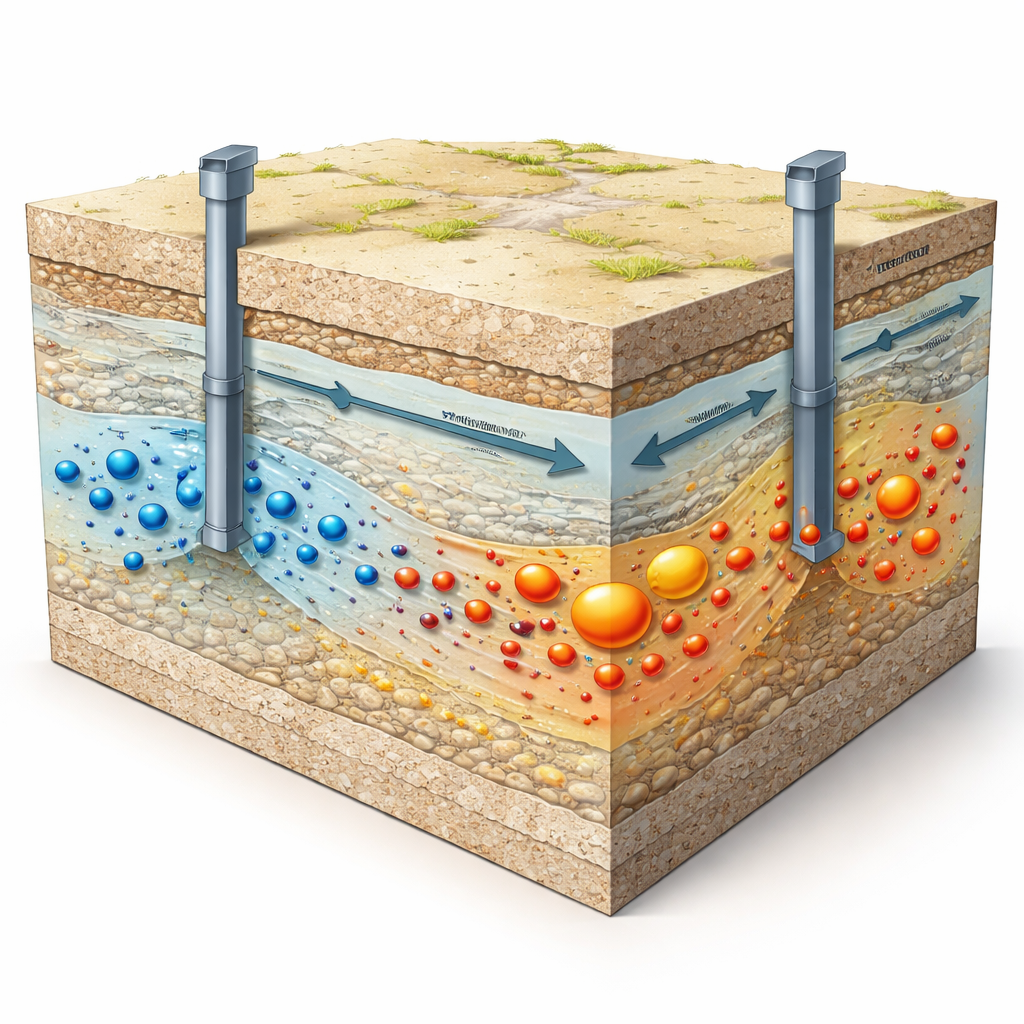
Much of the world’s drinking and irrigation water comes from underground, where it flows slowly through sand and rock. Yet spills of industrial solvents, fuels, and tars can linger there for decades as tiny oily droplets or thin coatings that are very hard to find. Traditional methods rely on drilling many wells and pulling up soil samples, which is expensive, slow, and can even spread the pollution. This study introduces a “smart” nano-sized reporter that can be injected into the ground and then recovered from a nearby well, offering a way to reveal how much hidden contamination is present without tearing up the site.
A new way to follow invisible oil underground
The contaminants targeted here are free-phase organic contaminants—oily liquids like chlorinated solvents and coal tar that do not mix well with water. Because they are dense and sticky, they sink, break into scattered droplets, and smear into thin films along their path. Finding these patchy pockets is crucial, because even small amounts can slowly leak toxic chemicals into drinking water for many years. Existing tracer methods send a dissolved chemical through the ground and measure how much is pulled into the oily phase, but they often struggle when groundwater flow is complex or when contamination is thinly spread. The authors set out to build a tracer that would move as easily as groundwater itself while responding strongly even to tiny traces of oil.
A tiny carrier with a built-in alarm
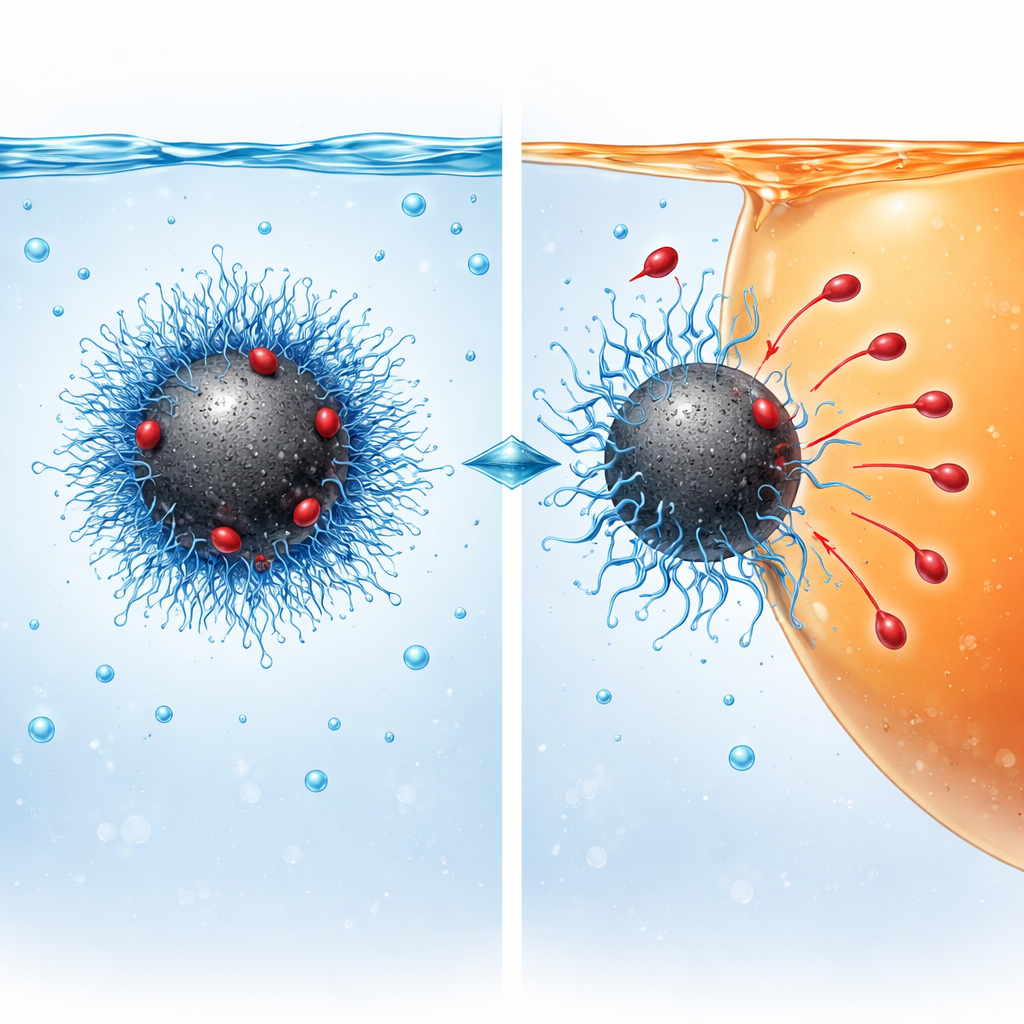
The team designed a nano-structured reporter made of three parts: a carbon black core, a surrounding shell of polyvinyl alcohol (PVA), and a fluorescent dye called Nile red tucked inside. The carbon core provides a stable platform for the dye. The PVA shell is water-loving and highly flexible, which keeps the particles from clumping and sticking to sand grains, so they drift with groundwater instead of getting trapped. In water, the PVA chains stretch outward and shield the dye. When the particles encounter an oily droplet or film, the PVA chains recoil to avoid the oil, exposing the dye molecules. These dye molecules, which prefer the oily phase, then escape into the contaminant. Because the amount of dye lost from the particles is directly tied to how much oil they have met, measuring that loss tells researchers how much contamination lies along the flow path.
From lab columns to real-world aquifers
To test this idea, the researchers first pumped the nano reporter through sand-filled columns in the lab. In clean columns, the fluorescent dye and the particle carrier came out together, showing that the dye stayed bound. When small amounts of oily contaminants were added, the dye signal dropped relative to the carrier, and that drop grew in proportion to the amount of contaminant present. By fitting these “breakthrough curves” with a two-site transport model, they could separate dye lost to oil from dye lost to any particle settling and convert it into an accurate estimate of contaminant mass. The reporter worked just as well in different types of aquifer materials, including quartz sand, carbonates, and clay-rich sand, and remained stable even in very salty water, showing that it can travel in a wide range of groundwater conditions.
Seeing how well it finds scattered pollution
The biggest challenge for any tracer is contamination that is sparse and unevenly distributed. Using transparent microfluidic chips packed with minerals, the team watched labeled oil and the released dye under a confocal microscope. Wherever oil films and droplets appeared, dye from the nano reporter accumulated in the same spots, even for very thin coatings, confirming good “targeting” of hard-to-reach pockets. Computer simulations at the molecular level supported this behavior: in water, the dye prefers to stay on the carbon core under the PVA shell, but near an oil–water boundary, the PVA folds back and the dye is energetically driven into the organic phase. The approach then scaled up to a meter-scale sand tank and finally to a contaminated industrial site, where measurements from the nano reporter agreed closely with independent estimates from electrical imaging and soil core samples.
What this means for cleaning up groundwater
In plain terms, this work shows that a carefully engineered nanoparticle can act like a scouting device for underground oil-like contamination. Injected at one well and pumped back at another, it travels with groundwater, sheds some of its fluorescent cargo whenever it brushes past oily droplets or films, and returns carrying a quantitative record of what it encountered. Because the method is sensitive to low levels of contamination and robust to complex geology, it can help map hidden source zones more accurately and at lower cost than drilling many boreholes. In the long run, such smart reporters could not only guide cleanup efforts to the most contaminated regions but also be adapted to deliver treatment agents directly to those underground hotspots.
Citation: Xu, S., Li, Y., Yang, C. et al. A nano-structured reporter for high-sensitivity contaminant detection in groundwater. Nat Commun 17, 1674 (2026). https://doi.org/10.1038/s41467-026-68373-9
Keywords: groundwater contamination, nanoparticles, environmental sensing, organic pollutants, water remediation