Clear Sky Science · en
4D printing through vat photopolymerization of two-stage UV-curable liquid crystal elastomers
Smart Materials That Remember Shapes
Imagine a medical stent that can thread through a tiny blood vessel, then gently expand once inside the body—and later shrink again on command. Or a soft robot that crawls and grasps using only changes in temperature instead of motors and gears. This research shows how to 3D-print such "smart" objects so they not only hold intricate shapes in three dimensions but also change those shapes over time in a controlled, repeatable way.
From 3D Objects to 4D Shape-Shifters
Traditional 3D printing builds fixed objects, but 4D printing adds time as a new dimension: printed parts can change shape when triggered by heat, light, or other signals. A particularly promising class of materials for this is liquid crystal elastomers—rubbery solids that contain rod-like building blocks which can line up and move cooperatively. When heated or cooled, these blocks rearrange and the whole material bends, stretches, or contracts. However, most earlier work relied on squeezing these materials through a nozzle, which limits the fineness of detail and makes it difficult to create delicate, freestanding structures such as open lattices or detailed architectural models.
A New Way to Print and Program Movement
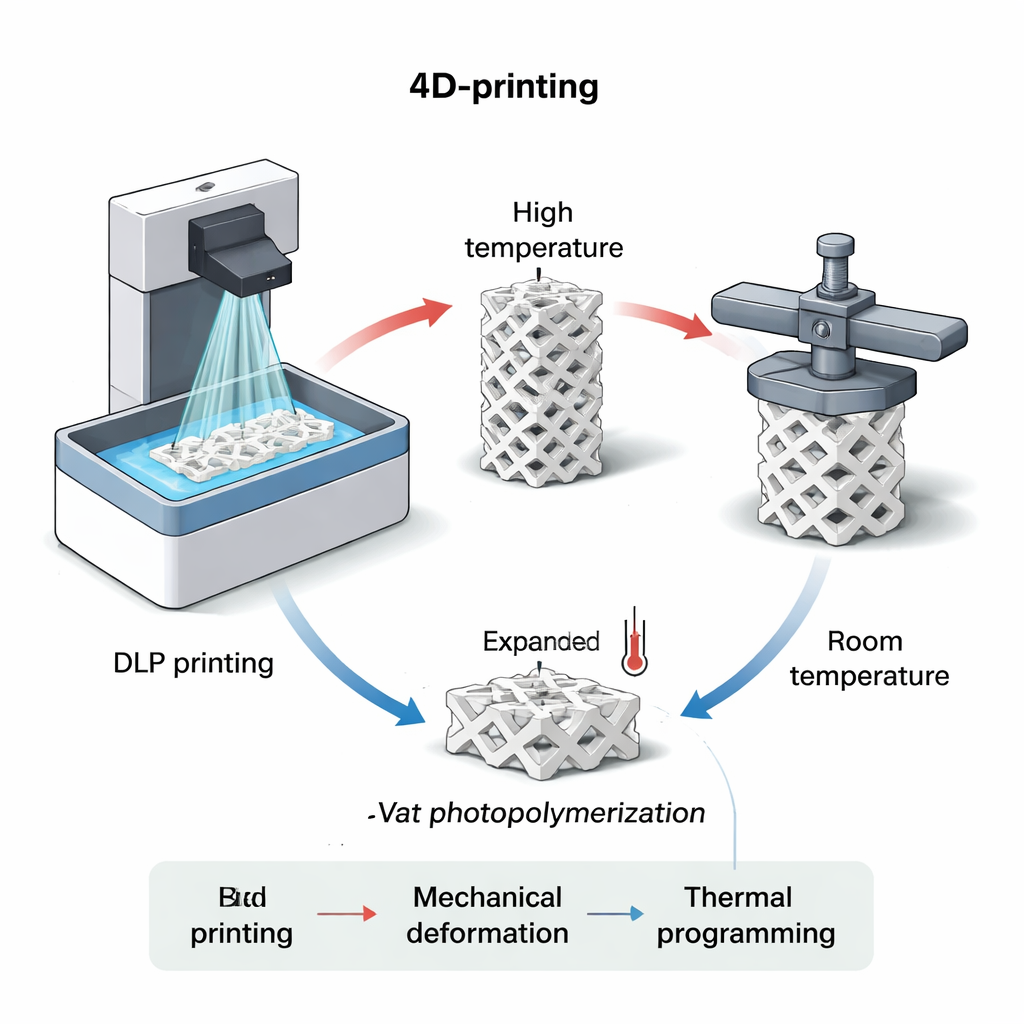
The authors combine these liquid crystal elastomers with a different style of 3D printing called vat photopolymerization, commonly used in high-resolution printers. In this method, a light projector cures thin layers of liquid resin to build up a solid object with features as small as a few tenths of a millimeter. The team designs a special resin that reacts in two stages. In the first stage, ultraviolet light links together acrylate components, forming a soft, rubbery network that can be printed into complex shapes. Crucially, other groups in the resin—epoxy groups—remain unreacted at this point, like spare connection points waiting to be used.
Locking In Shapes with Heat
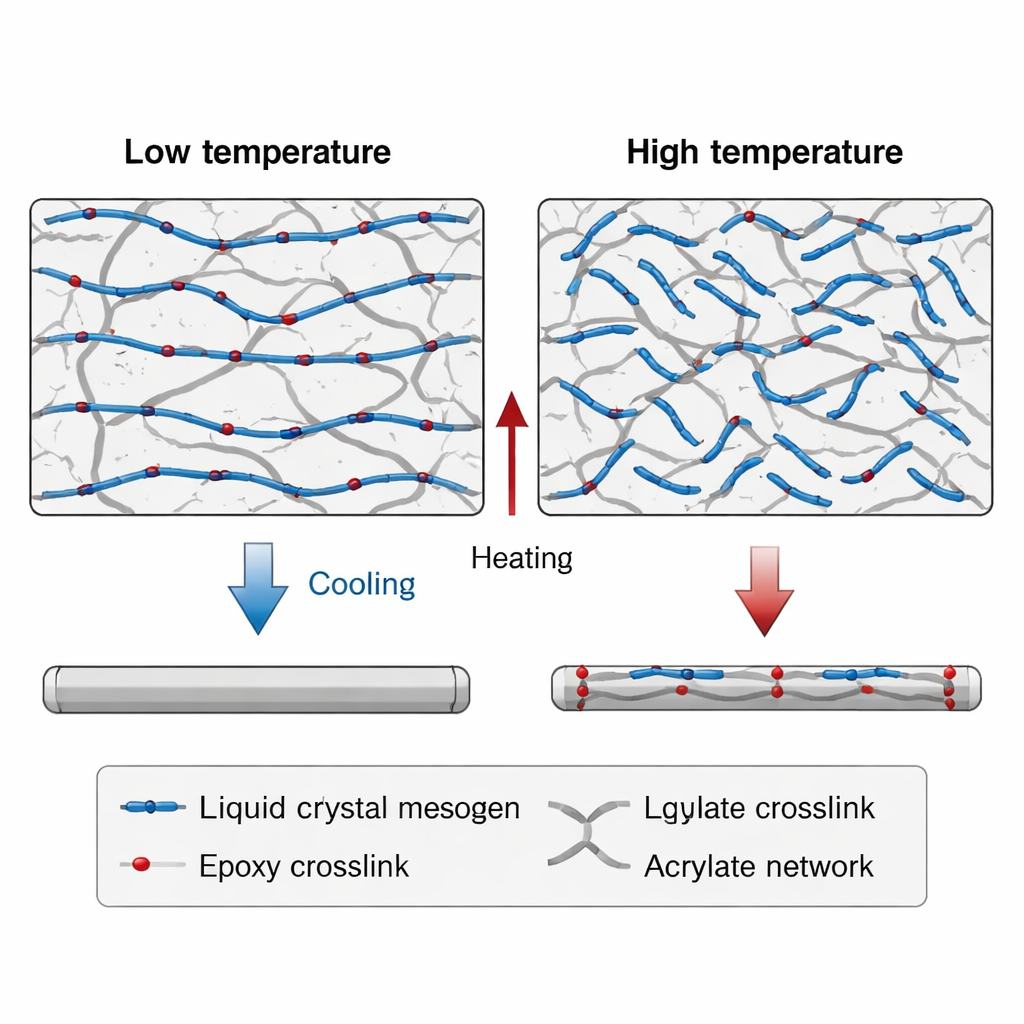
After printing, the researchers perform a separate "programming" step. They mechanically deform the printed piece—by stretching, compressing, or bending it into a desired configuration. This large-scale shaping forces the liquid crystal building blocks inside to line up along the local stress directions. While the part is held in this deformed state, it is gently heated so that the epoxy groups now react and form additional permanent links. These new links effectively freeze the internal alignment and the overall shape. Once cooled and released, the structure keeps this programmed form at room temperature, yet when it is heated above a certain transition temperature, it springs back toward its original, as-printed shape; cooling again returns it to the programmed configuration. This back-and-forth change is repeatable, giving a true reversible "shape memory" without the need for direct mechanical resetting.
Tuning Strength, Softness, and Motion
By adjusting the ratio of acrylate to epoxy components, the team can finely tune how stiff, strong, and responsive the material is. With only a modest amount of epoxy, the elastomer remains soft and stretchable but gains enough extra linking to reliably hold its programmed shape and recover it with nearly 100 percent accuracy upon heating. Larger epoxy contents yield stiffer materials that can bear more load but may move less. Using an optimized formulation, the researchers demonstrate a range of temperature-responsive structures: lattices whose stiffness can be tripled by heating; auxetic patterns that expand sideways instead of narrowing when stretched; and bistable elements that can be flipped thermally between two stable shapes for repeated energy absorption and release.
Shape-Shifting Devices and Soft Robots
To illustrate practical possibilities, the authors print several complex objects that morph reversibly. These include a deployable antenna, a miniature Eiffel Tower, medical stents that can contract for insertion and then reopen, and flower-like structures that bloom with heat. They further build soft robotic hands that make gestures or grip objects, a model prosthetic arm that bends and lifts using a printed "muscle" strip, and an inchworm-inspired robot that crawls forward when cycled between hot and cold. All of these examples rely on the same key idea: an object is first printed in one shape, then mechanically programmed into another, and temperature is used as a simple remote control to switch between the two.
Why This Matters for Future Devices
For non-specialists, the significance is that complex, moving devices can now be printed as single pieces using widely available chemistries and high-resolution printers. Designers no longer have to engineer microscopic internal patterns during printing to control motion; instead, they can sculpt the overall deformation afterward and let the material reorganize itself internally. This work opens the door to affordable, finely detailed, and fully reversible shape-changing systems for uses ranging from medical implants and adaptive building components to lightweight aerospace devices and untethered soft robots.
Citation: Jiang, H., Chung, C., Gracego, A.X. et al. 4D printing through vat photopolymerization of two-stage UV-curable liquid crystal elastomers. Nat Commun 17, 1671 (2026). https://doi.org/10.1038/s41467-026-68370-y
Keywords: 4D printing, liquid crystal elastomers, soft robotics, shape memory materials, smart structures