Clear Sky Science · en
Rubber-like DNA hydrogel enabled by fast-shrinking-induced entanglement
A New Kind of Eco-Friendly Rubber
Most of the plastics and rubbers we use every day come from fossil fuels and stick around in the environment for decades or longer. This research shows that a substance better known as the carrier of our genetic code—DNA—can be turned into a strong, stretchy, rubber-like material made mostly of water. If such "DNA hydrogels" can be produced at scale, they could offer a new class of sustainable, biodegradable materials for soft robots, medical devices, and other technologies that now rely on petrochemical plastics.
Turning Genetic Material into Everyday Matter
DNA occurs naturally in enormous quantities in all living things, from fish to plants and bacteria. In principle, just a tiny fraction of the Earth’s biomass DNA could replace a large share of today’s synthetic plastics. But until now, bulk materials made only from DNA have behaved more like wobbly jelly than solid rubber, tearing easily and lacking stiffness. The team behind this study set out to solve that problem: they wanted to transform long strands of DNA from a biological curiosity into a practical, tough material without adding lots of foreign chemicals or complicated molecular designs.
Fast Shrinking: The Trick Behind the Toughness
The key idea of the work is called fast-shrinking-induced entanglement, or FaSIE. The researchers begin with a thick solution of very long DNA chains, extracted from sources like salmon sperm. These chains are already partly intertwined, like overcooked spaghetti in a pot. They then pour a special mixture of liquids onto the DNA solution that rapidly pulls water out and makes the volume shrink by about half within seconds. Because the shrinking happens so quickly, the DNA strands do not have time to slide past one another and relax. Instead, they are squeezed into a smaller space while still tangled, greatly increasing how interlocked they become. 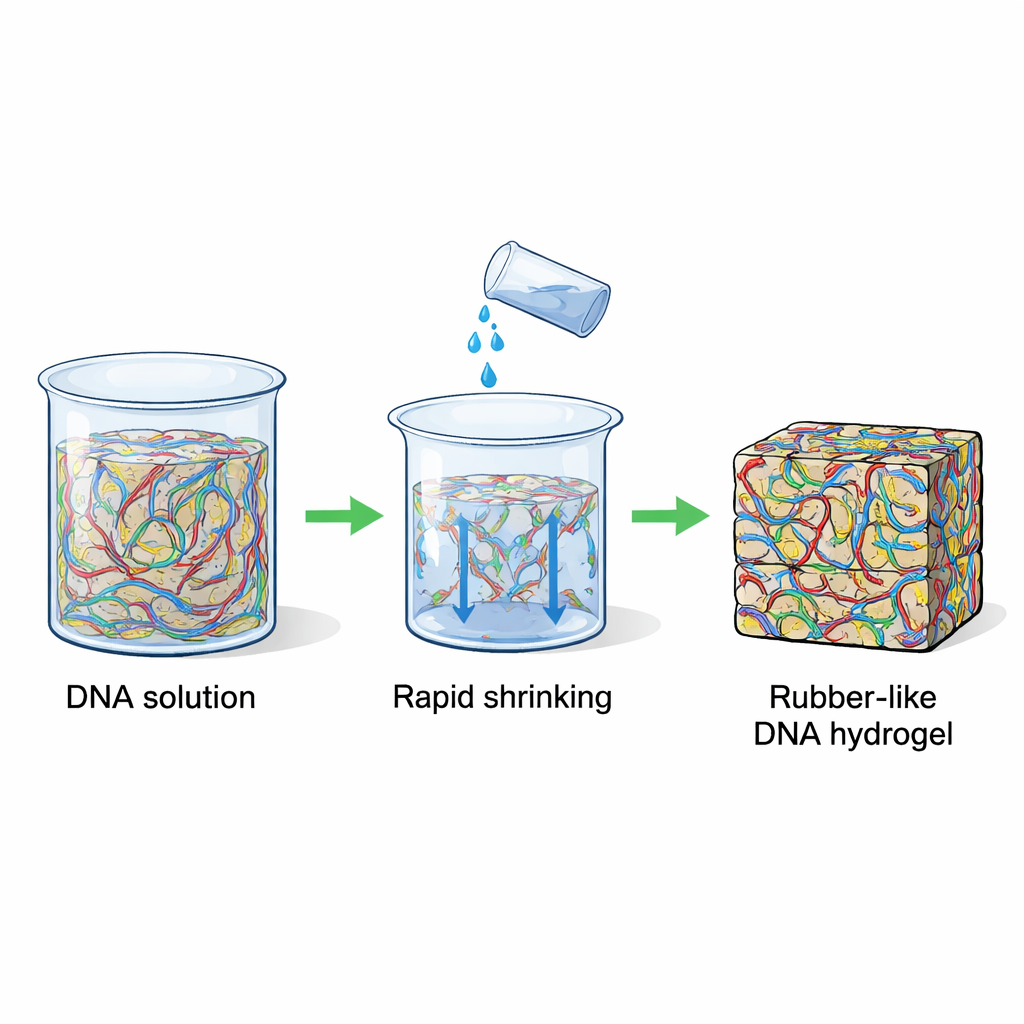
Rubber-Like Performance from a Water-Based Gel
The team carefully measured how this new DNA hydrogel behaves when pulled, compressed, and cycled repeatedly. Compared with a standard DNA gel made by conventional chemical bonding, the fast-shrunk version was dramatically tougher: it could stretch to more than ten times its original length before breaking, withstand high pressures without collapsing, and snap back quickly with very little permanent deformation. Under the microscope, the material showed a dense, uniform structure without obvious pores, and it remained stable over a wide range of temperatures and acidity. Calculations and mechanical tests both pointed to one conclusion: the material’s impressive performance is dominated by the sheer number of entanglements—hundreds per DNA chain—rather than by traditional chemical links.
Tuning, Printing, and Powering the New Material
The researchers also explored how to tune and use this DNA-based rubber. They found that starting with more concentrated DNA solutions and longer DNA strands made the gel even stiffer and stronger, up to levels comparable to some of the toughest synthetic hydrogels. To keep the material stable in water for long periods, they added magnesium ions and a mild crosslinker after the fast-shrinking step, which helped prevent excessive swelling while preserving elasticity. Because the original DNA solution flows under pressure like thick ink, the team used it for high-resolution 3D printing: they printed tiny lattice structures, then triggered fast shrinking to sharpen the features down to tens of micrometers, among the finest resolutions reported for hydrogel printing. By mixing in magnetic nanoparticles before shrinking, they even created a soft, DNA-based "robotic" fork that can lift small objects in response to a magnet. 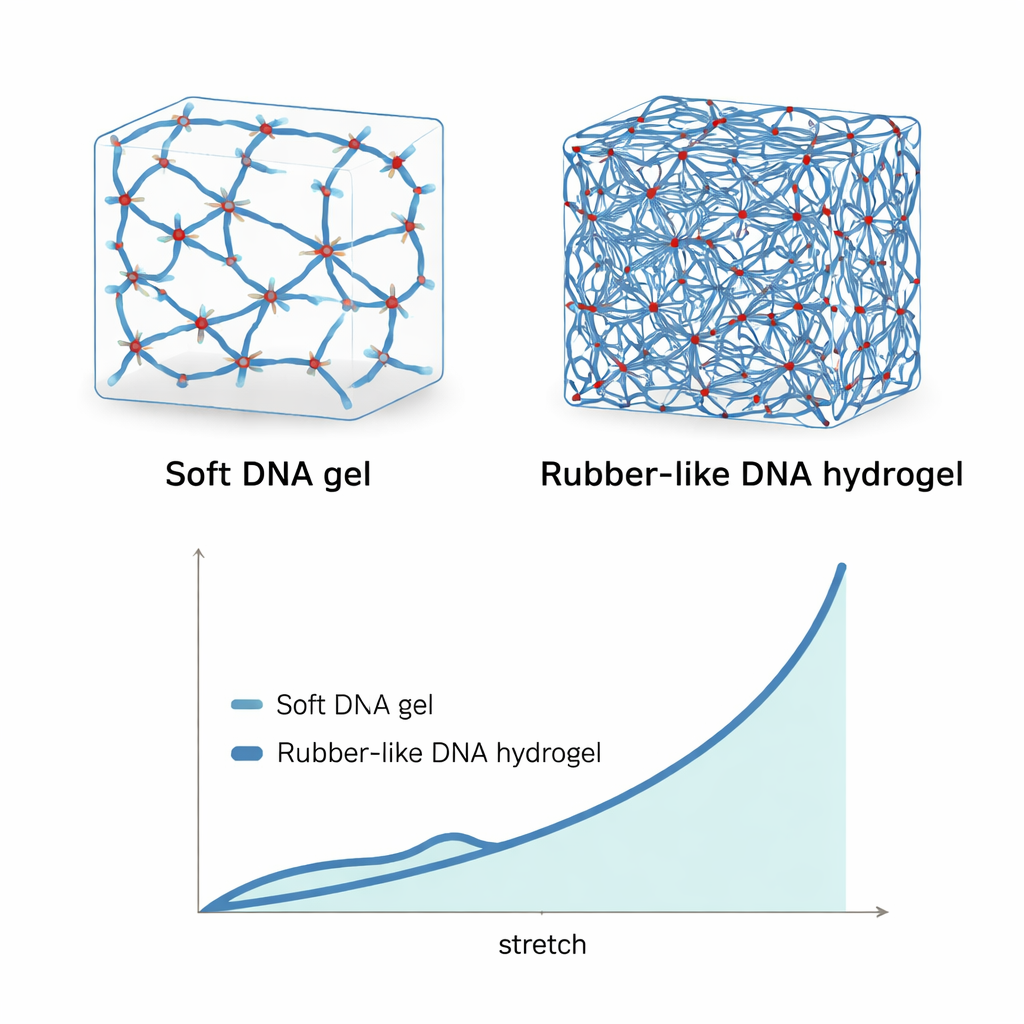
Beyond DNA: A Broader Toolkit for Green Materials
In everyday terms, this study shows that if you take very long natural molecules, pack them together quickly so they cannot untangle, and then lock that state in place, you can turn a watery solution into a resilient, rubber-like solid. The authors demonstrate this not only with DNA from different animal sources but also with other long-chain natural polymers, such as alginate and hyaluronate, achieving large jumps in strength and toughness using the same fast-shrinking recipe. This suggests a general route to greener materials: by harnessing the natural length of biomolecules and clever processing, rather than heavy chemical modification, we may be able to build the next generation of soft robots, medical implants, and flexible devices from substances that nature already produces in abundance—and that nature can safely take back.
Citation: Lin, Z., Fang, S., Huang, Q. et al. Rubber-like DNA hydrogel enabled by fast-shrinking-induced entanglement. Nat Commun 17, 1643 (2026). https://doi.org/10.1038/s41467-026-68363-x
Keywords: DNA hydrogels, sustainable materials, polymer entanglement, 3D printing, soft robotics