Clear Sky Science · en
Template-in-template assembly nanostructured microspheres for high performance chromatography
Why tiny porous beads matter
Modern chemistry, environmental testing, and drug development all depend on a workhorse technique called liquid chromatography, which separates complex mixtures into individual components. At the heart of every chromatographic column are microscopic beads that act like a maze for molecules. This paper shows how to build those beads with unprecedented architectural precision—controlling both their outside shape and their internal network of pores—to make separations faster, sharper, and capable of resolving some of the hardest molecular look‑alikes.
Building perfect beads, one droplet at a time
The researchers introduce a manufacturing concept they call template‑in‑template assembly nanostructuring, or TiTAN. The idea is to use one template—the shape of a tiny liquid droplet—to fix the overall size and roundness of each bead, and a second template—self‑organizing surfactant molecules—to sculpt the microscopic pore network inside. They generate highly uniform droplets using a microfluidic device that pinches a silica‑containing solution into identical spheres within a fluorinated oil. As solvent gently evaporates, the building blocks inside each droplet organize into a regular pattern and solidify, locking in a spherical particle whose pores are arranged with crystal‑like order. 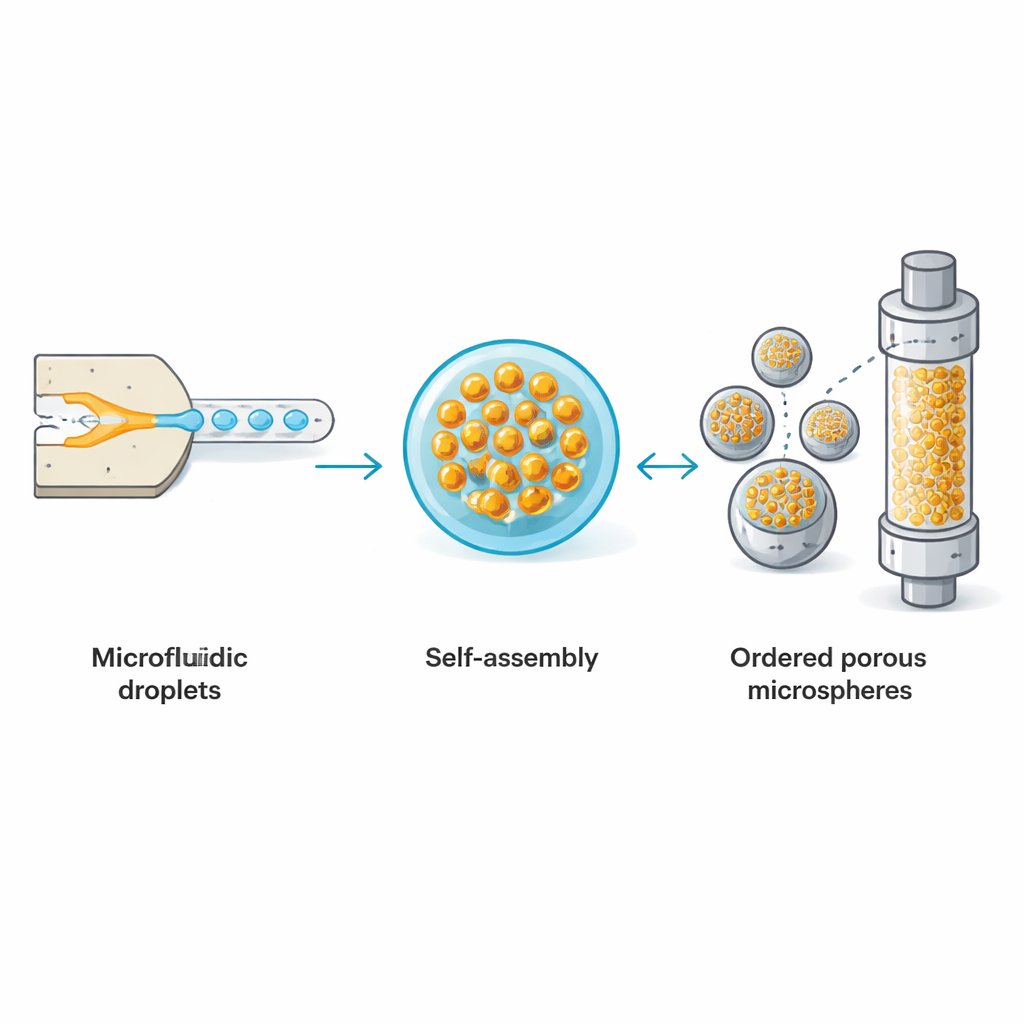
Designing the inner maze with atomic‑scale precision
Inside these microspheres, the team can dial in a variety of pore architectures that resemble different three‑dimensional tilings: hexagonal channels, cage‑like cubic frameworks, and even complex double‑gyroid networks. By choosing different surfactants and post‑treatment conditions, they switch between these patterns without disturbing the overall bead shape. Beyond the pattern itself, they also fine‑tune practical properties such as pore size, wall thickness, and surface area. By adjusting heat and treatment time, or the amount of surfactant added, they can expand or shrink pores in steps as small as about two tenths of a nanometer—roughly the width of a single atom—while keeping the particle size distribution extremely narrow.
Separating structure outside from structure inside
A key strength of the TiTAN approach is that it decouples the control of external shape from the internal pore network. The droplet template fixes how big and how spherical the beads are, minimizing size variations that normally disturb fluid flow through a column. Independently, the surfactant templates and processing conditions control how molecules will move inside each bead. The authors show that even when they change particle size from about 3 to 5 micrometers, the internal pore characteristics remain constant; conversely, when they tune pore size and connectivity, the beads stay round and evenly sized. This independent control is rare in porous materials and is exactly what chromatographers need to optimize flow and molecular interactions at the same time.
Turning better beads into better separations
To test real‑world impact, the team coats the new silica beads (with straight hexagonal channels) in a standard C18 layer and packs them into capillary columns. Compared with conventional porous particles of the same size, the TiTAN beads provide more surface area, more evenly distributed flow paths, and straighter diffusion routes inside the pores. In practice, that means analytes are retained more strongly when desired and their bands spread out less as they travel. The authors quantify this with standard test compounds: the new columns show roughly 50% higher efficiency, substantially higher retention for hydrophobic molecules, and the ability to reach a given resolution in only about one quarter of the time required by traditional media. 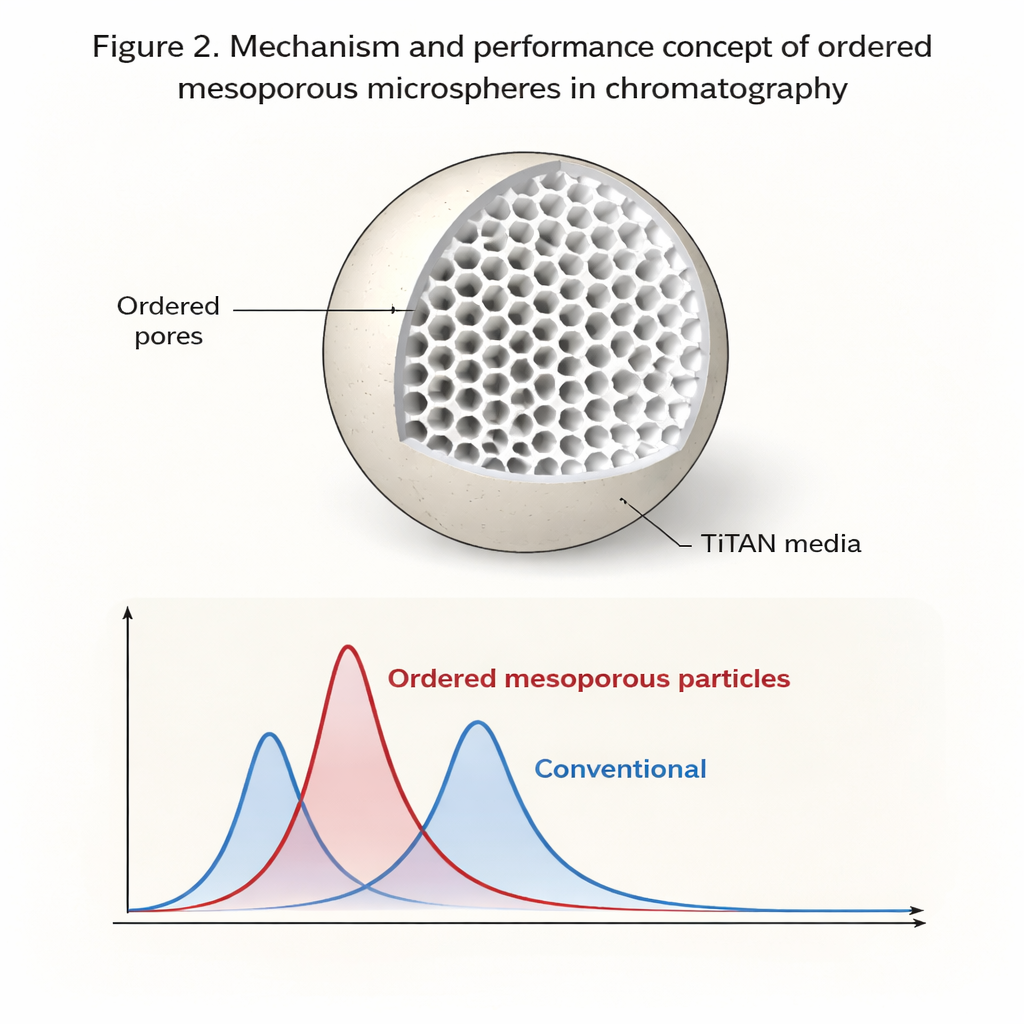
Tackling the hardest molecular look‑alikes
The most striking demonstrations involve so‑called critical pairs: molecules that are almost indistinguishable in size, shape, or chemical behavior, and thus notoriously hard to separate. Using their ordered mesoporous beads, the researchers fully resolve closely related polycyclic aromatic hydrocarbons, xylene isomers that differ only in the placement of two methyl groups on a benzene ring, and even isotopologues—molecules that are identical except for a few hydrogen atoms replaced by their heavier cousin deuterium. Where standard columns show overlapping or barely separated peaks, the TiTAN‑based columns produce cleanly split signals within practical analysis times.
What this means for real‑world chemistry
In everyday terms, this work is about making the “filters” inside analytical instruments much smarter by engineering them from the nanometer scale up. By precisely shaping both the outside of each bead and the microscopic maze within, the TiTAN strategy delivers packing materials that give sharper, faster, and more powerful separations without exotic chemistries or extreme operating conditions. That could translate into more reliable environmental monitoring, better characterization of pharmaceuticals, and improved tools for studying complex biological molecules. The method is also versatile enough to work with other materials beyond silica, hinting at a general route to custom‑designed porous media for many advanced applications.
Citation: Zeng, J., Cao, H., Sun, K. et al. Template-in-template assembly nanostructured microspheres for high performance chromatography. Nat Commun 17, 430 (2026). https://doi.org/10.1038/s41467-026-68362-y
Keywords: chromatography, mesoporous microspheres, microfluidics, nanostructured materials, molecular separation