Clear Sky Science · en
Historical deforestation drives strong rainfall decline across the southern Amazon basin
Why the Fate of the Amazon Matters for Rain
The Amazon rainforest is often called the “lungs of the planet,” but this study shows it also acts like a giant water pump. By turning vast areas of forest into farmland and pasture, people have already changed where and how much it rains across the basin. Understanding this shift matters not just for wildlife, but for regional farming, river flows, and the stability of the global climate system that we all depend on.
A Growing Gap Between North and South
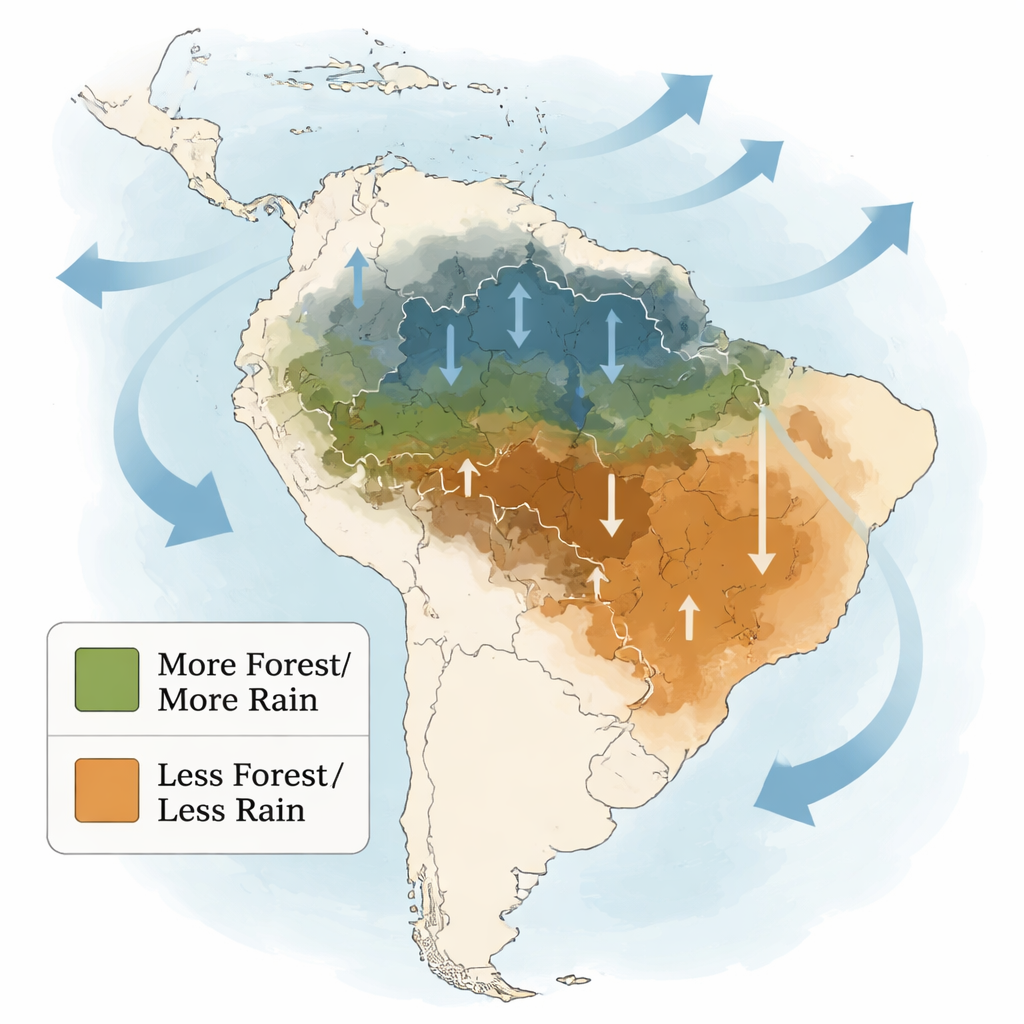
Using four decades of satellite data (1980–2019), the authors mapped how rainfall has changed across the Amazon. They found a striking north–south split: the northern Amazon has seen a modest increase in rainfall, while most of the southern Amazon has dried. In many southern areas, yearly rainfall has dropped so consistently that it now totals an 8–11% decline over the study period. This is not a small fluctuation; it is a systematic weakening of the water supply in a region where forests, rivers, and people rely on regular rain.
Following the Journey of Water in the Air
To understand why the south is drying, the team did more than just look at rain gauges. They used an atmospheric “tracking” model that follows water vapor through the air, from where it evaporates to where it falls as rain. This allowed them to separate rain fed by moisture that originally rose from the ocean from rain fed by moisture that first passed through land and vegetation. They discovered that the decline in southern rainfall cannot be explained by changes in ocean moisture alone. Instead, most of the missing rain comes from a weakening of land-sourced moisture — water that once evaporated or was released by plants and later returned as rainfall.
How Cutting Trees Cuts Rain
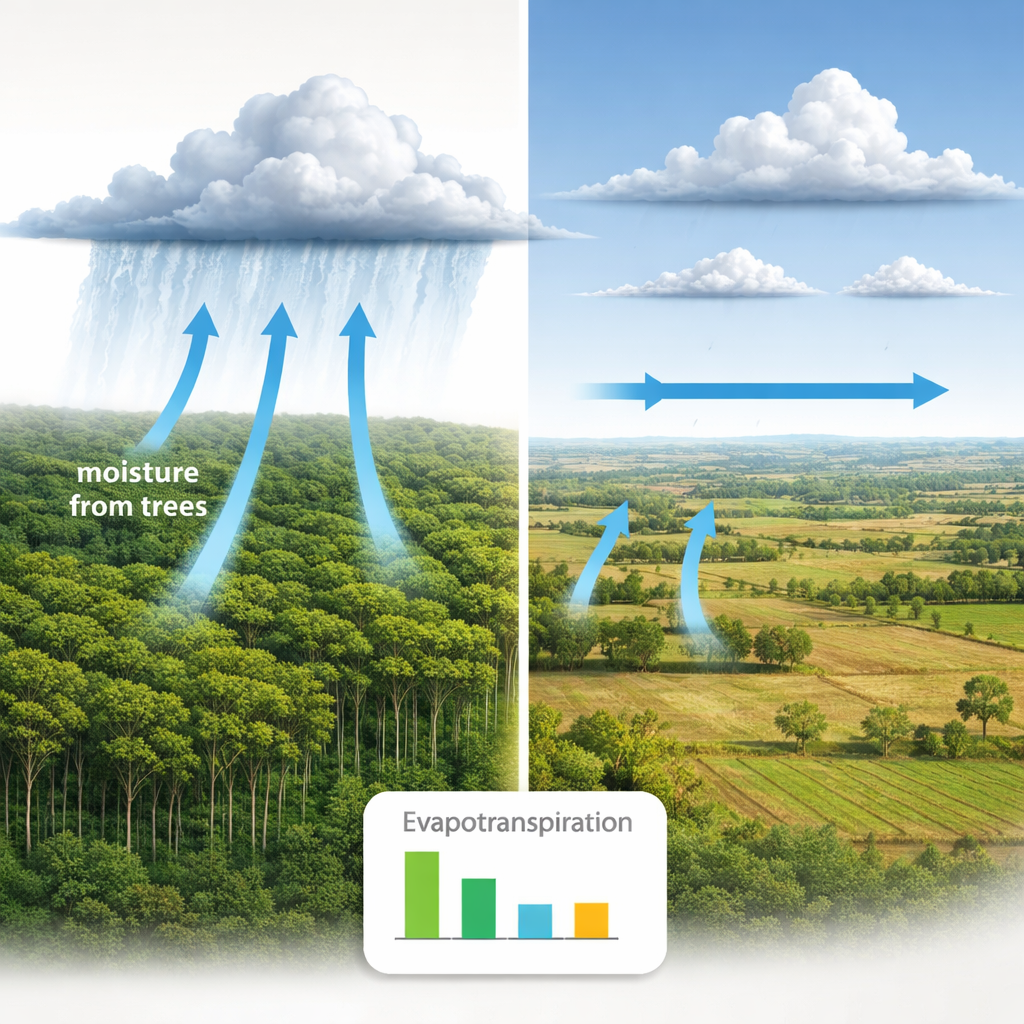
The authors then examined how changes in forest cover, plant water loss, and sunlight relate to these rainfall shifts. Satellite records show extensive forest loss in the southern and eastern Amazon, with more than four-fifths of the southern basin losing tree cover since the early 1980s. Where forests were cleared, they also observed strong declines in evapotranspiration — the combined evaporation from soil and water plus the invisible vapor released by leaves. Because tree-rich areas send large amounts of moisture back into the air, this drop in evapotranspiration meant less recycled water was available to fall again as rain over the region.
Hidden Effects from Far Upwind
Rain over any one patch of forest does not depend only on the trees beneath it. Moist air may have passed over thousands of kilometers of land before it condenses into raindrops. To capture this, the researchers built a new measure called “weighted forest cover,” which blends local forest cover with the amount of forest in all the upwind regions that feed moisture to that location. They found that when this weighted forest cover fell by one percentage point, recycled rainfall dropped by about 11.6 millimeters per year. Overall, they estimate that 52–72% of the observed rainfall decline in the southern Amazon is directly linked to deforestation across South America, not just to global climate change.
Atmosphere Becoming Less Friendly to Rain
The study also looked at how the character of the atmosphere changed as forests were lost. Over the southern Amazon, the energy available for storms declined, moisture traveled farther before raining out, and a smaller share of water released from the surface fell back nearby. These shifts are consistent with a more stable, drier atmosphere that favors moisture escaping the region instead of feeding local showers. Together, the loss of trees, the drop in plant-driven moisture, and the increased export of water vapor act like a three-part squeeze on regional rainfall.
What This Means for the Future
By combining their observational results with future land-use scenarios, the authors show that continued deforestation could cut southern Amazon rainfall by 10–15% by the end of this century, an impact comparable to or greater than direct climate change alone. Worryingly, they also find that current climate models underestimate how strongly rainfall responds to forest loss, suggesting that widely discussed “tipping points” for Amazon forest dieback may be closer than expected. The flip side is hopeful: slowing deforestation and promoting large-scale forest regrowth could stabilize or even restore rainfall, buying valuable time to protect the Amazon and the climate systems it helps to regulate.
Citation: Cui, J., Piao, S., Huntingford, C. et al. Historical deforestation drives strong rainfall decline across the southern Amazon basin. Nat Commun 17, 1642 (2026). https://doi.org/10.1038/s41467-026-68361-z
Keywords: Amazon rainforest, deforestation, rainfall change, moisture recycling, climate tipping point