Clear Sky Science · en
Weight-independent effects of dietary carbohydrate-to-fat ratio on metabolomic profiles: secondary outcomes of a 5-month randomized controlled feeding trial
Why the balance of carbs and fats matters
People often wonder whether low-carbohydrate or higher-carbohydrate diets are better for long-term health, especially after weight loss. This study asked a different question: if people keep off the same amount of weight, does the ratio of carbohydrates to fat in their diet still change what is happening inside their bodies? By measuring hundreds of small molecules in the blood, the researchers looked under the hood of human metabolism to see how different eating patterns may quietly shape future risks like type 2 diabetes and heart disease.
Three ways of eating, same weight, different chemistry
In a tightly controlled 5‑month feeding trial, 164 adults with overweight or obesity first lost about 10% of their body weight while eating provided meals. They were then randomly assigned to one of three maintenance diets that differed mainly in their carbohydrate‑to‑fat ratio: a low‑carbohydrate, high‑fat diet; a moderate diet; and a high‑carbohydrate, low‑fat diet, all with the same protein content. During the 20‑week test phase, the study team supplied virtually all food and adjusted portions so participants stayed within about two kilograms of their post‑weight‑loss weight. This design allowed the scientists to focus on how diet composition itself, not weight change, affected metabolism. 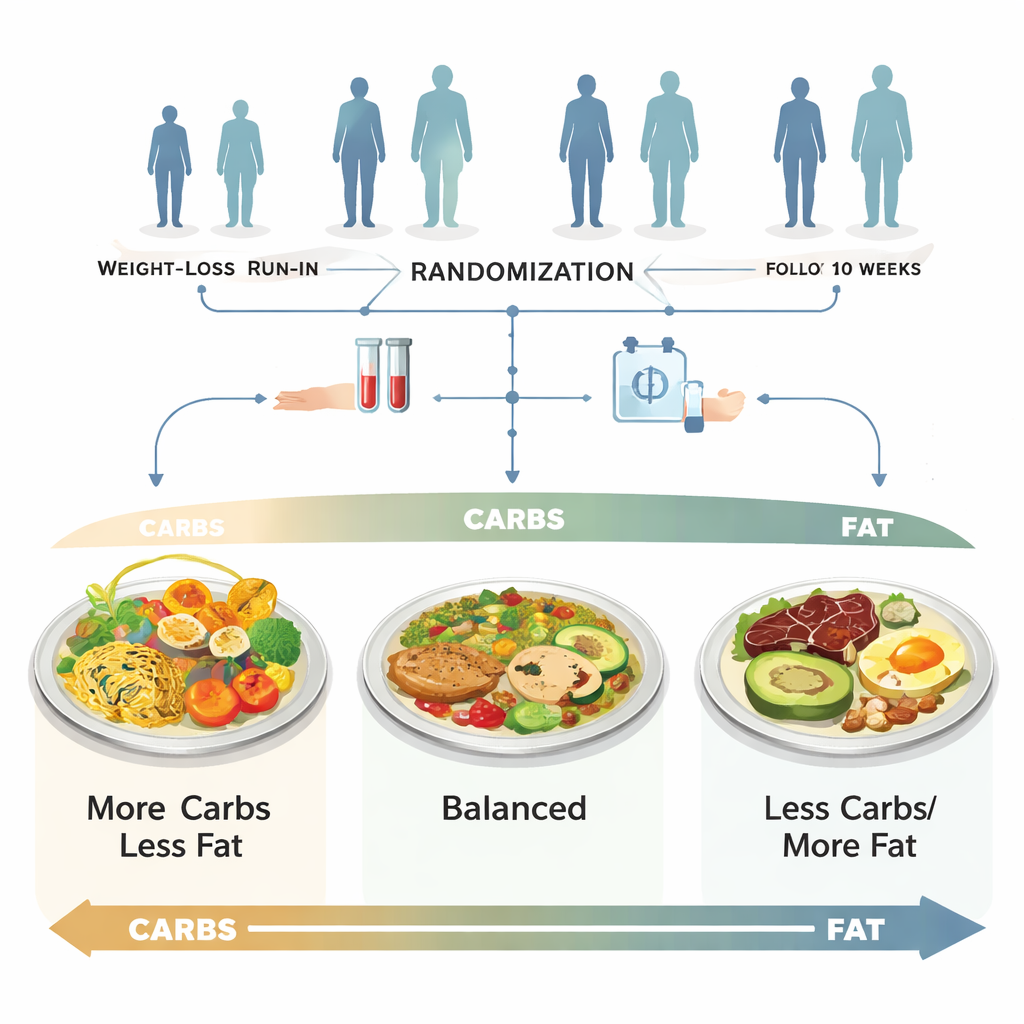
Tracking hundreds of blood molecules
Blood samples taken after an overnight fast at the start, middle (10 weeks), and end (20 weeks) of the test phase were analyzed with advanced mass spectrometry, capturing 479 known metabolites, most of them fats and fat‑like molecules. As the diet shifted from low to high carbohydrate (and from high to low fat), 148 metabolites changed in a consistent, statistically robust pattern. Many fats that form part of cell membranes and may have protective roles, such as certain phosphatidylcholines, plasmalogens, phosphatidylethanolamines, and sphingomyelins, tended to decrease on higher‑carbohydrate diets. In contrast, breakdown products of these lipids and blood fats that circulate as energy carriers, including several lysophospholipids and many triglycerides, generally increased as carbohydrate intake rose.
Specific fat molecules tied to diabetes risk
The researchers took a closer look at triglycerides and related fats, because these showed some of the biggest shifts. They found that higher‑carbohydrate diets raised particular triglyceride species whose fatty acid chains had certain lengths—mostly between 48 and 52 carbon atoms—and relatively few double bonds. Earlier large population studies have linked these specific triglycerides to a higher risk of developing type 2 diabetes. When the team compared their results with an independent meta‑analysis of metabolite patterns in people who later developed diabetes, they saw that many of the same triglycerides and diglycerides that rose with higher carbohydrate intake were also associated with greater diabetes risk. Some other metabolite groups moved in potentially favorable directions, underscoring that diet‑induced changes are complex and not uniformly good or bad.
Stable signatures and markers of adherence
Most metabolite changes appeared early, by 10 weeks, and stayed remarkably stable through 20 weeks, suggesting the body settles into a new metabolic state under each eating pattern. A subset of molecules, especially some acylcarnitines and fatty acids involved in energy use, shifted strongly at first but then adapted, hinting at short‑term adjustments to the new diet. Using multivariate models, the scientists showed that combinations of these metabolites could accurately identify which diet a person was on, particularly when comparing the lowest‑ and highest‑carbohydrate plans. Participants who gained more than two kilograms during the test phase—likely indicating poorer adherence—had less distinct metabolite patterns, suggesting that this blood “fingerprint” could eventually help monitor how closely people follow prescribed diets. 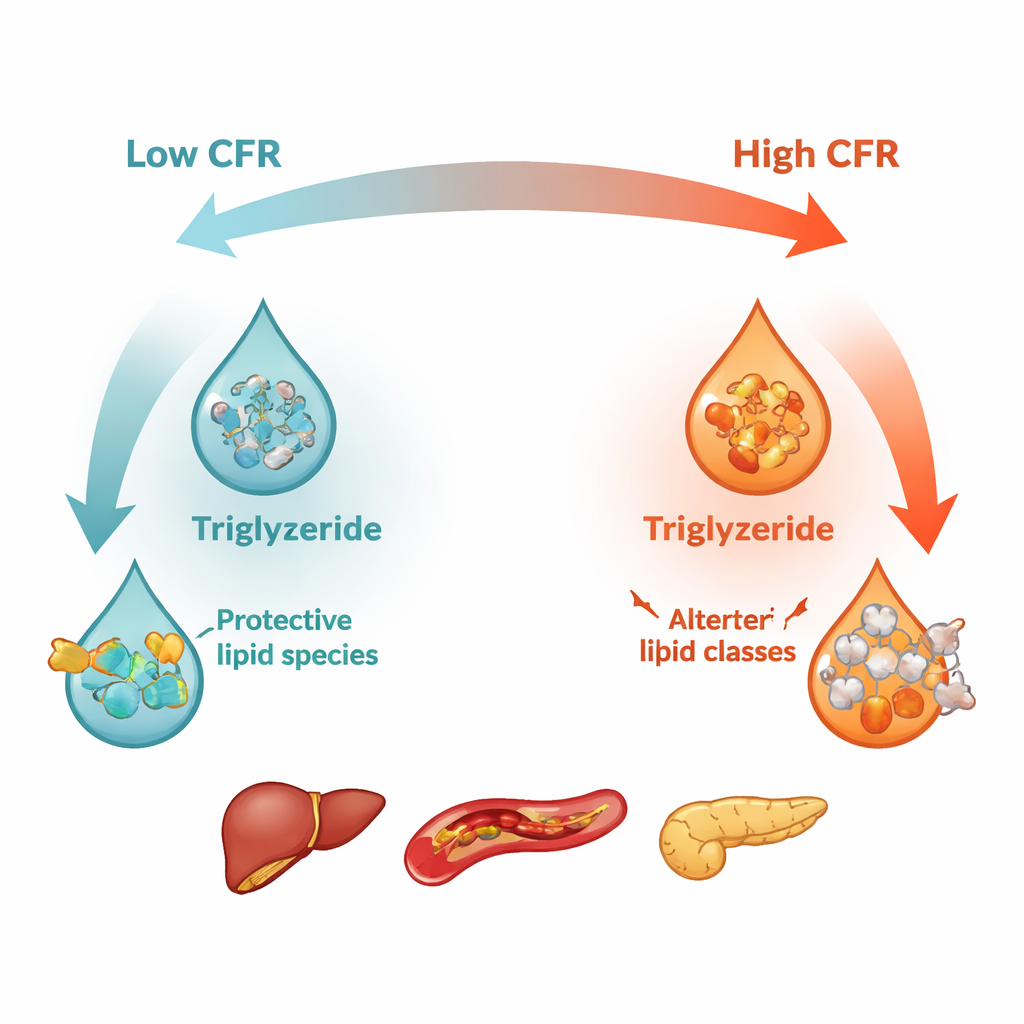
Connecting molecules to heart and metabolic health
To probe health relevance, the authors tested whether diet‑responsive metabolites helped explain changes in conventional blood markers. Several lipid molecules partly mediated the relationships between diet and LDL (“bad”) cholesterol, total cholesterol, and an index of insulin resistance based on lipoprotein profiles. This implies that shifting the balance of carbohydrates and fats in the diet can rewire lipid metabolism in ways that may nudge cardiometabolic risk up or down, even when body weight is held constant. However, different metabolite groups pointed in different directions for future disease risk, meaning that no single macronutrient pattern was purely beneficial or harmful at the molecular level.
What this means for everyday eating
For non‑scientists, the key message is that how we divide calories between carbohydrates and fats reshapes the chemistry of our blood in specific, measurable ways that go beyond the number on the scale. Low‑carbohydrate diets in this study tended to lower certain triglycerides linked to type 2 diabetes and preserve potentially protective membrane lipids, while higher‑carbohydrate diets had the opposite pattern, all during similar weight‑loss maintenance. These findings do not prove that one diet guarantees better long‑term health, but they do highlight that diet quality and macronutrient balance influence metabolic pathways that are closely tied to diabetes and heart disease. As research progresses, such metabolite fingerprints may help clinicians tailor dietary advice to individual biology, turning “eat fewer carbs or fats” into more precise, personalized nutrition strategies.
Citation: Angelidi, A.M., Bartell, E., Huang, Y. et al. Weight-independent effects of dietary carbohydrate-to-fat ratio on metabolomic profiles: secondary outcomes of a 5-month randomized controlled feeding trial. Nat Commun 17, 1662 (2026). https://doi.org/10.1038/s41467-026-68353-z
Keywords: low-carbohydrate diet, metabolomics, triglycerides, type 2 diabetes risk, weight-loss maintenance