Clear Sky Science · en
Activity in human dorsal raphe nucleus signals changes in behavioural policy
Why this matters for everyday choices
Every day we decide whether a payoff is worth our time: Should you grab a so-so job offer now or wait for something better? This study shows that the human brain does something similar to an animal foraging for food. It reveals how a tiny region in the brainstem, the dorsal raphe nucleus (a major source of serotonin), helps us change our decision strategy when the world around us becomes richer or poorer in rewards.
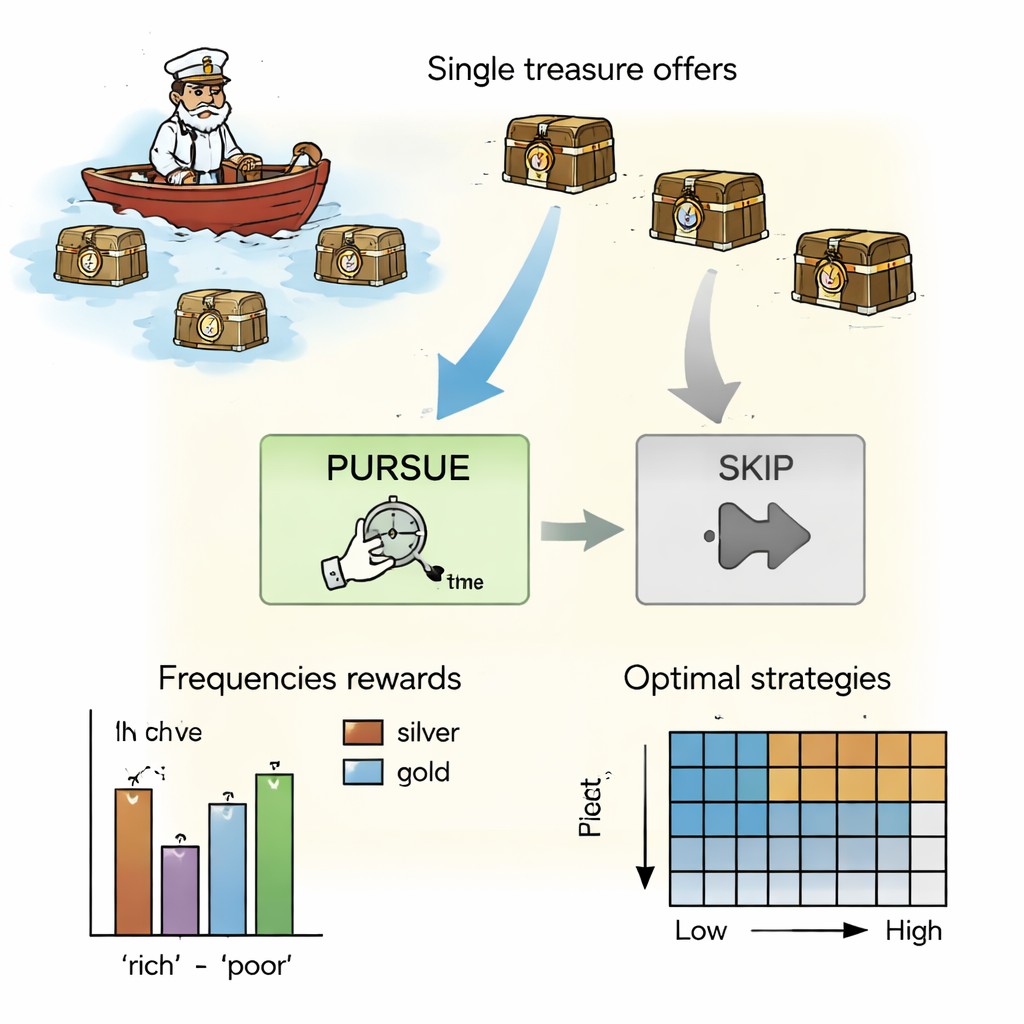
A simple treasure-hunting game
Volunteers lay in an MRI scanner while playing a treasure-hunting game. On each round they saw a single “offer” worth a low, medium, or high number of points, shown as bronze, silver, or gold medallions. They could either press a button to pursue that treasure or let it pass and wait for the next one. The catch was that chasing treasure took time, costing them the chance to see another offer. Over many minutes, this created a realistic trade-off between grabbing what is in front of you and holding out for something better.
Worlds of plenty and worlds of scarcity
Behind the scenes, the game alternated between “rich” and “poor” environments. In rich periods, high-value gold offers were common; in poor periods, low-value bronze offers dominated. The medium silver offer appeared equally often in both kinds of environment. Rationally, that medium offer should be accepted more often when the world is poor (because better options are rare) and rejected more often when the world is rich (because better options are likely to appear soon). Participants were never told about these hidden environments, so they had to infer the overall richness from experience.
How people’s strategies adapted
Behavioral analyses showed that participants did adjust their strategy. Over time, they became more willing to accept the medium offer in poor environments and relatively choosier in rich environments. The researchers treated each person’s tendency to accept or reject a given option as a “policy” for that option and then tracked when those policies changed. Policy switches—such as changing from usually rejecting the medium offer to usually accepting it—were most common for the medium option and were strongly tied to how rich or poor the environment had recently been.
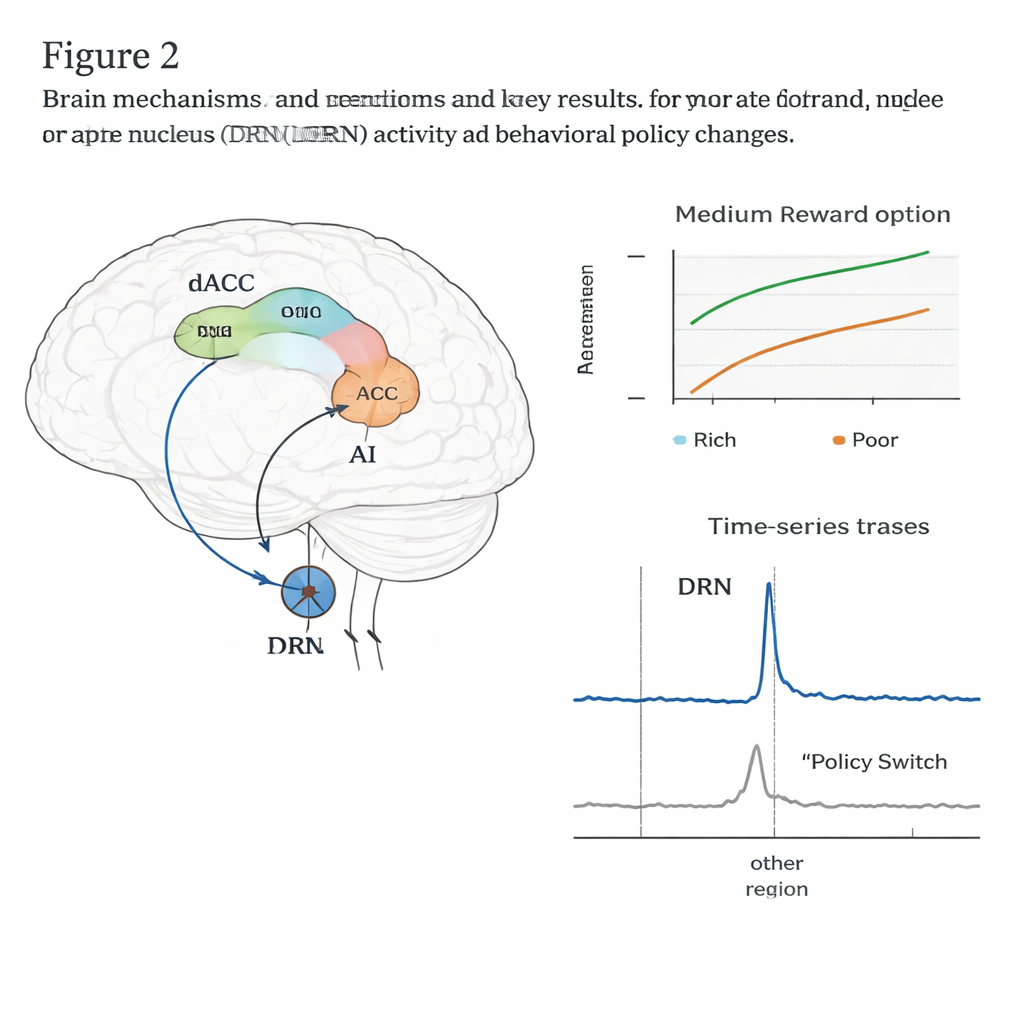
Serotonin hub that implements strategy shifts
Using ultra–high field functional MRI, the team examined activity in several deep neuromodulatory centers that send widespread chemical signals across the brain. Only the dorsal raphe nucleus showed a clear signature of policy switches that made sense given the environment: its activity spiked when people started pursuing the medium reward in poor environments, and shifted in the opposite direction when they began rejecting it in rich environments. Other nearby centers, such as dopaminergic regions, carried different information—about action initiation, prediction errors, or more exploratory changes—rather than these focused, environment-appropriate strategy shifts.
Cortical regions that evaluate context
At the same time, two areas on the brain’s surface—the dorsal anterior cingulate cortex and the anterior insula—represented the options in a context-dependent way. Patterns of activity for the medium option moved closer to those for the high option when the environment was poor, and farther away when the environment was rich, but only in people whose behavior actually adapted well to the task. This suggests these cortical areas build an internal “map” of how valuable each option is in the current world, while the dorsal raphe nucleus uses that information to flip the brain’s policy for whether to seize or skip an opportunity.
Big picture: tuning behavior to the world
To a layperson, the core message is that the brain does not judge rewards in isolation. It constantly compares each opportunity to the broader backdrop of how good or bad things have been lately, and then adjusts our willingness to act. This study proposes that a circuit linking frontal cortical regions with the serotonin-rich dorsal raphe nucleus helps retune our policies when circumstances change—making us more accepting in lean times and more selective when rewards abound. Understanding this circuit may eventually shed light on conditions, such as depression or apathy, where this kind of adaptive strategy change seems to break down.
Citation: Priestley, L., Mahmoodi, A., Reith, W.D. et al. Activity in human dorsal raphe nucleus signals changes in behavioural policy. Nat Commun 17, 1665 (2026). https://doi.org/10.1038/s41467-026-68349-9
Keywords: foraging decisions, serotonin, dorsal raphe nucleus, adaptive behavior, reward environment