Clear Sky Science · en
Sequence-encoded layered heteroleptic metalla-[2]catenanes for programmable supramolecular function
Turning Molecular Sequences into Smart Materials
DNA shows how the order of molecular building blocks can store information and control life. Chemists are now asking whether man‑made molecules could use similar “codes” to create materials that think and respond. This article explores a new class of tiny interlocked metal–organic structures that use their internal sequence—the order of stacked molecular plates—to tune how efficiently they turn light into heat.
From Genetic Code to Molecular Code
Beyond biology, information can be written directly into the shape and arrangement of molecules. When small components snap together on their own, their spatial layout can dictate how they interact, how energy flows through them, and how they respond to the environment. Most previous work has focused on cage‑like structures where functional groups point inward to bind guests or catalyze reactions. The authors instead pursue “layered” architectures, in which flat, electronics‑rich units are stacked like cards, creating pathways for electrons and heat to move through the material.
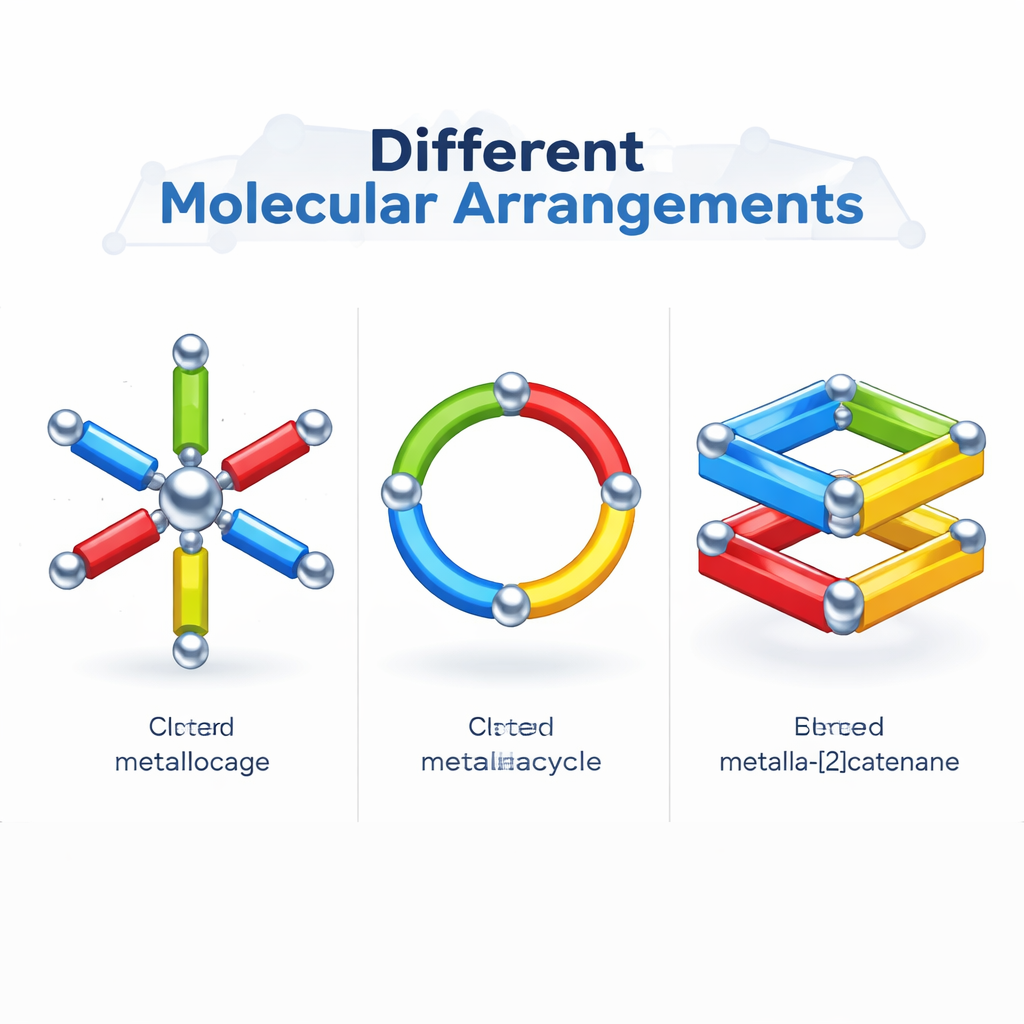
Interlocked Molecular Chains with Programmable Layers
The team builds on a family of metal–organic assemblies that weave two rectangular loops through one another, forming a tiny mechanical link called a metalla-[2]catenane. Each loop is made from flat organic ligands that can carry different electronic characters—some donate electrons, others withdraw them—and silver ions act as the connecting hubs. By choosing two or three ligands of similar size but different electronic nature, the chemists coax the system to assemble into specific layered sequences, such as donor–acceptor–acceptor–donor. These stacks resemble four-story molecular sandwiches, where the exact order of ingredients is under tight control.
Building Complexity by Molecular Fusion
Creating well‑ordered mixtures is difficult because many random combinations are possible. The researchers overcome this by two complementary routes. In one, they directly combine ligand precursors with silver oxide so that the pieces self‑assemble into the desired interlocked structures. In the other, they first make simpler “homoleptic” assemblies containing only one type of ligand, then allow these to swap components in solution through a process the authors call supramolecular fusion. In both cases, only a few carefully defined sequences emerge, even though many are statistically possible. X‑ray crystallography reveals the detailed three‑dimensional arrangements, and quantum‑chemical calculations show that the observed sequences are the most energetically stable among all competitors.
Reading Out the Molecular Code with Light and Heat
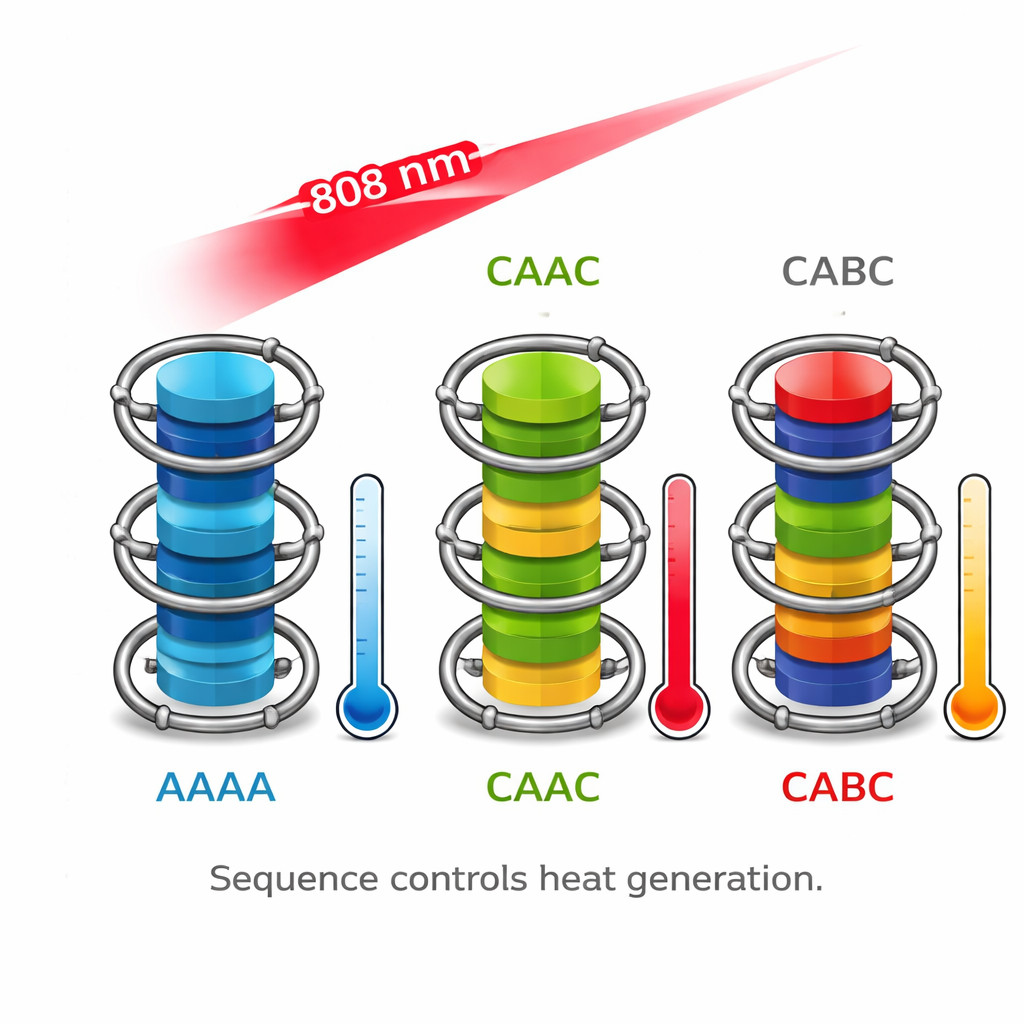
To see whether sequence really matters for function, the team shines near‑infrared laser light on solutions of their different metalla-[2]catenanes and measures how much the temperature rises. All of the structures absorb light in this region because of interactions between stacked aromatic plates, but they do not behave equally. The heteroleptic (mixed‑ligand) systems heat up more than those built from a single ligand type, and one particular sequence—where electron‑poor units sit directly above and below electron‑rich ones—shows the strongest heating and highest photothermal conversion efficiency. Electron‑spin measurements support the idea that charge moves between layers under illumination, turning organized stacks into tiny, sequence‑dependent heat generators.
Why These Findings Matter
This work demonstrates that the precise order of molecular layers inside a nanoscale object can be programmed and that this hidden pattern strongly influences how the object handles light and heat. In simple terms, rearranging the same four “tiles” in an interlocked molecular link changes how efficiently it warms up under a laser. Such control over sequence and response could guide the design of future materials for solar energy harvesting, smart coatings, or nanoscale heaters for medical and technological applications—extending the concept of a code from DNA into the broader realm of functional molecules.
Citation: Zhang, YW., Zhang, HN., Wang, MX. et al. Sequence-encoded layered heteroleptic metalla-[2]catenanes for programmable supramolecular function. Nat Commun 17, 1632 (2026). https://doi.org/10.1038/s41467-026-68348-w
Keywords: supramolecular assembly, molecular coding, metalla catenane, photothermal conversion, self-assembly