Clear Sky Science · en
Oxytocin facilitates social behavior of female rats via selective modulation of interneurons in the medial prefrontal cortex
Why a "social hormone" in rats matters to us
Why do we sometimes seek company even when we are tired, stressed, or hungry? This study looks at that question in an unexpected place: the brains of female rats. The researchers focus on oxytocin, often nicknamed the “bonding hormone,” and show how a very specific set of brain cells can push animals toward social contact, even when survival needs like food are competing for attention. Understanding this finely tuned system in rats may eventually help explain—and perhaps treat—social difficulties in humans.
Tracing a social signal into the thinking brain
Oxytocin is made deep in the brain, in a region called the hypothalamus, best known for its roles in childbirth and breastfeeding. But oxytocin also acts inside the brain itself, where it can shape emotion and social behavior. The team showed that oxytocin-producing neurons send long fibers directly into a front-of-the-brain region called the medial prefrontal cortex, specifically a subdivision called the infralimbic cortex. Among several nearby areas, this infralimbic zone received by far the densest oxytocin wiring, marking it as a key entry point for social signals into higher brain functions like decision-making and motivation. 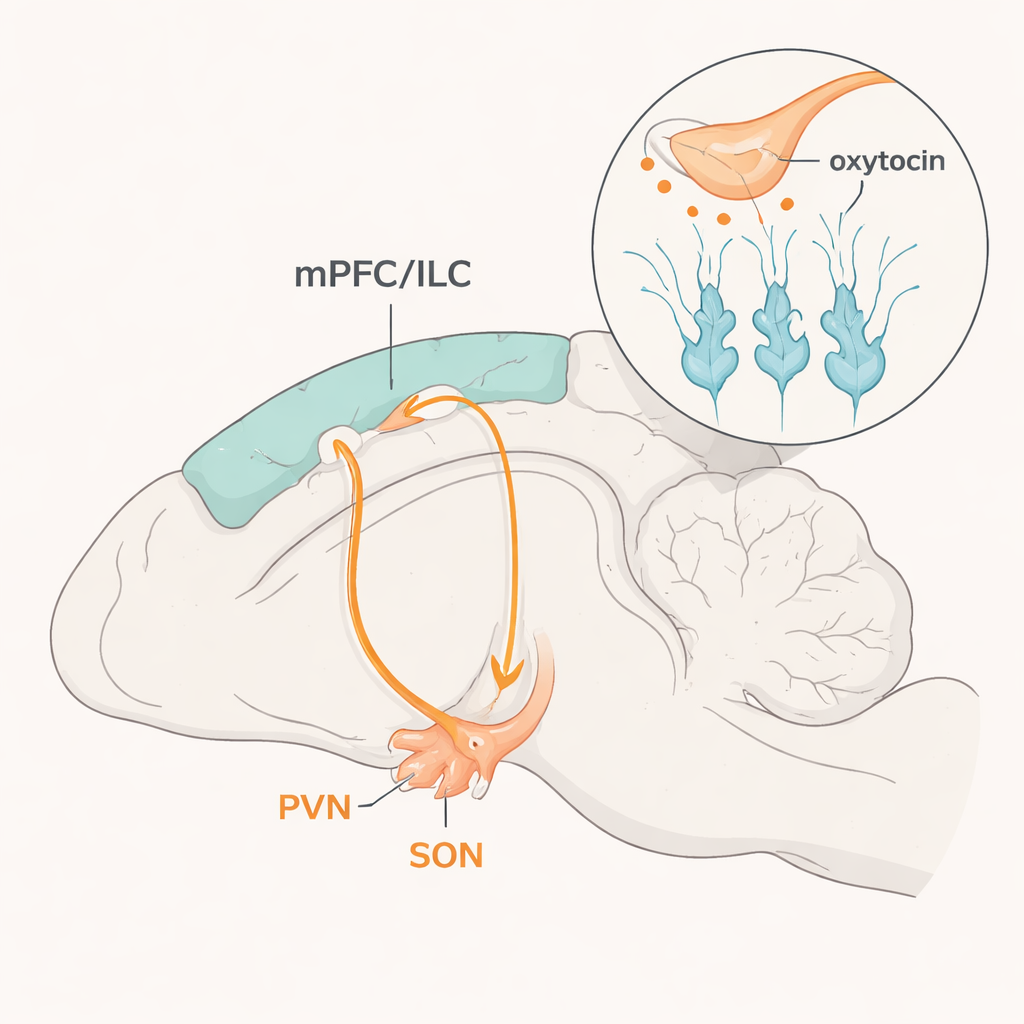
Turning up oxytocin boosts friendly contact
Next, the scientists asked whether releasing oxytocin in this frontal area actually changes behavior. Using light-sensitive proteins, they could trigger oxytocin fibers in the infralimbic cortex of awake female rats while the animals interacted with an unfamiliar rat. When the oxytocin pathway was switched on, the test rats spent roughly twice as much time investigating and following the newcomer, but they did not show extra interest in a toy rat or changes in general movement or anxiety. This suggests the effect is not simple restlessness or curiosity—it is specifically an increase in social engagement. They also used a fluorescent sensor that glows when oxytocin is present, confirming that the light stimulation truly released oxytocin in this region.
Small but powerful: a tiny group of gatekeeper cells
Digging deeper, the researchers identified which local brain cells respond to oxytocin. Surprisingly, only about one in a hundred infralimbic neurons carried oxytocin receptors, but most of these were a special class of inhibitory cells called interneurons, concentrated in upper cortical layers. These interneurons acted like social “gatekeepers”: their activity spiked when the rat actively sniffed or approached another rat, but not when the rat merely received attention or investigated an object. Artificially exciting these cells with light or designer drugs made rats more social; weakening oxytocin signaling in the same spot made them less social, again without altering interest in non-social objects. In a choice test between food and a social partner, activating these cells nudged hungry rats to spend more time in the social corner, showing that this circuit can tilt decisions toward contact even when food is tempting.
A targeted brake on fear-related output
How can cells that silence other neurons increase social behavior? The answer lies in which targets they inhibit. The team found that the oxytocin-sensitive interneurons mostly belong to a form called chandelier cells, famous for gripping the starting segment of neighboring output neurons and tightly controlling whether those neurons fire. Here, these chandelier cells preferentially inhibited pyramidal neurons that send signals from the infralimbic cortex to the basolateral amygdala, a region crucial for fear and threat processing. When the chandelier cells were activated, overall activity in this frontal area dropped in a pattern consistent with strong local inhibition, and activity in the basolateral amygdala decreased. By contrast, a reward-related region, the nucleus accumbens, became more active. When the researchers directly activated the infralimbic neurons that project to the amygdala, social interaction fell—mirroring what happened when they shut down the oxytocin-sensitive interneurons. 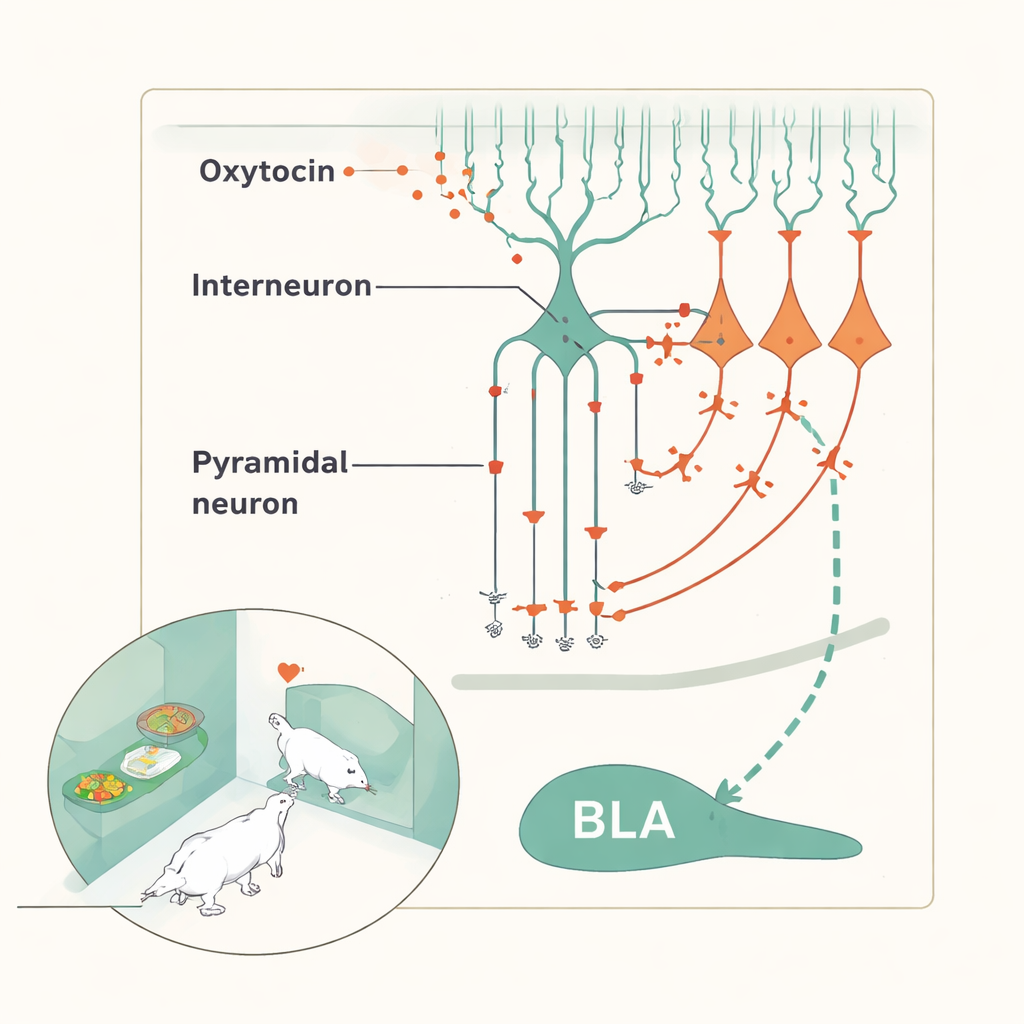
What this means for social behavior—and maybe for people
In simple terms, this study reveals a compact control circuit: oxytocin arriving from the hypothalamus activates a tiny set of inhibitory cells in the infralimbic cortex; these cells, in turn, put the brakes on a pathway leading to the fear-related amygdala, while sparing or even favoring links to reward centers. The result is a brain state that makes social contact feel safer and more appealing, even under challenging conditions like hunger. Because similar oxytocin pathways exist in primates and humans, these findings hint that carefully targeting oxytocin-sensitive cortical circuits could one day help rebalance social motivation in conditions marked by social withdrawal or avoidance, without broadly sedating or overstimulating the brain.
Citation: Schimmer, S., Kania, A., Lefevre, A. et al. Oxytocin facilitates social behavior of female rats via selective modulation of interneurons in the medial prefrontal cortex. Nat Commun 17, 1932 (2026). https://doi.org/10.1038/s41467-026-68347-x
Keywords: oxytocin, social behavior, prefrontal cortex, interneurons, amygdala