Clear Sky Science · en
Earthquakes act as a capacitor for terrestrial organic carbon
How Quakes Shape the Planet’s Carbon Piggy Bank
Earthquakes are usually thought of as sudden disasters that topple buildings and unleash landslides. This study shows they also quietly reshape Earth’s carbon budget. By ripping loose forests and soils on steep slopes, big quakes can lock away or release carbon that would otherwise help warm the planet. Understanding this hidden role of earthquakes helps us see how the solid Earth, climate, and life are more tightly linked than we might imagine.
Mountains, Landslides, and Hidden Carbon
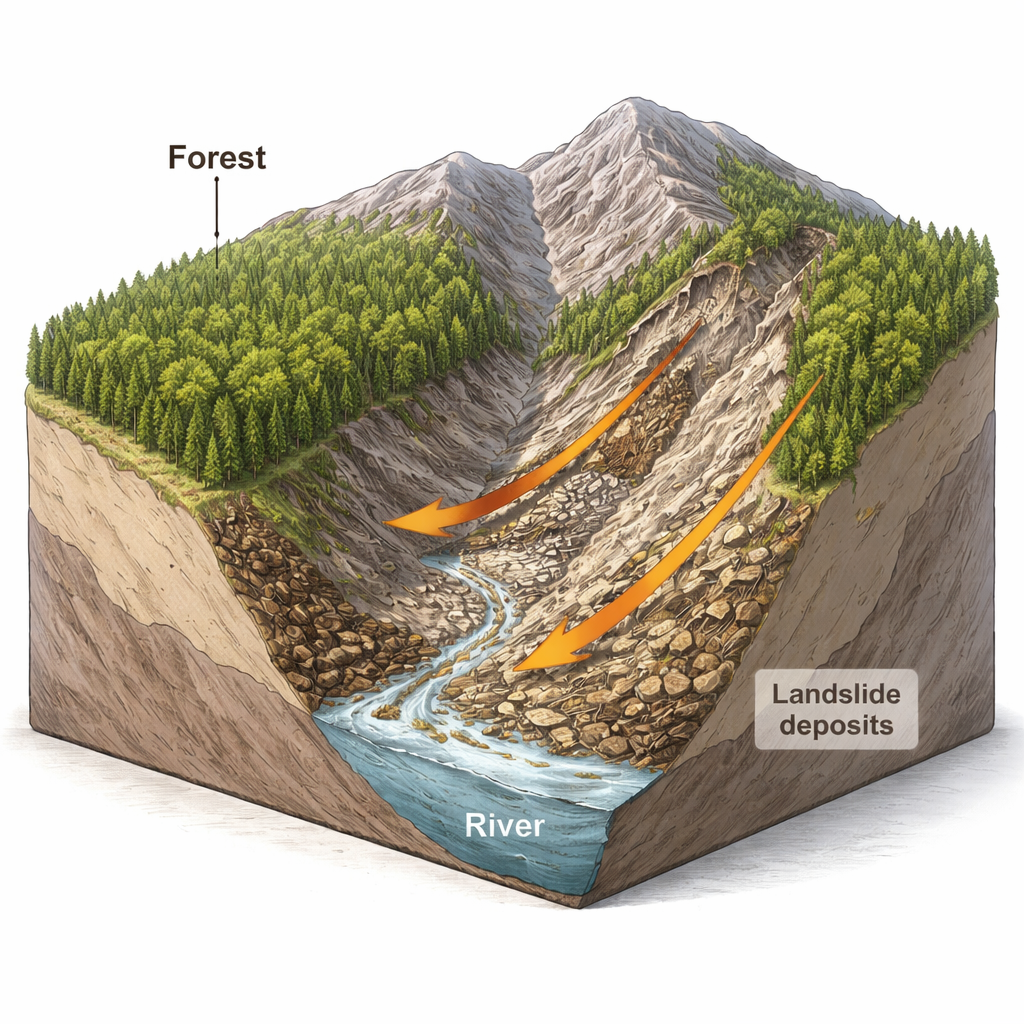
Forests and soils in mountain belts store large amounts of organic carbon, built up from dead leaves, roots, and wood. When a strong earthquake strikes such a region, thousands of landslides can strip away this living carpet and the soil beneath it. The 2008 Wenchuan earthquake in China, one of the largest recent continental quakes, triggered vast slope failures that moved several cubic kilometres of rock and soil. The authors treat this event as a natural experiment to ask: did it ultimately turn the mountains into a carbon source or a carbon store?
Measuring Carbon Before and After the Shock
To answer this, the researchers mapped and sampled 123 locations across the Longmenshan range, including fresh landslide deposits and nearby undisturbed slopes. They combined field measurements of soil and vegetation, laboratory analyses, satellite images, and machine-learning models to reconstruct how much organic carbon was present before the earthquake, how much was stripped away, and how much has returned since. Before the quake, the region’s steep, wet slopes held abundant carbon—about 136 metric tons per hectare on average, with the richest stocks along the very range front where landslides later hit hardest.
Landslides as Temporary Carbon Warehouses
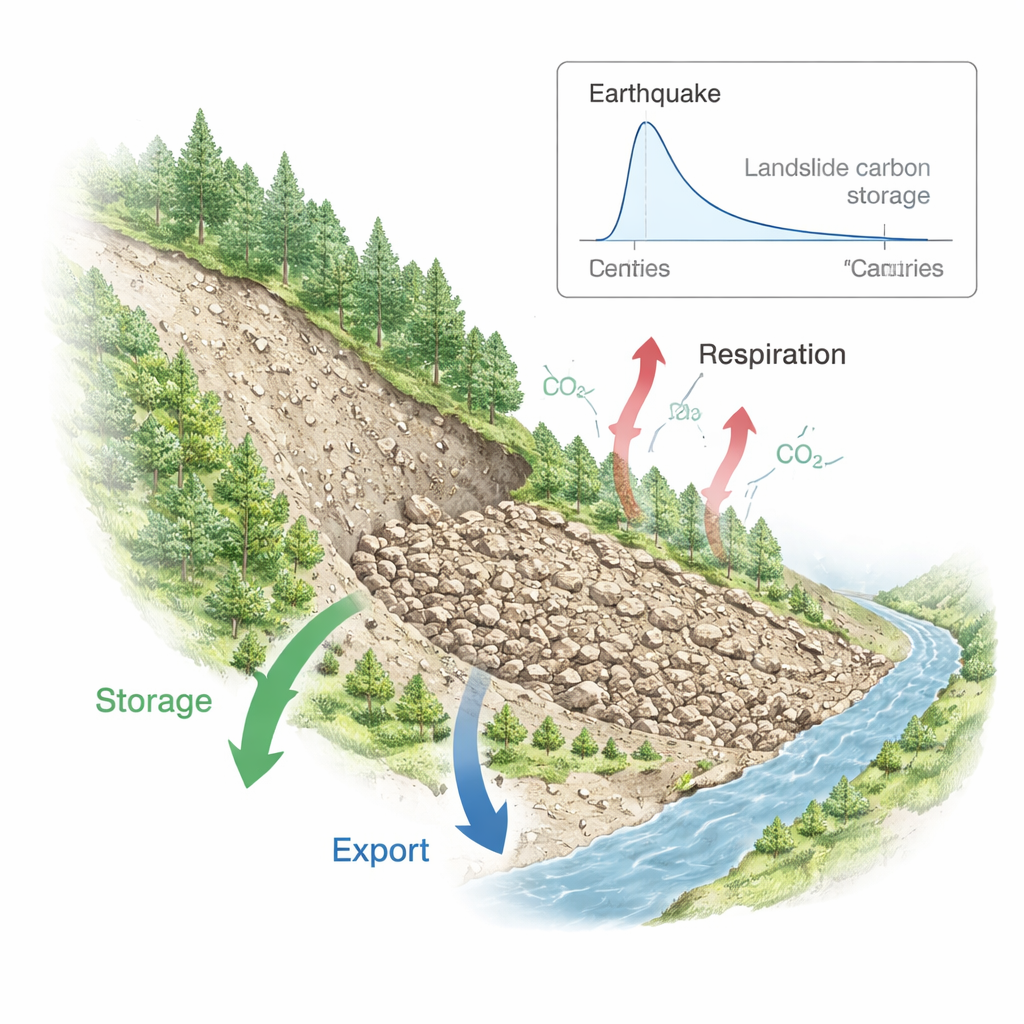
The Wenchuan landslides eroded roughly 5.5 million tons of organic carbon from hillslope soils and vegetation. One might expect most of this to be flushed rapidly down rivers and ultimately to the sea, or to decay and return to the atmosphere as carbon dioxide. Instead, the team finds that only about 12–43% of this carbon left the hillslopes within the first decade, largely through debris flows and river transport. The remainder—between about 3.1 and 4.8 million tons—stayed trapped in thick landslide deposits perched on slopes and in mountain valleys, where it is shielded from rapid removal.
Fast Greening, Slow Carbon Payoff
Satellite data and field plots show that vegetation bounced back quickly on the scars and deposits. Within about ten years, plant growth on the disturbed areas had recovered to around 80–90% of its pre-quake vigor. New trees and shrubs, often different species from those present before, took root in the loose material. Even so, the total carbon stored in these recovering sites was still much lower than before the earthquake because rebuilding deep, carbon-rich soils takes far longer than regrowing leaves and trunks. By 2020, landslide surfaces had regained about 2.2 million tons of organic carbon in soils and biomass, while still holding large amounts of buried material from 2008.
Earthquakes as Giant Carbon Capacitors
Putting all of these pieces together, the authors describe the landscape as acting like a giant carbon “capacitor.” The earthquake rapidly charges this capacitor by burying organic matter in landslide deposits and then gradually discharges it over centuries to millennia through slow erosion and decomposition. For the Wenchuan case, the net effect is that the mountain belt’s organic carbon stock actually increased by about 10% in the years after the event. Their modeling suggests that vegetation will recover to its former carbon level in roughly two centuries, buried material in about a century, and soils only after nearly two millennia—timescales similar to the recurrence of major earthquakes in the region.
What This Means for Climate and Tectonics
For a non-specialist, the key message is that big earthquakes do more than cause short-lived destruction: they also reshape where carbon is stored on Earth’s surface and for how long. In rugged, quake-prone ranges like those in China, New Zealand, and Taiwan, repeated landslides may, over the long term, lead to a net gain of organic carbon stored in mountain soils and sediments. That means tectonic activity can indirectly help remove carbon from the atmosphere for centuries at a time, adding a new piece to the puzzle of how Earth’s interior and its climate system are connected.
Citation: Liu, J., Fan, X., Hales, T. et al. Earthquakes act as a capacitor for terrestrial organic carbon. Nat Commun 17, 1627 (2026). https://doi.org/10.1038/s41467-026-68341-3
Keywords: earthquake landslides, mountain carbon cycle, soil organic carbon, Wenchuan earthquake, carbon storage