Clear Sky Science · en
Soil carbon debt from land use change in Brazil
Why the ground beneath our feet matters for climate
When we talk about climate change, we often picture smokestacks and exhaust pipes. But a huge, hidden player lies underfoot: the carbon stored in soil. This study looks at how turning Brazil’s native landscapes into farmland has quietly drained carbon from the ground, and how smarter farming could put much of that carbon back, helping to slow global warming while keeping agriculture productive.
A nation-sized experiment in changing the land
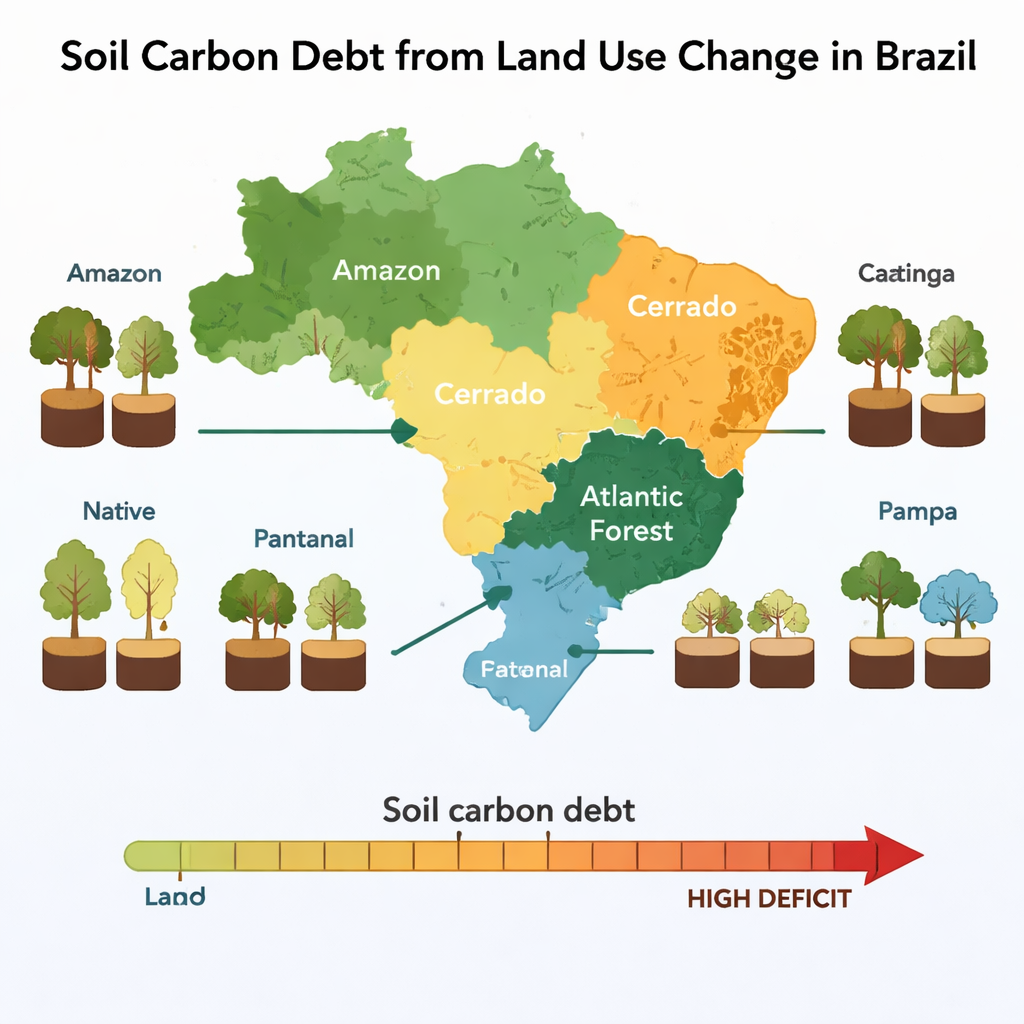
Brazil is one of the world’s agricultural powerhouses, with hundreds of millions of hectares devoted to crops and pasture. For decades, forests, savannas, grasslands, and wetlands have been cleared or converted to make way for this growth. The authors of this paper ask a simple but profound question: how much carbon has been lost from Brazilian soils because of this land use change, and how much could be restored? To answer it, they compiled a national database of more than 4,000 soil measurements from all six major Brazilian biomes, comparing carbon in soils under native vegetation with nearby agricultural fields, mostly in the upper 30 centimeters where farming has the strongest impact.
Measuring the hidden carbon gap
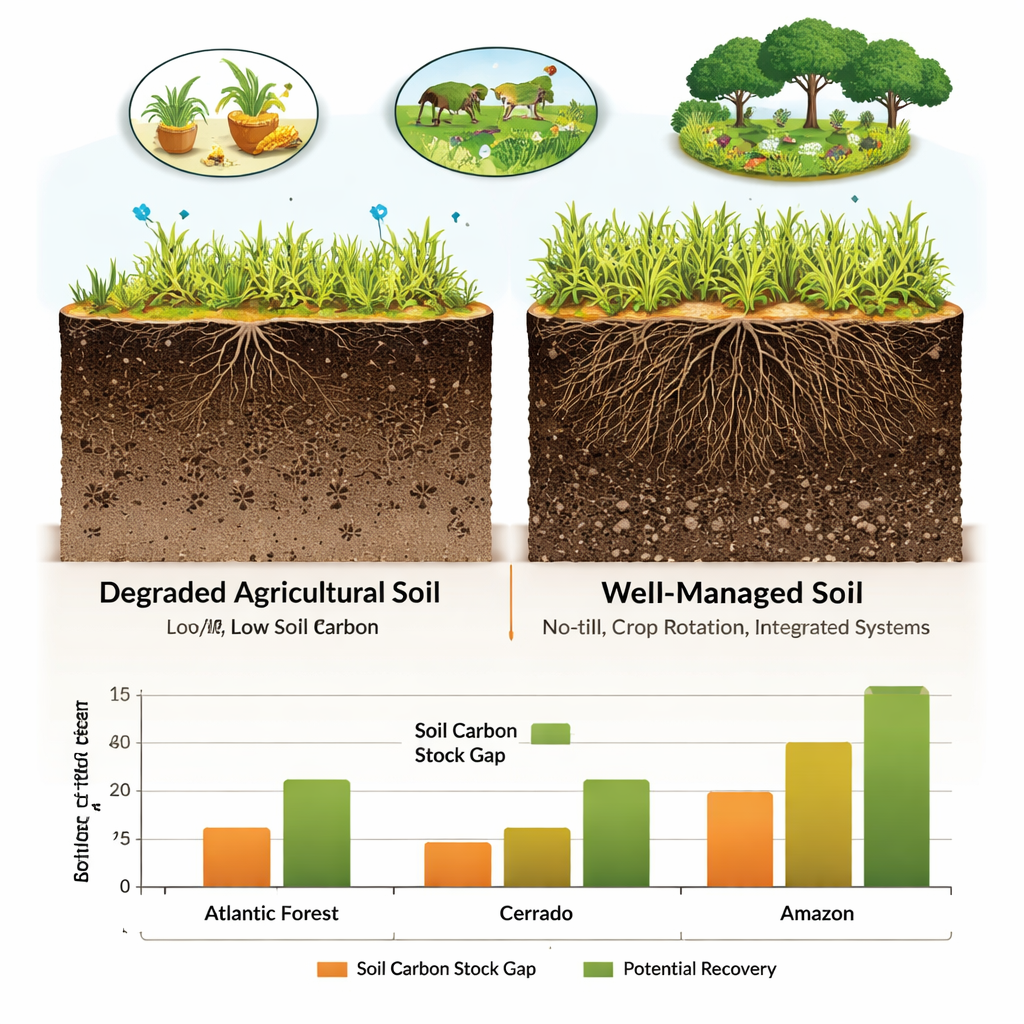
The team calls the difference between natural and farmed soils the “soil carbon gap” or “soil carbon debt.” Across Brazil, they find that agricultural conversion has reduced soil carbon in the top 30 centimeters by an average of roughly 5 metric tons of carbon per hectare. Scaled up to the country’s agricultural area, this amounts to a national soil carbon debt of about 1.4 petagrams of carbon—equivalent to more than 5 billion tons of carbon dioxide released to the atmosphere. This loss is not uniform. Moist, cooler regions such as the Atlantic Forest and the Cerrado savanna, where soils naturally hold more carbon, show the largest drops after conversion, while drier or already carbon-poor regions lose less in absolute terms.
Climate, soils, and history shape the damage
Why do some places lose more carbon than others? The study shows that climate and soil type play a major role. Cooler and wetter areas tend to build up more organic matter, but they also suffer greater losses when disturbed, because there is simply more carbon to lose. Certain soil types with strong mineral binding can protect carbon better, while sandy or erosion-prone soils let it escape more easily. The history of land use also matters. Many of the largest carbon gaps occur where agriculture has been established for decades and where repeated tillage, compaction, and poor pasture management have broken down soil structure and sped up decomposition.
Farming practices that rebuild the bank
Crucially, the study is not just a tally of losses; it also points to ways of rebuilding this underground carbon bank. By comparing different farming systems, the authors find that simple monocultures and conventional plowing cause the greatest declines in soil carbon. In contrast, systems that diversify and disturb the soil less—such as crop rotation, intercropping, no-till farming, better-managed grasslands, and integrated systems that mix crops, livestock, and trees—substantially reduce losses and in some cases begin to close the gap with native soils. Across Brazil, the authors estimate that if only about one third of the theoretical recarbonization potential were realized through such practices, it could cover a large share of the country’s planned greenhouse-gas reductions under the Paris Agreement.
What this means for climate and for Brazil’s future
For non-specialists, the message is clear: the way we treat soils can either add billions of tons of carbon dioxide to the atmosphere or quietly lock it away. This study shows that Brazil’s soils currently carry a large “carbon debt” from past land use change, but also that there is a huge opportunity to pay it down through smarter agriculture. By encouraging practices that keep roots in the ground, protect soil structure, and maintain continuous plant cover, Brazil can boost food production, restore soil health, and make major contributions to global climate goals—all by working with the carbon hidden in the first spadeful of earth.
Citation: Villela, J.M., Damian, J.M., Gonçalves, D.R.P. et al. Soil carbon debt from land use change in Brazil. Nat Commun 17, 1626 (2026). https://doi.org/10.1038/s41467-026-68340-4
Keywords: soil carbon, land use change, Brazil agriculture, carbon sequestration, climate mitigation