Clear Sky Science · en
Targeting mGlyR with nanobodies for depression
Why This New Approach to Depression Matters
Many people with major depression do not get enough relief from current medications, which can be slow to work and cause unwanted side effects. This study explores a very different kind of treatment: tiny engineered antibodies, called nanobodies, that home in on a single brain receptor linked to mood. By showing that one such nanobody can rapidly ease depression-like symptoms in mice, the research opens a new path toward highly targeted, biological therapies for difficult-to-treat depression. 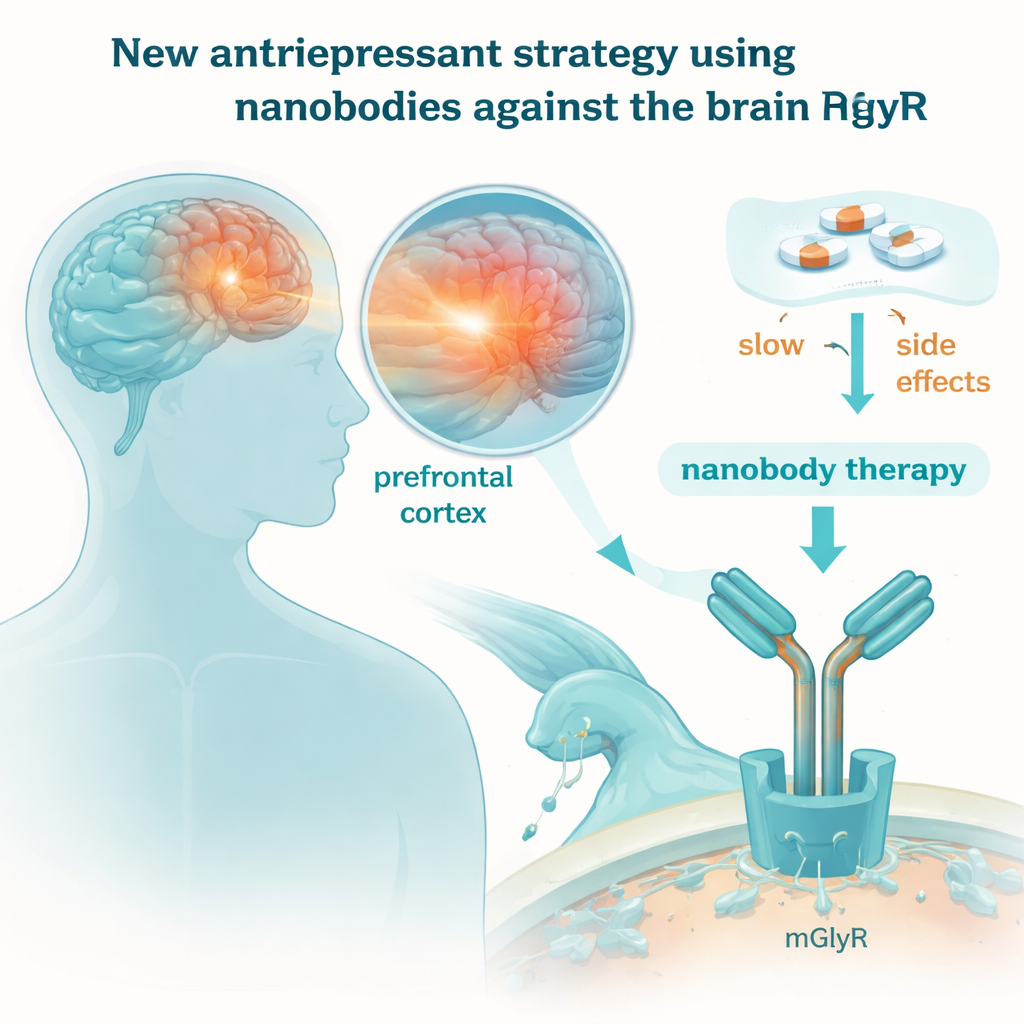
A New Target Hidden in the Brain’s Wiring
Most antidepressant drugs act on classic brain chemicals like serotonin and dopamine. Here, the focus is on another system built around glycine, a small molecule that also acts as a messenger in the brain. A recently discovered receptor for glycine, called mGlyR, is found at high levels in the prefrontal cortex, a region that helps control emotions and stress responses. People with major depression tend to have more of this receptor, and mice bred without mGlyR are unusually resilient to stress and show fewer depression-like behaviors. These clues suggested that dialing down mGlyR activity might have antidepressant benefits.
Designing a Tiny, Precise Antidepressant Tool
Instead of searching for a traditional small-molecule drug, the scientists turned to nanobodies—single-domain antibodies derived from animals like llamas. Nanobodies are much smaller than conventional antibodies, can be highly specific, and are increasingly being explored as medicines. The team immunized a llama with cells displaying mGlyR, then used a phage display technique to sift through billions of antibody fragments. From 61 promising candidates, one nanobody, named Nb20, emerged as the strongest and most selective binder to mGlyR. Tests in cultured cells showed that Nb20 attaches tightly to the receptor’s outer domain but does not stick to related brain receptors, confirming its precision.
How the Nanobody Rewires Cell Signaling
mGlyR controls brain signaling in an unusual way. On its inner side, it couples not to the typical G proteins directly, but to a helper complex called RGS7/Gβ5 that speeds the shutdown of G protein signals. When this complex is very active, it dampens nerve cell responses. Using a light-based assay in living cells, the researchers found that Nb20 interferes with this shutdown machinery: when Nb20 is present and mGlyR is active, G proteins turn off more slowly, meaning the RGS7/Gβ5 complex is less effective. Detailed cryo–electron microscopy images at near-atomic resolution showed Nb20 clasping the receptor’s outer “Cache” domain and subtly shifting its shape. Those shifts appear to ripple through the protein to the inner side, making the RGS7/Gβ5 complex looser and more flexible, and less able to clamp down on signaling. 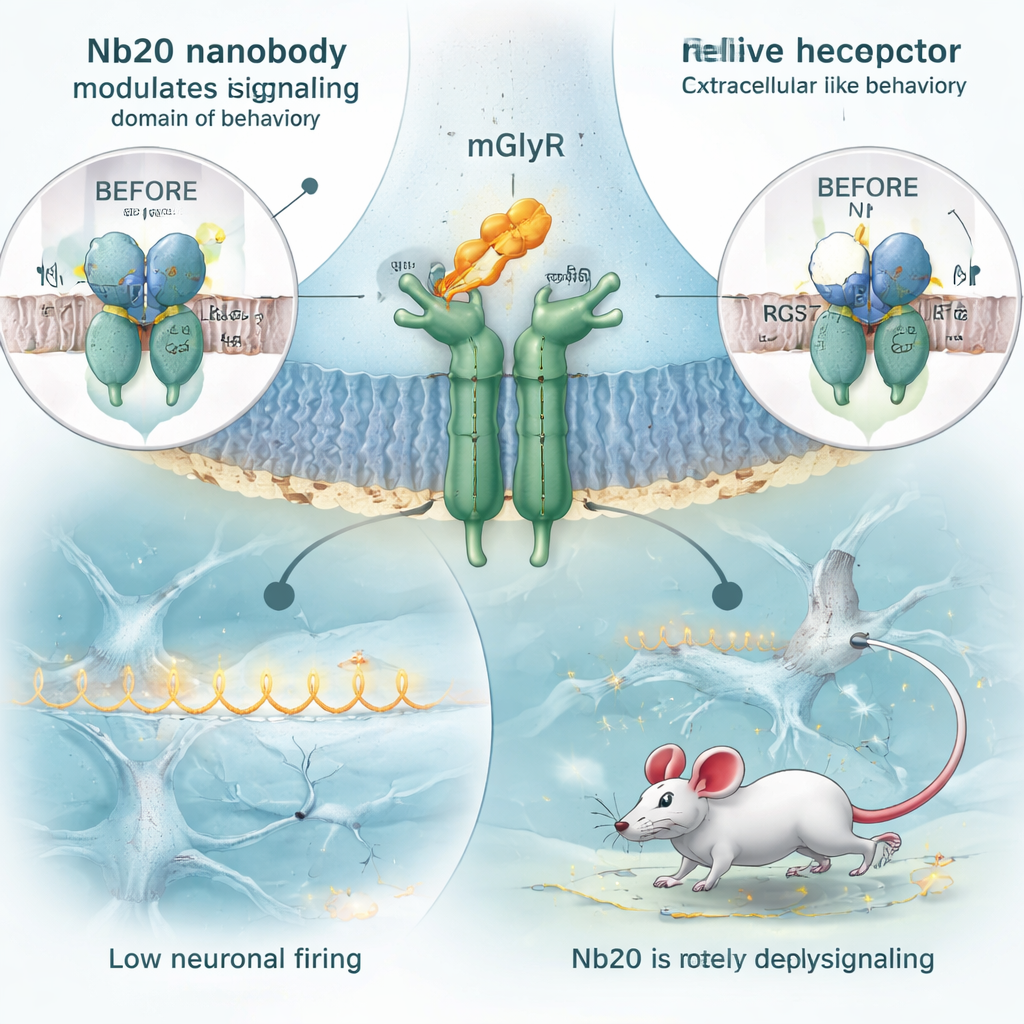
From Molecules to Mood in Mice
The team then asked whether this molecular effect matters for behavior. When Nb20 was delivered directly into the brains of mice, the animals showed fewer depression-like signs: they struggled more in stress-based tests and buried fewer marbles, a behavior linked to anxiety and compulsive tendencies. Remarkably, giving Nb20 by a simple intranasal route—dripping the nanobody solution into the nose—also produced strong antidepressant-like effects in mice that had been exposed to weeks of unpredictable stress. Across several behavioral tests, Nb20’s benefits were comparable to those of the fast-acting antidepressant ketamine, but without changes in basic movement or coordination. Recordings from brain slices showed that Nb20 made certain prefrontal cortex neurons easier to excite, consistent with a shift toward more active mood-control circuits.
What This Could Mean for Future Treatments
This study provides a proof of concept that a highly specific biological tool, aimed at a single receptor linked to depression, can quickly improve mood-related behaviors in animals. It suggests that nanobody-based drugs targeting mGlyR might someday offer a new option for people whose depression does not respond to existing medicines. Much work remains before human testing is possible, including improving how Nb20 enters the brain, ensuring safety, and confirming that similar mechanisms operate in people. Still, the results highlight a powerful idea: rather than broadly altering brain chemistry, it may be possible to relieve depression by precisely nudging one key receptor and its signaling partners into a healthier state.
Citation: Laboute, T., Zucca, S., Sial, O.K. et al. Targeting mGlyR with nanobodies for depression. Nat Commun 17, 831 (2026). https://doi.org/10.1038/s41467-026-68339-x
Keywords: depression treatment, nanobodies, glycine receptor, brain immunotherapy, prefrontal cortex