Clear Sky Science · en
Towards high resolution, validated and open global wind power assessments
Why better wind maps matter for everyone
As countries race to replace fossil fuels, wind turbines are becoming a backbone of clean electricity. But planning where to build them, how many are needed, and how they will perform still relies heavily on computer models that can be surprisingly wrong. This article presents a new, openly available global wind power modeling tool that is carefully checked against real-world data. For citizens, planners, and policymakers, this means more trustworthy estimates of how much clean power wind can actually provide, and where it makes the most sense to build it.
The challenge of guessing the wind
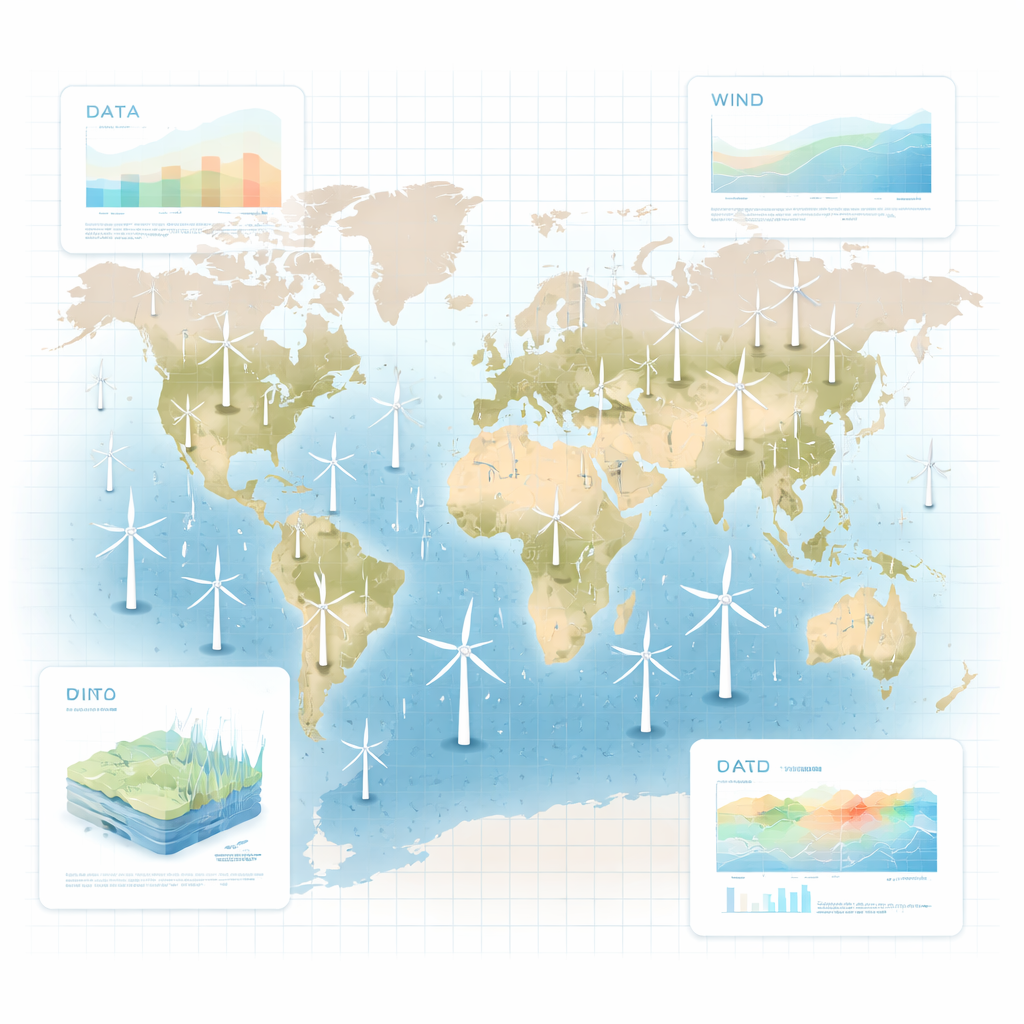
Turning moving air into electricity might sound straightforward: if the wind blows, turbines spin. In reality, estimating wind power for entire countries or the whole planet is complicated. Wind differs from place to place (a hilltop is not like a valley), from hour to hour and season to season, and from turbine to turbine. Most large-scale wind studies use global “reanalysis” weather datasets and digital wind maps that blend measurements with physics-based weather models. Earlier tools using these datasets often skipped thorough reality checks, especially outside Europe, and rarely corrected for systematic errors in the underlying wind data. As a result, estimates of how much electricity wind farms could produce could be off by tens of percent, undermining confident long-term energy planning.
Building an open, global wind power engine
The authors expand the open-source modeling framework ETHOS.RESKit into a high-resolution global wind power simulation system. It combines modern weather reanalysis data (ERA5) with the latest Global Wind Atlas, refining wind information down to grids as small as 250 meters. The model can represent over 800 different turbine types and also create “synthetic” turbines based on a few design choices such as tower height and rotor size—useful for testing future technology that is not yet built. Crucially, all of this is done in a transparent way: code and data products needed to run the model or repeat the analysis are publicly accessible, allowing other researchers and planners to scrutinize, adapt, and improve the workflow rather than relying on black-box estimates.
Tuning the model to match the real world
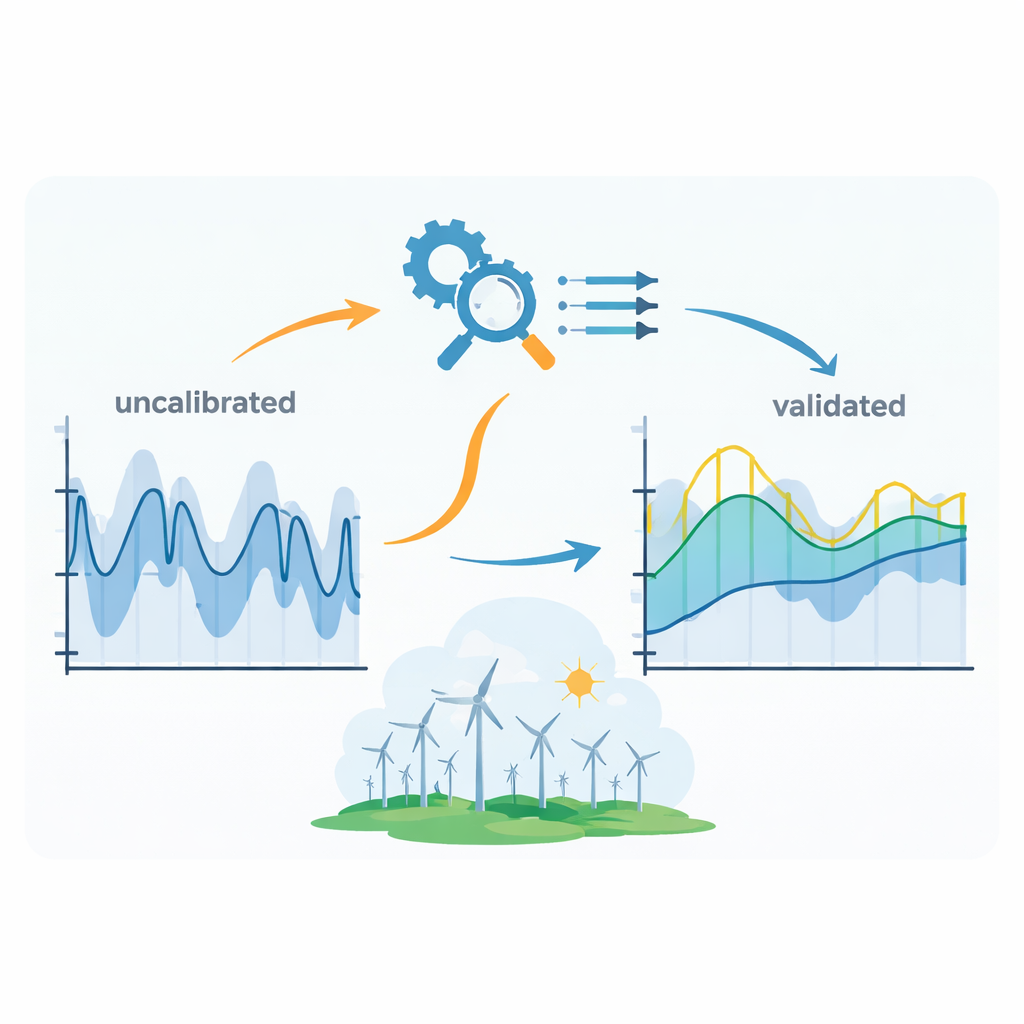
A central innovation of this work is a detailed “calibration” step that corrects systematic errors in the wind data before any power calculations are made. The team assembled more than 18 million hourly measurements from tall meteorological masts around the world, at heights similar to turbine hubs. Comparing these measurements with the modeled winds revealed that the standard datasets tend to underestimate gentle winds and overestimate stronger ones, especially in the range that matters most for turbine output. The authors respond with a wind-speed-dependent correction curve: low modeled winds are nudged upward, high winds are pulled down, in a nonlinear way tailored to the observed bias. This correction is then applied globally in ETHOS.RESKit to any simulated location.
Putting the model to the test
To see whether the calibrated model truly captures real turbine behavior, the authors compared simulated output with 8 million hours of measured electricity production from 152 turbines and wind farms in six countries, both on land and offshore. After calibration, the average error in capacity factor—a common measure of how fully a turbine is used—falls to about 5.6%, with a strong correlation (0.844) between simulated and measured hourly performance. They also tested how well the model reproduces the behavior of different turbine designs. By feeding real hub-height wind measurements into both manufacturer power curves and ETHOS.RESKit’s synthetic curves, they show that their synthetic approach closely mimics real machines: for the major manufacturers that account for nearly 80% of global wind capacity, the match score is typically 0.96 or higher on a 0–1 scale. Finally, they simulated the entire national wind fleets of 71 countries and compared the results with official statistics from the International Energy Agency. On average, the calibrated workflow differs by only about 0.6 percentage points in national capacity factors, a major improvement over uncalibrated estimates.
From better numbers to better decisions
For non-specialists, the upshot is that this work turns rough guesses about future wind power into more solid numbers, and it does so using open tools that anyone can inspect and reuse. By correcting biases in global wind datasets and thoroughly checking results against real turbines and national statistics, ETHOS.RESKit provides a far more reliable picture of how much electricity wind can deliver, and where. This helps governments, grid operators, and investors design cleaner power systems with greater confidence—deciding, for example, how much backup or storage is required, or which regions can become major wind hubs. In short, better wind simulations mean better planning for a net-zero energy future.
Citation: Peña-Sánchez, E.U., Dunkel, P., Winkler, C. et al. Towards high resolution, validated and open global wind power assessments. Nat Commun 17, 539 (2026). https://doi.org/10.1038/s41467-026-68337-z
Keywords: wind power, renewable energy modeling, capacity factor, global wind atlas, energy system planning