Clear Sky Science · en
Deterministic and highly indistinguishable single photons in the telecom C-band
Light for the Future Internet
Today’s internet sends information with laser light in glass fibers, but tomorrow’s quantum internet will need streams of single particles of light—photons—that behave in a perfectly controlled way. This study shows how to build a tiny light source on a chip that can reliably emit one high‑quality photon at a time at the same wavelengths already used in long‑distance fiber networks, bringing practical quantum communication a step closer.
Why Single Photons Need to Look Alike
For many quantum technologies, from ultra‑secure communication to powerful new kinds of computation, it is not enough to have single photons on demand; those photons must also be nearly identical. If two photons are truly indistinguishable—same color, timing, and shape—they can interfere with each other in a way that has no counterpart in everyday life. This “two‑photon interference” is a basic building block for quantum logic operations carried out with light. The challenge has been to make a source that produces such nearly identical photons at the standard telecom C‑band around 1550 nanometers, where existing fiber‑optic networks have the lowest loss.
A Tiny Artificial Atom on a Chip
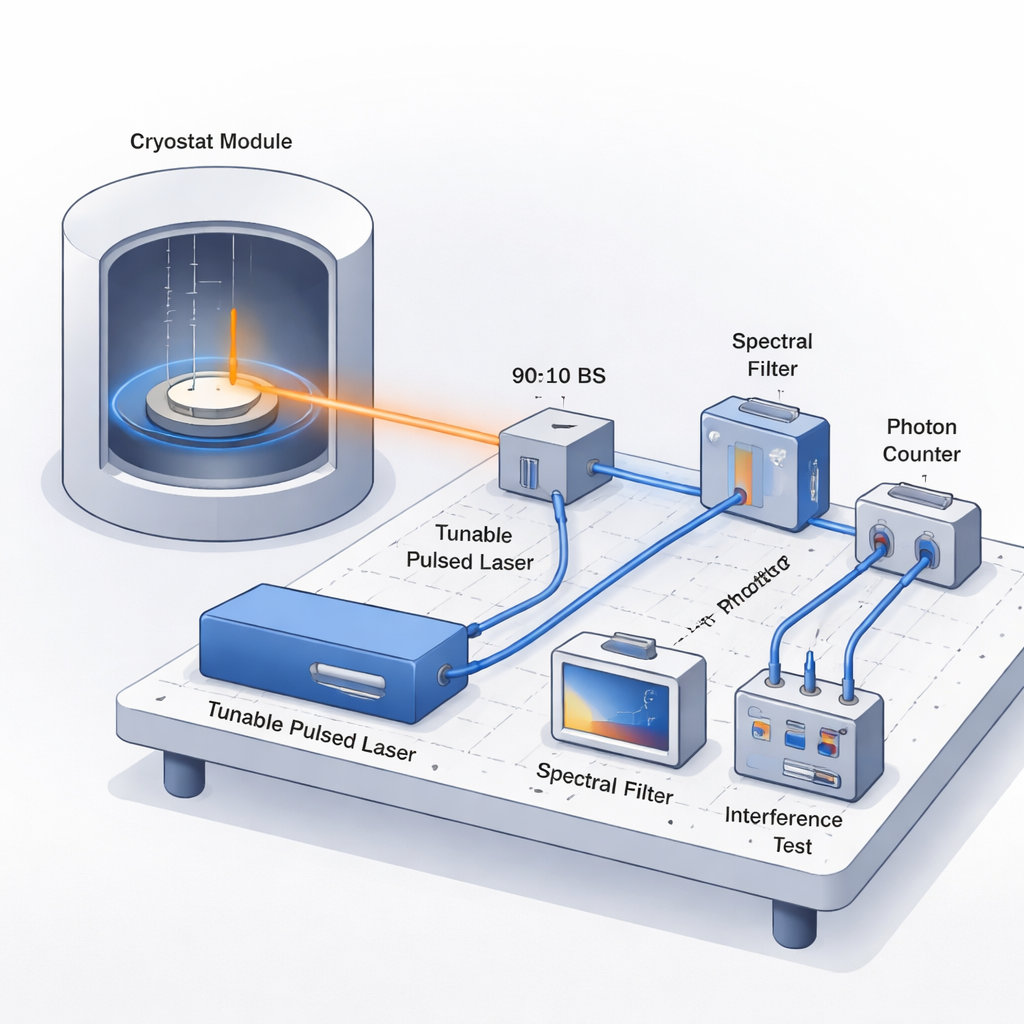
The authors use a semiconductor quantum dot, a man‑made structure so small that it behaves like an artificial atom. Their device is built from indium arsenide embedded in a carefully engineered surrounding material and placed inside a circular Bragg grating resonator, which acts like a microscopic mirror cavity that guides the emitted light upward. The chip sits in a cryostat at four degrees above absolute zero and is excited by very short laser pulses. The researchers then send the resulting photons through filters and fiber‑optic components to analyze their color, timing, and how often more than one photon is emitted at once.
Tuning How the Dot Is Excited
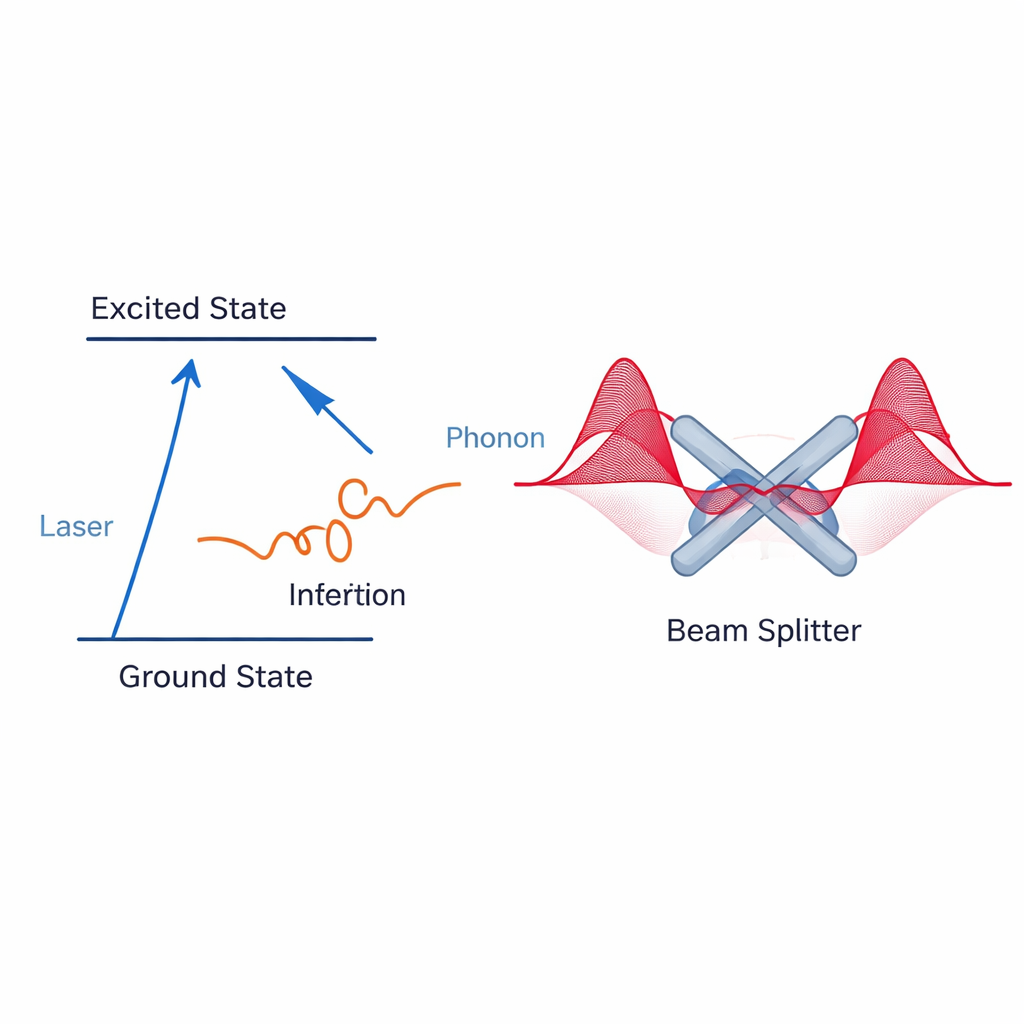
To find the best operating conditions, the team systematically compares four different ways of driving the quantum dot with a laser. One method uses a high‑energy laser that excites many states at once, while others use more selective wavelengths, including a technique where the laser is tuned slightly off the main transition and the quantum dot absorbs or emits vibrations in the crystal—phonons—to reach the right state. For each scheme, they measure how “single” the source is, by looking at the probability of getting more than one photon per pulse, and how indistinguishable successive photons are, by sending pairs into a beam splitter and recording how strongly they interfere.
Reaching Record Photon Sameness
The most striking result comes from the phonon‑assisted excitation method. In this regime, the device emits almost no extra photons—the multi‑photon contribution is only a few percent—and, crucially, successive photons interfere with a raw visibility above 91 percent. This number is a direct indicator of how alike the photons are, and it surpasses previous records for solid‑state emitters at telecom wavelengths. The authors show that other excitation methods still produce good single‑photon behavior but fall short in indistinguishability, likely because they prepare the quantum dot state more slowly and less cleanly.
What This Means for Quantum Networks
In simple terms, the researchers have built a microscopic light source that can spit out nearly identical single photons on demand at the same color used in today’s long‑distance fiber networks. By matching or exceeding the photon quality of more complex probabilistic sources while remaining deterministic—emitting a photon whenever asked—their approach helps close a key performance gap. This brings practical quantum communication systems and future light‑based quantum computers closer to reality, using hardware that can be integrated into existing telecom infrastructure.
Citation: Hauser, N., Bayerbach, M., Kaupp, J. et al. Deterministic and highly indistinguishable single photons in the telecom C-band. Nat Commun 17, 537 (2026). https://doi.org/10.1038/s41467-026-68336-0
Keywords: single-photon sources, quantum dots, telecom C-band, quantum communication, photon indistinguishability