Clear Sky Science · en
Genomic and physiological signatures of adaptation in pathogenic fungi
Why fungi on our skin and in our soil matter
Fungi are often thought of as mushrooms in the forest or mold on old bread, but many microscopic fungi quietly live in soil, on plants, and even on our skin. Some of these harmless species can suddenly turn into serious threats, causing life‑threatening infections in people with weakened immune systems. This study asks a deceptively simple question: what changes inside these fungi when they shift from living on dead leaves to invading human bodies?
Tracing family ties among friendly and harmful fungi
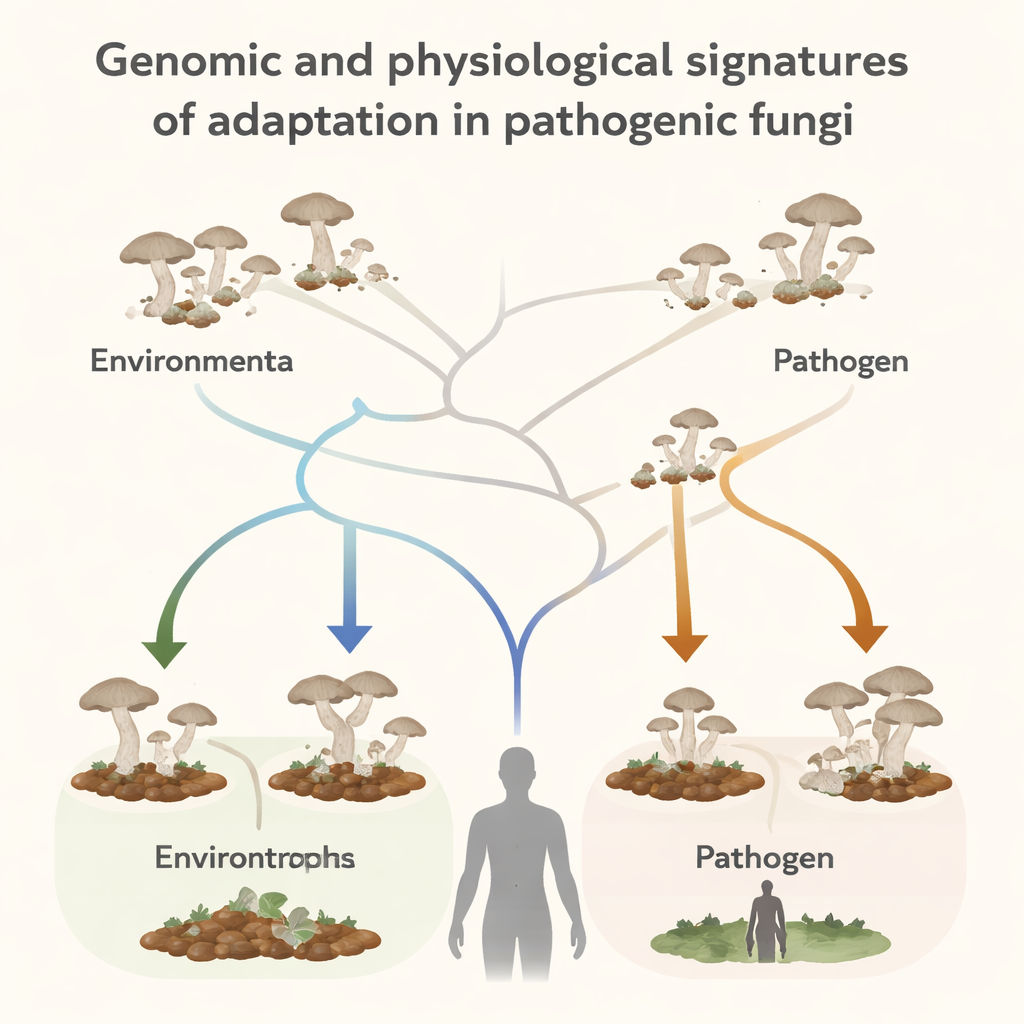
The researchers focused on a group of yeasts called Trichosporonales, which includes both environmental species that feed on decaying material and opportunistic species that can infect humans. By comparing the genomes of 45 fungal strains, they built a family tree that shows how these species are related. The tree revealed that human‑infecting fungi are scattered across different branches rather than clustered in one lineage. This pattern suggests that the ability to infect humans has evolved multiple times independently, instead of arising once and being inherited.
Same toolbox, different way of using it
A natural guess is that dangerous fungi might carry special sets of genes—like extra tools—that harmless fungi lack. To test this, the team counted genes involved in breaking down carbohydrates (important for life on plant debris) and genes involved in handling fats and oils (important inside animals). Surprisingly, they found that pathogens and saprotrophs have very similar numbers of these genes, as well as similar genome sizes, repetitive DNA, and secreted enzymes. In other words, simply owning particular genes does not clearly separate the fungi that infect humans from those that do not. The crucial difference seems to lie not in what genes they have, but in how efficiently they can use them.
Speed‑tuning the protein factory
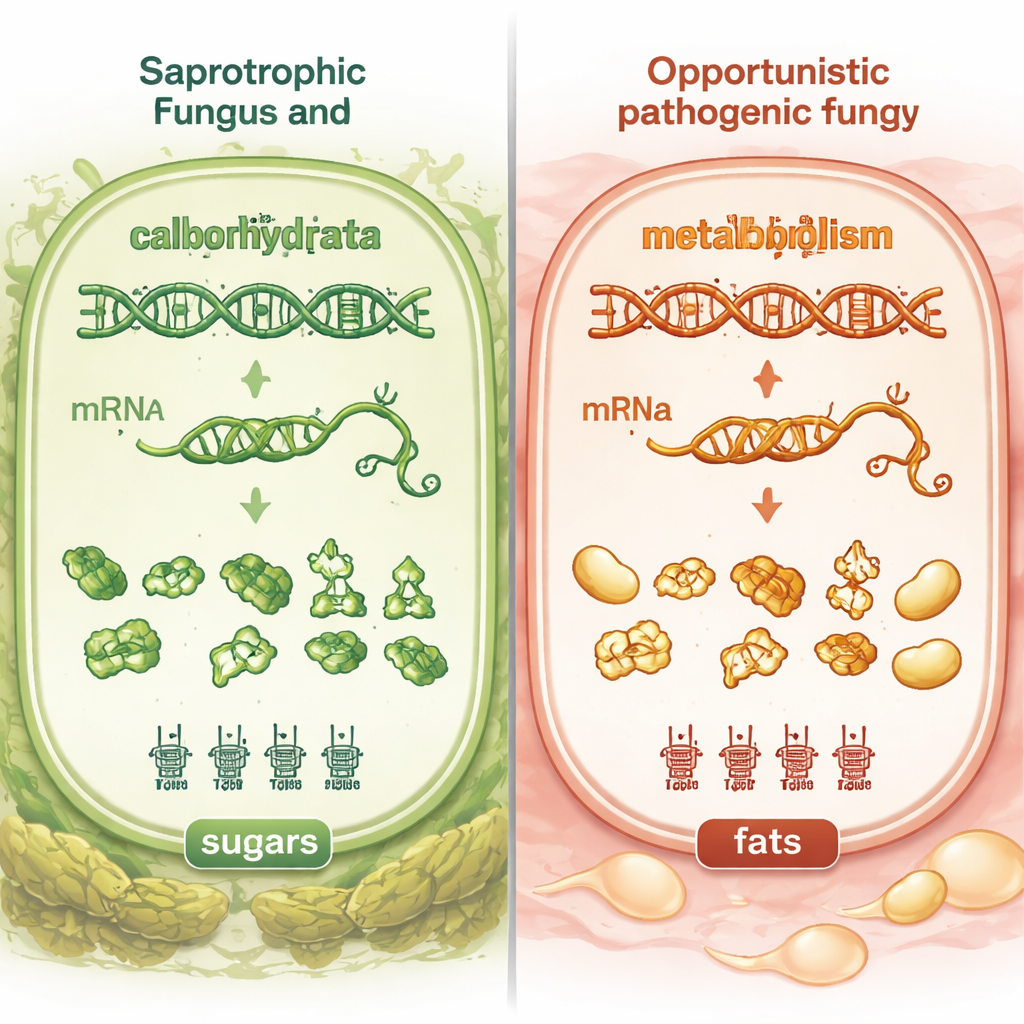
To look deeper, the authors turned to the process of translation—the step where cells read genetic information and build proteins. Translation depends on transfer RNAs (tRNAs), small molecules that match genetic “codons” to amino acids. If a gene’s codons match the most abundant tRNAs, its protein can be made more quickly and efficiently. The team measured how well codons in carbohydrate‑related and lipid‑related genes were “optimized” for the available tRNAs in each species. They found that saprotrophic fungi tended to be better tuned for carbohydrate metabolism, while opportunistic pathogens showed relatively higher optimization for lipid metabolism. This pattern was strong enough that a simple decision‑tree model could usually predict whether a species was a pathogen or saprotroph just from the relative optimization of lipid versus carbohydrate pathways.
From genetic tuning to real‑world growth
Genomic signatures are useful only if they matter in practice, so the researchers tested how different fungi grew in the lab. They measured growth in sugar‑rich media and in lipid‑rich media, and also tracked how quickly the fungi adjusted to new conditions. While overall growth rates did not strongly track with codon optimization, the length of the lag phase—the waiting time before rapid growth began—did. Fungi whose metabolism genes were more optimally encoded for a given food source started growing faster on that substrate. The team also tested growth at warmer temperatures, including 33 °C and 37 °C, similar to mammalian body heat. Many known pathogens grew well at these temperatures, but some nominally “environmental” species did too, and some pathogens did not, showing that heat tolerance is important but not the sole factor in pathogenicity.
Hidden candidates for future fungal threats
One striking outcome was that certain fungi currently classified as harmless saprotrophs showed translational patterns and temperature tolerance similar to known opportunistic pathogens. In particular, some Apiotrichum and Vanrija species appear genetically primed to handle lipid‑rich environments and to grow near body temperature, even though they are not yet common in clinical reports. This suggests that the line between environmental fungi and potential pathogens is thinner than it appears, and that some quiet residents of soil or leaf litter could become future health threats under the right conditions.
What this means for human health
For non‑specialists, the key message is that dangerous fungal traits may not depend on exotic “virulence genes,” but on how efficiently common metabolic genes are translated when fungi encounter new environments, such as the human body. By reading subtle signatures in codon usage and tRNA composition, scientists can begin to flag environmental fungi that are poised to adapt rapidly to hosts. Such genomic and physiological markers could eventually help doctors and public health officials anticipate which species are most likely to emerge as the next opportunistic pathogens, improving surveillance and preparedness before outbreaks occur.
Citation: Guerreiro, M.A., Yurkov, A., Nowrousian, M. et al. Genomic and physiological signatures of adaptation in pathogenic fungi. Nat Commun 17, 748 (2026). https://doi.org/10.1038/s41467-026-68330-6
Keywords: fungal pathogens, genome evolution, codon optimization, opportunistic infections, host adaptation