Clear Sky Science · en
Evolutionary dynamics of sex determination in Branchiostoma belcheri driven by repeated transposition of a single novel gene
How a tiny sea creature shuffles the rules of being male or female
In most school textbooks, sex is presented as a simple matter of X and Y chromosomes, but in much of the living world the rules are far more fluid. This study looks at a small, fish-like animal called amphioxus, a close relative of vertebrates, and uncovers an unexpectedly dynamic system for deciding who becomes male or female. By following the movements of a single gene across the genome, the authors show how sex-determining switches can be born, move, and partly lose their function, all within one species.
A simple animal with a complex sex switch
Amphioxus, or lancelets, live buried in shallow sand and occupy a key position on the evolutionary tree between invertebrates and vertebrates. Earlier work showed that several amphioxus species, including Branchiostoma belcheri, have a ZW system, where females carry Z and W sex chromosomes but these chromosomes look almost identical under the microscope. This makes it difficult to pinpoint the exact DNA regions that decide sex. Using new, high-quality genome assemblies from multiple B. belcheri individuals, the researchers re-examined where the sex-determining regions lie and how they differ between males and females.
One key gene, copied and moved
The team focused on a gene called tesD, which is active only in testes in three amphioxus species. By using CRISPR gene editing in the related species B. floridae, they knocked out tesD. Genetic males that lacked functional tesD no longer formed testes and instead developed ovaries, while otherwise remaining healthy. This shows that tesD is essential and specific for male development, acting as a master switch in the pathway that leads to sperm-producing organs. Intriguingly, similar genes are missing from vertebrates, suggesting that this is an ancient chordate solution that was later replaced in our own lineage.
Two female-only regions born from jumping DNA
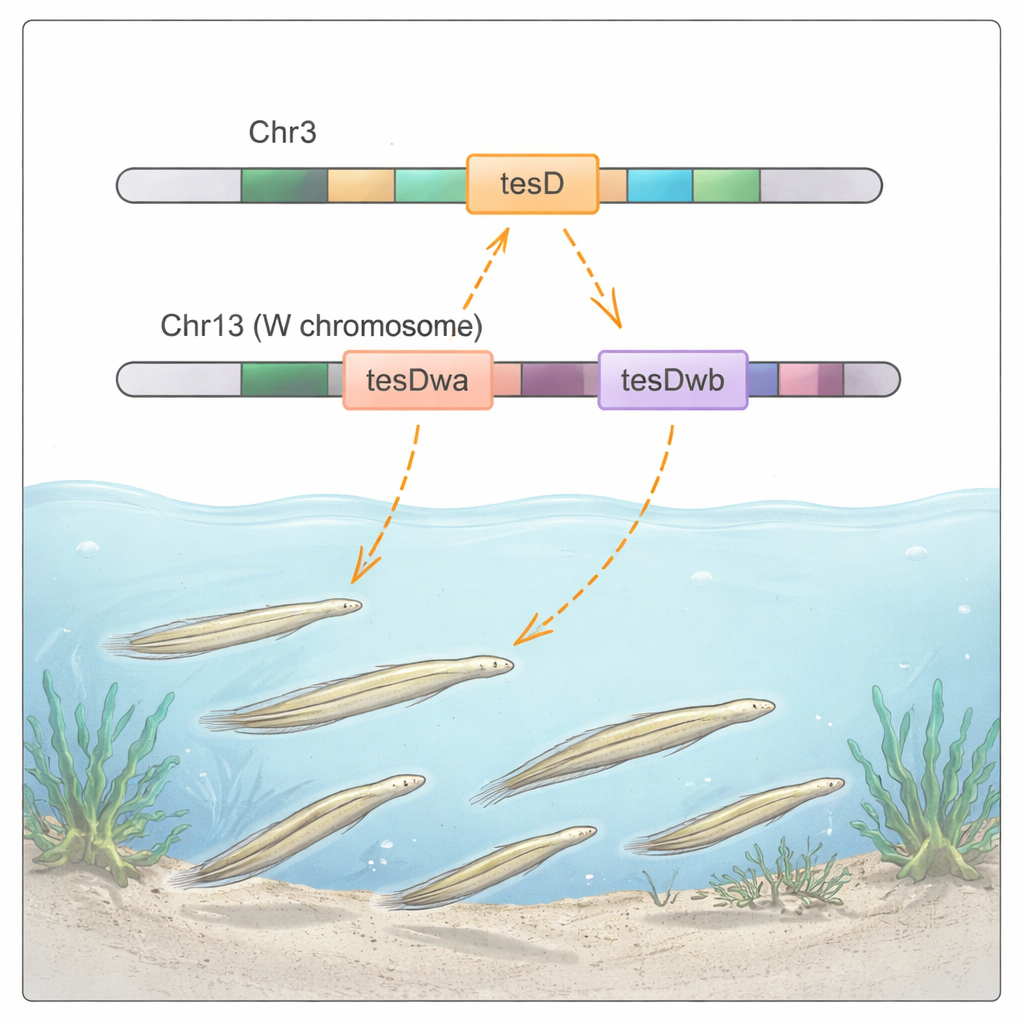
In B. belcheri itself, the authors discovered not one but two distinct female-specific regions on chromosome 13. Both regions contain extra copies of tesD, named tesDwa and tesDwb. These copies did not arise by simple duplication beside the original gene; instead, they were carried by mobile bits of DNA called transposons, which can cut and paste themselves around the genome. One sex-determining region landed inside a gene called twai, and the other inserted into the tail end of a gene called vps9c. Genetic surveys and targeted PCR tests showed that about half of the females carry the older region with tesDwa, and the other half carry the newer region with tesDwb, while males generally lack both.
How copied genes help create females
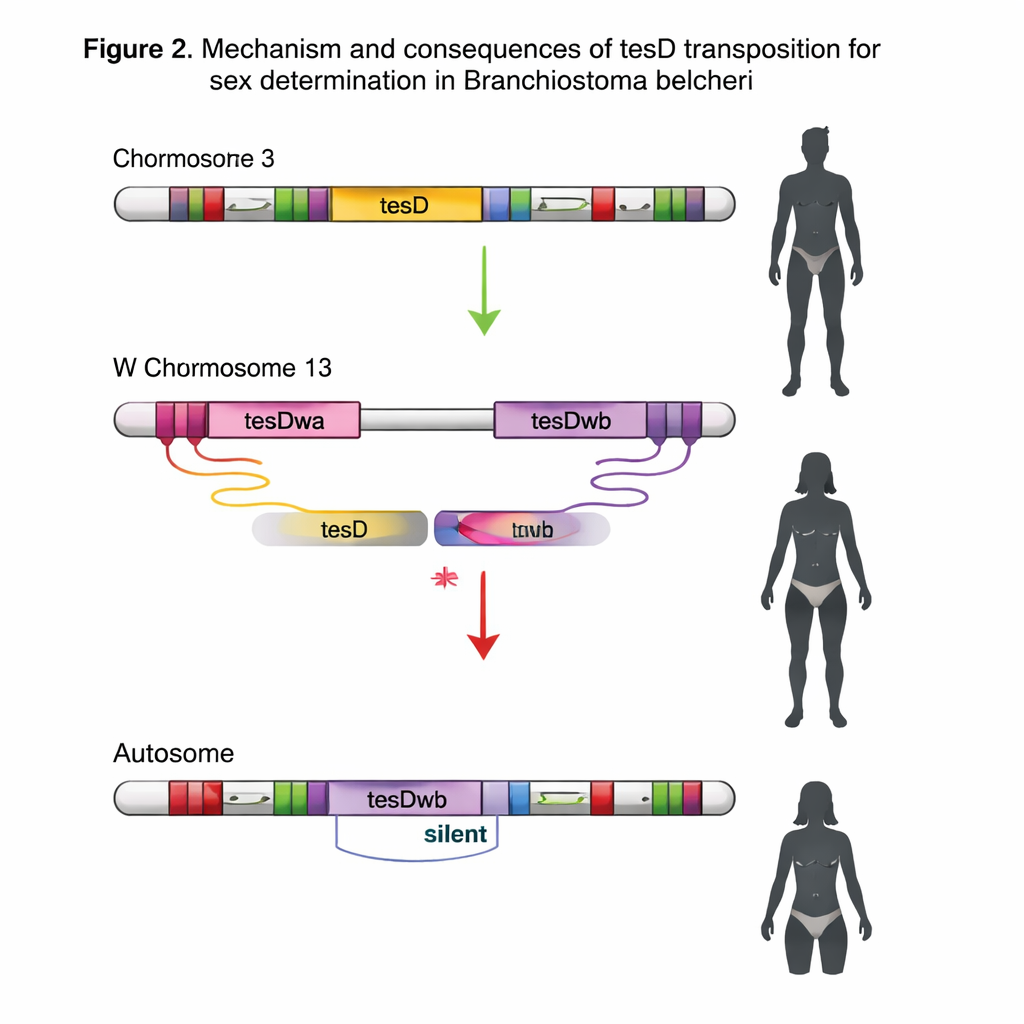
Having extra copies of a male-promoting gene on the female W chromosome seems paradoxical. The solution lies in how these copies are used. In ovaries, the W-linked tesDwa and tesDwb are read in the opposite direction to the original autosomal tesD, producing long non-coding RNAs rather than protein. These long RNAs overlap the normal tesD message and are transcribed together with their host genes, suggesting they hijack local promoters. The presence of these antisense RNAs correlates with a shut-down of the original tesD gene at the DNA level in females, as shown by chromatin accessibility assays. In effect, the W-linked copies act as silencers, turning off the male switch and steering development toward ovaries.
When the sex switch jumps and goes quiet
The younger region containing tesDwb is still mobile. Its surrounding transposons carry intact repeat structures that signal recent activity, and the authors found individuals where this cassette had jumped from the W chromosome to ordinary (autosomal) chromosomes, including a telomere and an intron of another gene. In these new locations, however, tesDwb is not transcribed, its silencing effect on tesD is lost, and it no longer tracks with sex. Roughly 5–10% of both males and females carry such “silent” copies, illustrating how mobile sex-determining modules can spread, become inactive, and perhaps be replaced over evolutionary time.
What this means for the evolution of sex
To a non-specialist, the main message is that sex determination is not fixed once and for all, even within a single species. In B. belcheri, a single gene that makes males, tesD, has been copied, moved by jumping DNA, and repurposed to help make females by blocking its own activity. Old and new sex-determining regions now coexist, and the newer one is still moving around the genome. This kind of ongoing reshuffling may help explain why many animals retain sex chromosomes that look ordinary, without the heavy degeneration seen in human Y chromosomes, and it offers a living snapshot of how new sex-determining systems are born and compete over evolutionary time.
Citation: Li, H., Liu, F., Li, J. et al. Evolutionary dynamics of sex determination in Branchiostoma belcheri driven by repeated transposition of a single novel gene. Nat Commun 17, 1616 (2026). https://doi.org/10.1038/s41467-026-68322-6
Keywords: sex determination, amphioxus, transposable elements, lncRNA, evolutionary genetics