Clear Sky Science · en
Manipulating charge transfer dynamics and stabilizing lead bromide octahedra for efficient blue perovskite light-emitting diodes
Brighter, Truer Blues for Future Screens
From smartphones to wall-sized TVs, today’s displays still struggle to produce bright, energy-efficient, and long‑lasting pure blue light. This article reports a clever chemical tweak that makes a promising class of materials—perovskites—shine bright, stable blue for much longer. By redesigning the tiny molecules that sit between perovskite layers, the researchers boost both efficiency and lifetime, bringing next‑generation blue pixels a big step closer to everyday products.
Why Blue Perovskites Are Hard to Tame
Perovskite light‑emitting diodes (PeLEDs) are attractive because they can be made from solution, cover a wide color range, and emit very pure light. Red and green PeLEDs are already impressively efficient and stable, but blue devices lag behind. A common workaround is to mix chlorine into bromide‑based perovskites to push the color toward blue. Unfortunately, the different halides tend to move around under an electric field, causing the color to drift and the device to age quickly. Another route uses very small perovskite nanocrystals capped with long organic chains, but those insulating chains make it hard for electrical charges to move, limiting performance in real devices.
Layered Perovskites and a New Molecular “Bridge”
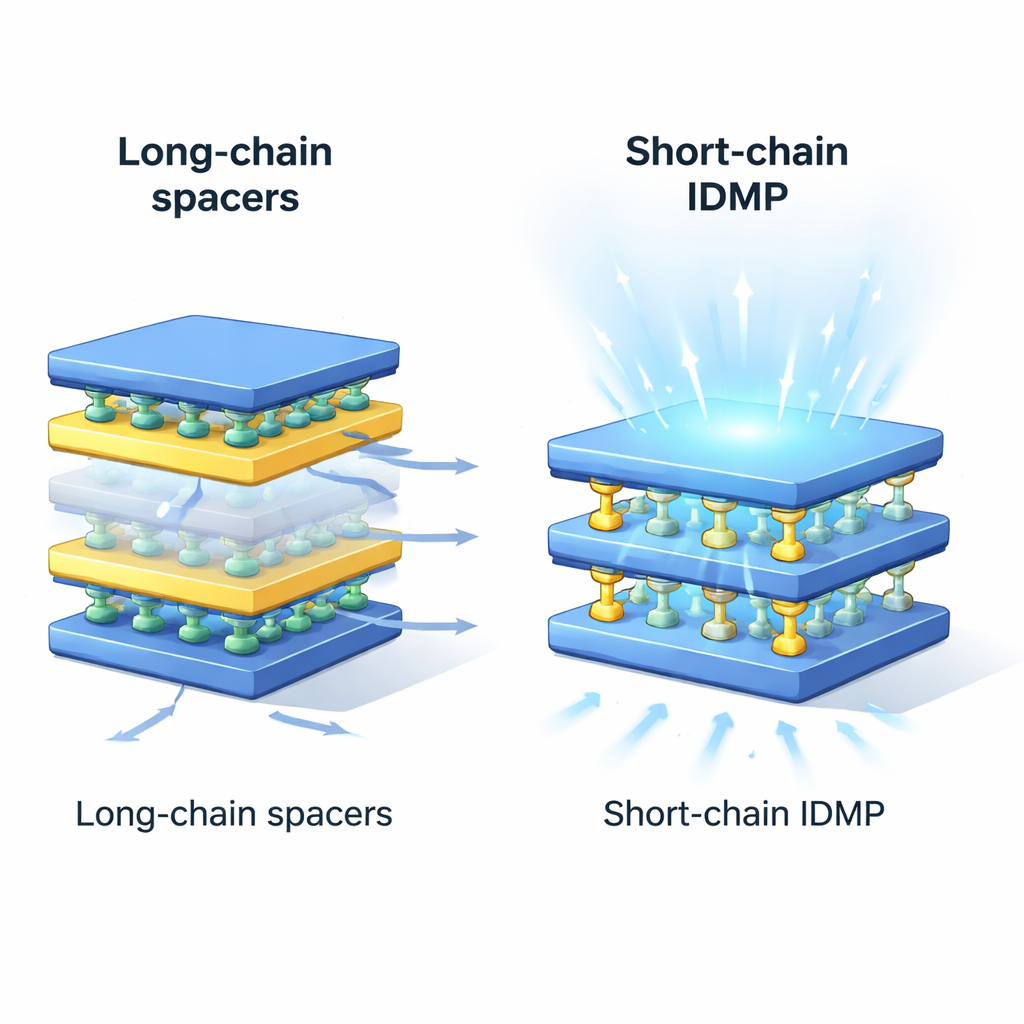
Instead of mixing halides, this work focuses on layered, pure‑bromide perovskites that naturally emit blue light. These materials resemble stacks of atomically thin sheets, separated by organic “spacer” molecules. Conventional spacers are long and electrically insulating, which blocks charges from hopping between layers. The team replaces them with a short molecule called iminodi(methylphosphonic acid), or IDMP. IDMP has two phosphonic groups at its ends that can bind strongly to neighboring lead–bromide units, forming double‑anchored bridges between layers. This design simultaneously tightens the crystal structure, reduces electrical defects, and creates better pathways for charges to travel through the film.
Tuning How Light Is Generated Inside the Film
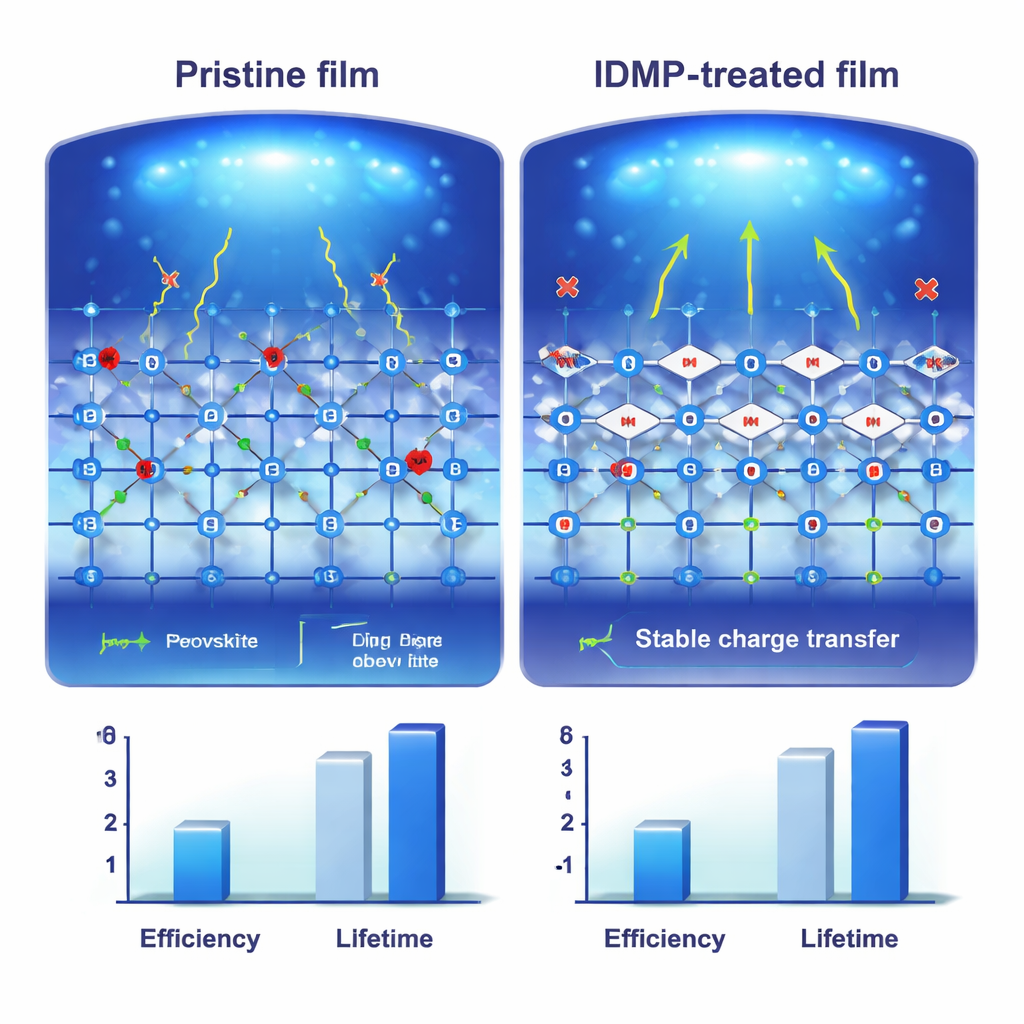
By measuring how the materials absorb and emit light, the researchers show that IDMP changes the way excited states—excitons—behave. The short, strongly binding IDMP lowers the material’s average dielectric constant, which strengthens the attraction between electrons and holes and raises the exciton binding energy. As a result, radiative recombination—the process that produces light—becomes faster and more likely. The treated films exhibit a much higher photoluminescence quantum yield (about 70%, versus 21% in untreated films) and longer lifetimes of the light‑emitting states, signaling fewer non‑radiative loss channels. Ultrafast measurements further reveal that energy moves more efficiently between different perovskite layers, so excitations funnel rapidly to the regions that emit blue light most effectively.
More Conductive, More Stable, and Less Prone to Drift
Electrical tests show that IDMP‑modified films conduct charges better and have more uniform surface potentials, indicating a smoother landscape for electrons and holes to move through. The dominant carrier type also shifts in a way that favors better balance between electrons and holes in the device. Under strong electric fields, heat, and ultraviolet light—conditions that normally cause perovskites to degrade—the IDMP‑treated films retain their brightness far longer than untreated ones. Microscopic imaging reveals that, while control films quickly develop dark regions and phase separation, IDMP‑stabilized films maintain even blue emission, pointing to suppressed ion migration and a more rigid, defect‑poor lattice.
Record‑Level Blue LEDs and What They Mean
When integrated into a full LED stack, the IDMP‑enhanced perovskite layer delivers both sky‑blue and pure‑blue devices with striking performance. The best sky‑blue PeLED reaches an external quantum efficiency of 25.4% and a luminance of roughly 2,500 candelas per square meter, nearly doubling the efficiency of comparable untreated devices. Operational lifetime at a practical brightness level extends from under two hours to well over 13 hours, and similar gains are seen for deeper blue tones. Because these advances arise from a molecular design that improves charge transfer and structural stability without changing the basic perovskite composition, this strategy could be broadly applied to other layered perovskite light sources. For non‑specialists, the takeaway is simple: by engineering better molecular bridges inside the crystal, the authors make blue perovskite LEDs significantly brighter, more stable, and closer to the reliable blue pixels needed for future high‑performance displays.
Citation: Zhang, X., Liu, Z., Wang, L. et al. Manipulating charge transfer dynamics and stabilizing lead bromide octahedra for efficient blue perovskite light-emitting diodes. Nat Commun 17, 1610 (2026). https://doi.org/10.1038/s41467-026-68315-5
Keywords: blue perovskite LEDs, light emitting diodes, charge transfer, display technology, optoelectronics