Clear Sky Science · en
Spin-state engineering of single titanium adsorbates on ultrathin magnesium oxide
Why single atoms on surfaces matter
Today’s computers move charges through billions of transistors, but future quantum machines may instead store information in the tiny magnetic moments, or “spins,” of single atoms. This article explores how scientists can place individual titanium atoms on a carefully prepared surface and deliberately set them into different magnetic states, a step toward building customizable quantum bits (qubits) one atom at a time.
Building a playground for single atoms
The researchers work with an ultrathin layer of magnesium oxide grown on a silver crystal. This insulating film acts as a kind of cushion that weakens the direct contact between an atom and the metal underneath, helping preserve the atom’s quantum properties. Using a scanning tunneling microscope, which can both image and move atoms, they deposit titanium atoms onto regions where the film is either two or three layers thick. The titanium atoms naturally settle into a few preferred spots on the magnesium oxide grid: right on top of an oxygen atom (“O-atop” sites) or in between two oxygen atoms (“bridge” sites). 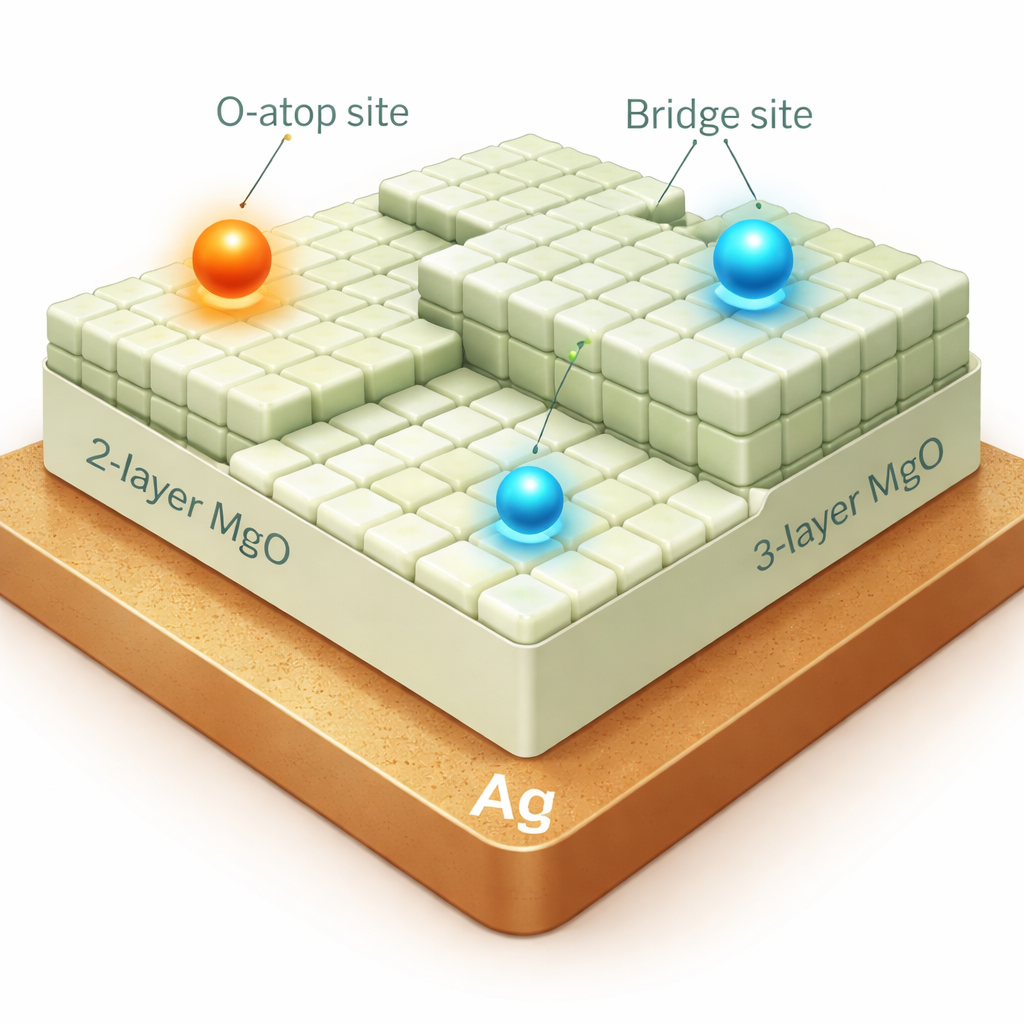
Reading spins with tiny radio antennas
To find out how these atoms behave magnetically, the team combines standard tunneling spectroscopy with electron spin resonance, a technique that drives the atom’s spin using radio waves while the microscope tip detects the response. For many titanium atoms—those on both kinds of sites in the two-layer film and on bridge sites in the three-layer film—the data show a simple “spin one-half” character. This type of spin has just two levels, making it a natural candidate for a qubit. In contrast, titanium atoms sitting on oxygen sites in the three-layer film show a very different fingerprint: they lack a clear spin resonance in the usual frequency range and display steps in the current at specific voltages, signaling a higher spin and a built-in preference for certain directions in space.
Switching spin states by moving one atom
A key advance of this work is that the scientists can rearrange individual titanium atoms and watch their spin state change in a controlled, reversible way. By picking up an atom with the microscope tip and dropping it onto another area, or by nudging it between nearby positions with voltage pulses, they move titanium between oxygen and bridge sites and across regions with different film thickness. Each time, the spectroscopic signatures switch between those of a spin one-half system and those of a higher-spin system. Importantly, this happens without signs of permanent chemical changes such as binding to stray hydrogen atoms, which had previously been suspected. Instead, the results show that the local bonding environment and film thickness alone are enough to tune the spin. 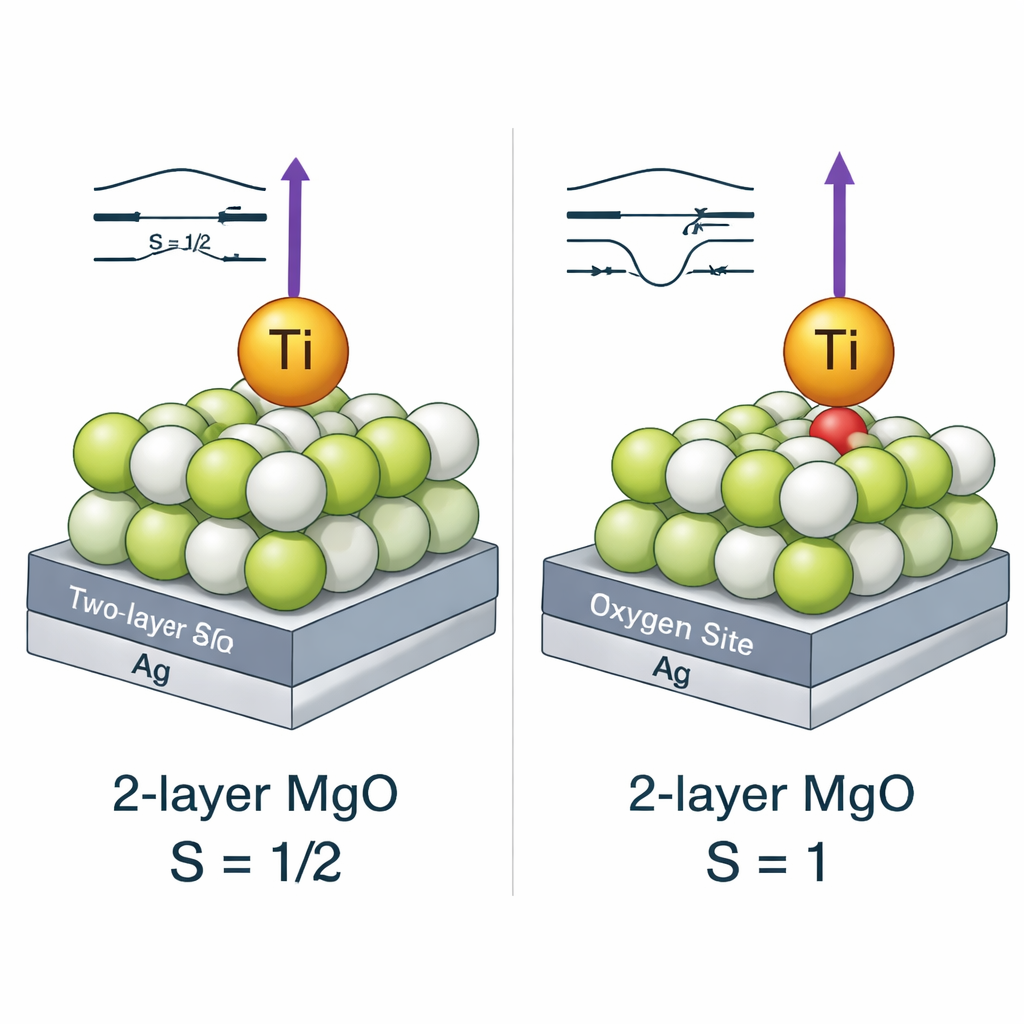
Peering inside with quantum calculations
To explain why the same titanium atom can host different spins, the authors turn to advanced computer simulations. These calculations indicate that, on this surface, titanium tends to lose one electron to the underlying metal, behaving like a positively charged ion with about three remaining valence electrons. How those electrons are distributed among its outer orbitals then determines the spin. On some sites, two electrons line up to reinforce the magnetic moment while the third partly cancels it out, yielding a net spin one-half. On other sites, two electrons cooperate more strongly, giving a spin of one. Subtle changes in how tightly certain orbitals are bound—affected by details like the exact height of the film—can tip the balance between these two situations.
Toward designer quantum bits on surfaces
In plain terms, this study shows that by choosing where a single atom sits on a surface, and how thick that surface layer is, scientists can dial in whether the atom behaves like a simple two-level quantum bit or a more complex spin. Because this control is achieved without adding extra atoms or molecules, it opens a clean route to building ordered arrays of spins with tailored properties. Such atomically engineered structures could become the building blocks of future quantum devices that are assembled one atom at a time and operated with the precision of modern surface science tools.
Citation: Phark, Sh., Bui, H.T., Seo, Wh. et al. Spin-state engineering of single titanium adsorbates on ultrathin magnesium oxide. Nat Commun 17, 1609 (2026). https://doi.org/10.1038/s41467-026-68314-6
Keywords: single-atom qubits, electron spin resonance, scanning tunneling microscopy, magnesium oxide films, spin state control