Clear Sky Science · en
Glutamatergic projection neurons in the basal forebrain underlie learned olfactory associational valence assignments
How the Brain Learns to Like or Dislike a Smell
Everyday experiences—like craving the smell of coffee or recoiling from sour milk—rely on the brain’s ability to attach emotional value to odors. This study explores how a deep brain region called the basal forebrain helps mice learn whether a smell predicts something pleasant, like rich food, or unpleasant, like a mild shock. Understanding this process may illuminate how the brain turns neutral sensations into powerful motivations that guide behavior.
A Hub That Links Senses and Motivation
The basal forebrain is known for its role in arousal, attention, and learning, largely through cells that use the chemical messenger acetylcholine. But this region also contains glutamatergic projection neurons—cells that send fast excitatory signals to many other brain areas involved in reward, punishment, and decision-making. The researchers focused on a subdivision called the horizontal limb of the diagonal band, which both receives smell information and sends signals back to olfactory areas. They asked whether this specific group of glutamatergic neurons helps transform simple smell signals into learned “good” or “bad” values that steer behavior.
Neutral Smells Don’t Stand Out at First
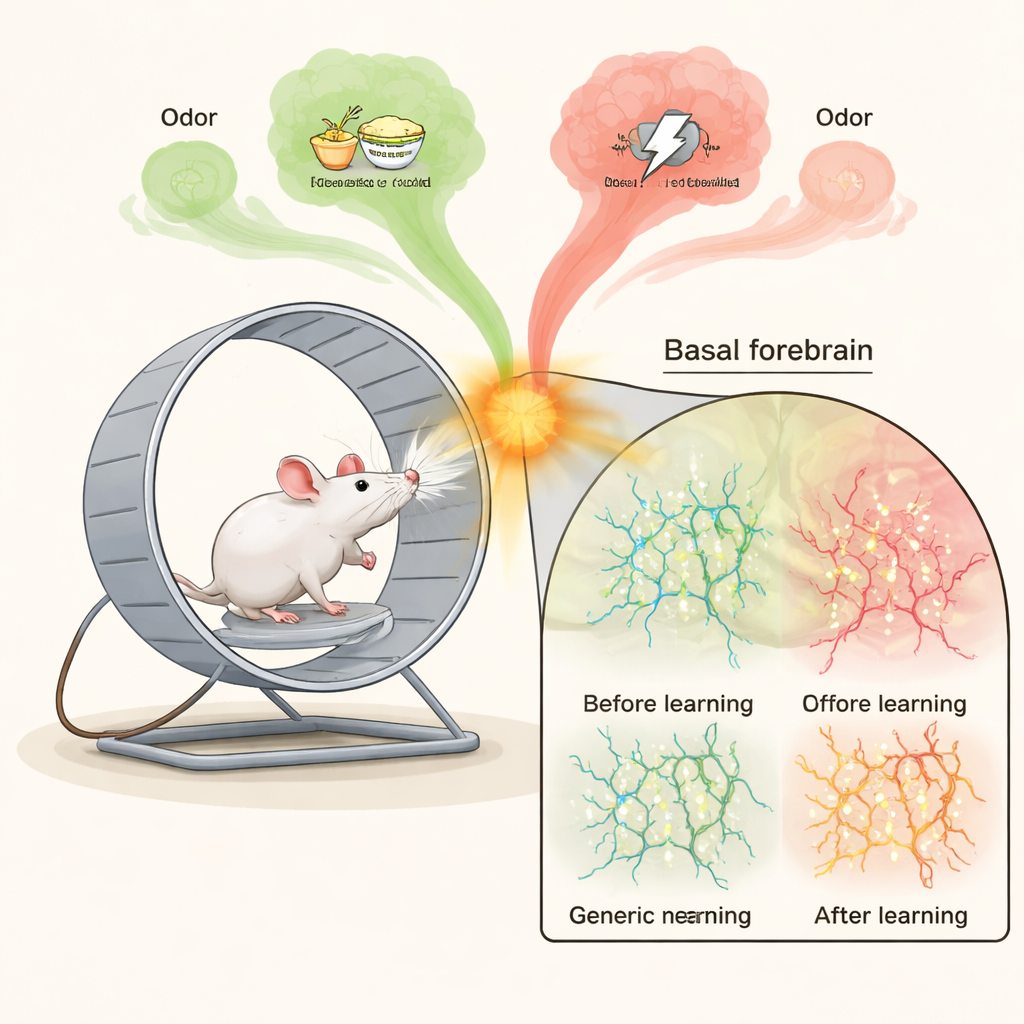
Using tiny lenses and a miniature microscope mounted on the heads of mice, the team recorded activity from individual basal forebrain neurons while neutral odors were delivered. They found that many of these neurons responded when odors were presented, but their responses were broad and overlapping: single neurons often reacted to several different smells, and many did not respond at all. When the researchers used computer models to try to “read out” which odor had been presented from the combined activity of all recorded neurons, the decoding was no better than chance. The same was true even for odors that are innately unpleasant to mice. In other words, at baseline these cells did not clearly signal which smell was which, nor whether a smell was naturally attractive or aversive.
Learning Turns Smells into Meaningful Signals
The picture changed dramatically once odors were paired with meaningful outcomes. The scientists trained mice so that one previously neutral odor predicted access to a high-fat food reward, while another predicted a brief foot shock. A third odor was left unpaired, and a fourth was merely repeated to cause simple habituation. Behaviorally, mice learned to seek out the food-linked odor and avoid the shock-linked one. In the basal forebrain, responses to both the rewarded and punished odors grew stronger, and additional neurons that had been silent before now became active. Population-level analyses showed that patterns of activity for the conditioned odors diverged from each other and from the control odors, and decoding models could now reliably tell the learned smells apart. The neurons became especially reliable in responding to the shock-associated odor, suggesting that particularly salient negative experiences leave a strong imprint in this circuit.
Silencing or Driving Neurons Changes What Mice Learn
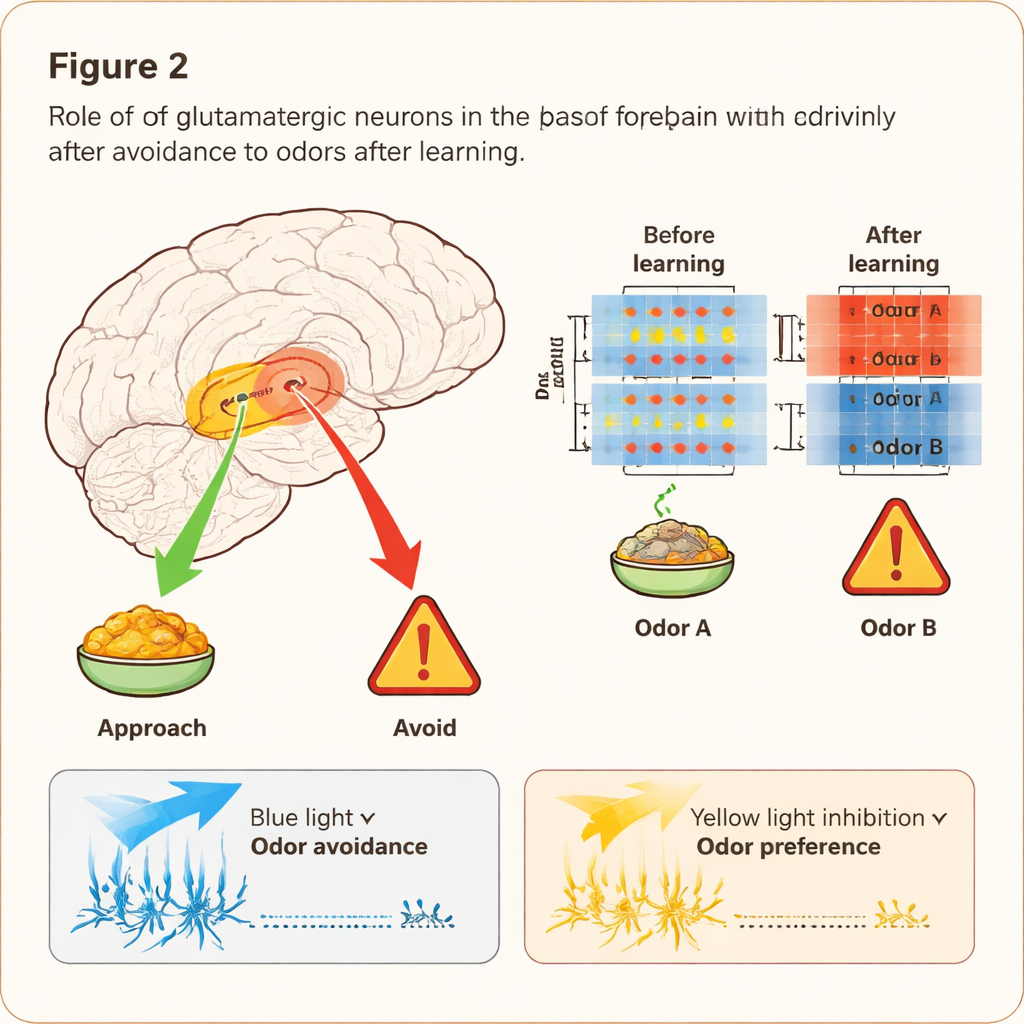
To test whether these neurons are required for odor-based learning, the team used chemogenetic tools to temporarily dampen their activity during an odor discrimination task. Mice could still smell and tell odors apart in simple tests, but when asked to learn which of two new odors predicted water reward, mice with silenced basal forebrain glutamatergic neurons learned more slowly and performed worse overall. In separate experiments, the researchers used light-sensitive proteins to artificially activate or inhibit these neurons exactly when a neutral odor was presented. Pairing odor with activation pushed mice to avoid that odor later, while pairing odor with inhibition caused mice to prefer it. Simply put, shifting the activity of this cell population at the moment of smelling was enough to stamp a negative or positive value onto an otherwise meaningless scent.
Why This Matters for Everyday Experience and Disease
This work shows that a specific group of cells in the basal forebrain does not initially label smells as good or bad, but comes to encode their learned emotional value through experience. By strengthening and reshaping their responses after training, these neurons help convert simple sensory input into motivational signals that drive approach or avoidance. Because the same circuit talks to brain regions involved in reward, mood, and stress, these findings may help explain how certain cues—like the smell of a favorite food or a reminder of a bad event—gain powerful influence over behavior, and suggest potential targets for treating conditions in which such value assignments go awry, such as addiction, anxiety, or depression.
Citation: Chin, PS., Ding, Z., Kochukov, M. et al. Glutamatergic projection neurons in the basal forebrain underlie learned olfactory associational valence assignments. Nat Commun 17, 1608 (2026). https://doi.org/10.1038/s41467-026-68313-7
Keywords: olfactory learning, basal forebrain, neural valence coding, motivated behavior, glutamatergic neurons