Clear Sky Science · en
Diffractive magic cube network with super-high capacity enabled by mechanical reconfiguration
Turning Light into an Ultra-Dense Data Canvas
Modern technologies – from ultra-fast internet links to holographic displays and precision microscopes – all rely on how well we can shape beams of light. This paper presents a new way to squeeze far more information into a single optical device by cleverly rearranging just three thin patterned plates. The approach promises smaller, cheaper systems that can store, route, and sculpt light in thousands of ways without needing power-hungry electronics.
A Puzzle Cube for Light Waves
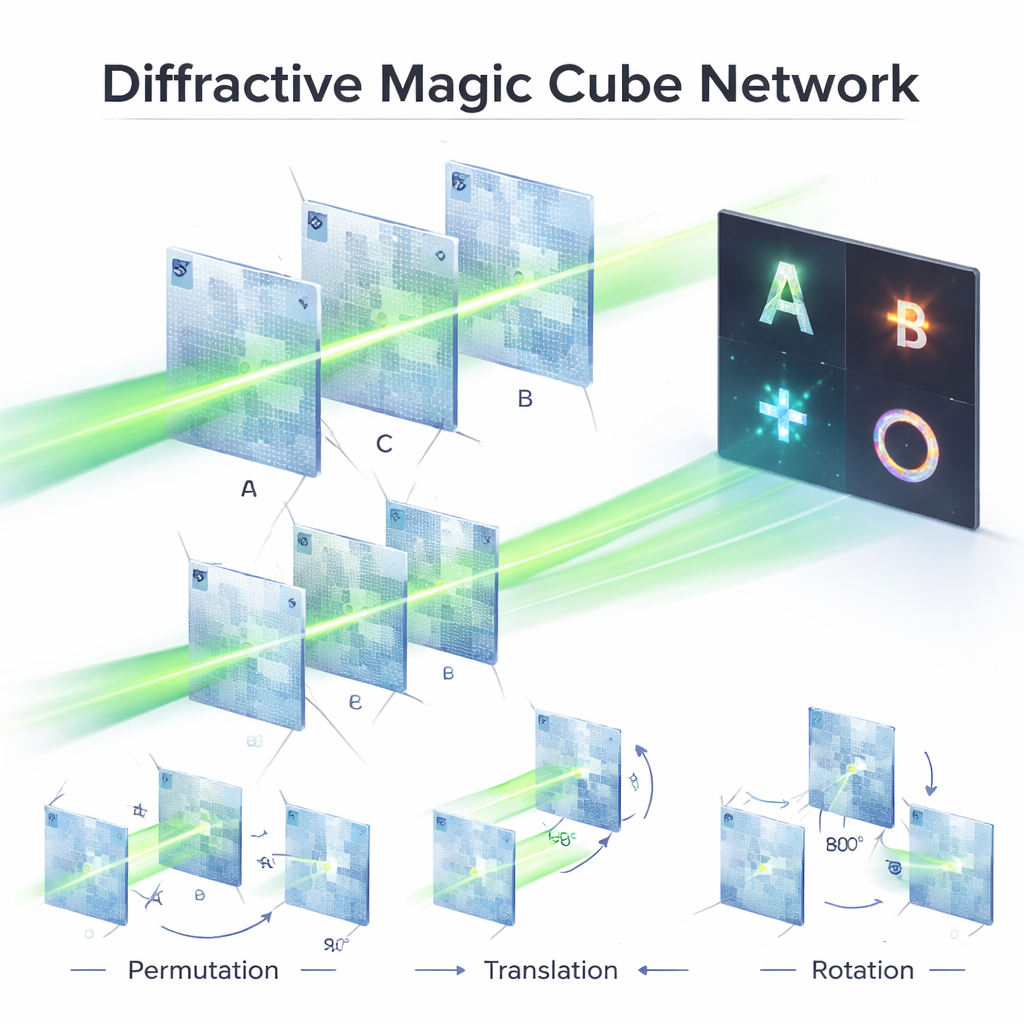
The researchers introduce what they call a diffractive magic cube network, or DMCN. Instead of using complex electronics or exotic materials, the system relies on three flat, transparent plates etched with microscopic patterns that nudge passing light waves. Like a Rubik’s cube for optics, these plates can be swapped in order, slid closer or farther apart, and rotated in quarter turns. Each distinct mechanical arrangement acts as a “channel” that transforms an incoming laser beam into a different output pattern – such as an image, a sharp focus, or a special kind of twisted light.
Borrowing Tricks from Artificial Intelligence
Designing such a device by hand would be nearly impossible, because every change in one plate affects all of the others. To tackle this, the team uses a concept borrowed from deep learning, known as a diffractive deep neural network. In software, they model how light ripples from one plate to the next and into a target region, then numerically “train” the phase pattern on each plate so that many different mechanical configurations all produce their own desired result. Crucially, all channels share the same three plates, so the training must carefully balance them to avoid crosstalk – unwanted mixing between channels.
Packing in Hundreds of Optical Functions
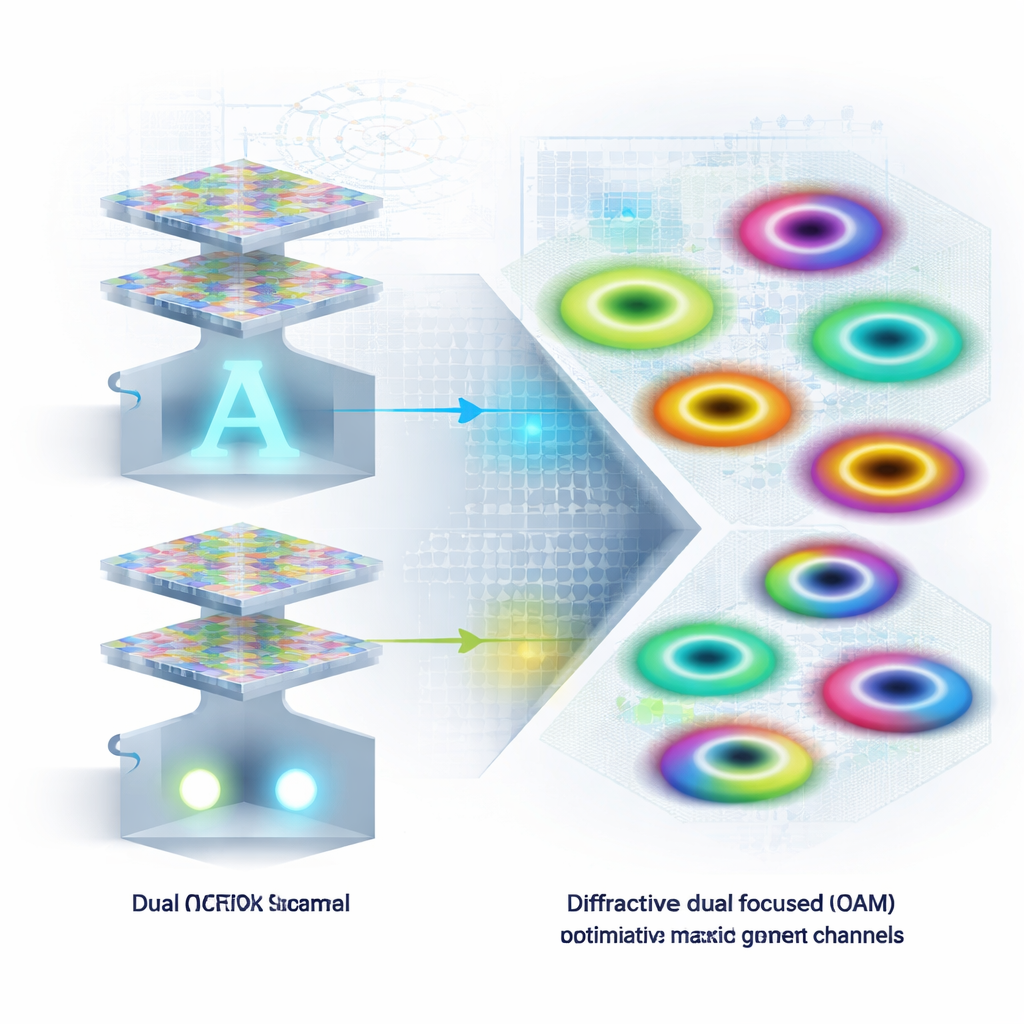
By combining the three simple motions – permutation (changing the plate order), translation (adjusting distances), and rotation – the DMCN can, in principle, realize more than four thousand different channels. The authors do not optimize all of them at once, but they carefully choose subsets that can be trained together. Experimentally, they demonstrate 144 distinct holographic images, 108 different single or dual focus patterns, and 60 channels that generate single or multi-mode orbital angular momentum (OAM) beams – light shaped into donut-like rings with a twist. Despite the huge number of functions, the measured image similarity and noise levels show that the channels remain clean and largely independent, with low interference between them.
Scaling Up Without Starting Over
To understand how far this idea can go, the researchers derive a simple “connectivity” rule that links plate size, spacing, and wavelength to how strongly layers interact. Devices that share the same connectivity behave almost like scaled versions of one another: patterns trained for one set of hardware can be transferred to another with different dimensions or even different colors of light, as long as this rule is obeyed. Simulations show that increasing the plate size relative to the viewing area both raises the number of usable channels and improves image quality, suggesting a clear recipe for building larger-capacity systems.
What This Means for Future Light-Based Technologies
In everyday terms, the DMCN shows that you can get “super-high capacity” control of light simply by rearranging a few carefully designed plates. Instead of wiring in more electronics or stacking many specialized components, a single passive device can act as hundreds of holograms, lenses, and beam shapers, all selected by mechanical motion. This makes it attractive for secure holographic storage, reconfigurable microscopes and lithography tools, and dense optical communication links. Because it only needs phase-patterned surfaces, the same idea could be built using metasurfaces or liquid crystals and extended from visible light to terahertz and microwave bands – turning the humble act of sliding and twisting optical layers into a powerful control knob for information-rich light.
Citation: Feng, P., Liu, F., Liu, Y. et al. Diffractive magic cube network with super-high capacity enabled by mechanical reconfiguration. Nat Commun 17, 1605 (2026). https://doi.org/10.1038/s41467-026-68310-w
Keywords: holography, diffractive optics, optical multiplexing, orbital angular momentum, reconfigurable photonics