Clear Sky Science · en
Cooperative atomic motion during shear deformation in metallic glass
Why this hidden atomic dance matters
When we bend a paper clip or pull on a piece of plastic, we see smooth motion, not the frantic jostling of trillions of atoms underneath. For glassy metals—metallic glasses used in everything from sports gear to tiny devices—this invisible motion has been especially mysterious because their atoms are arranged without a regular crystal pattern. This study peeks behind the curtain, using supercomputer simulations and a clever “time‑machine” trick to show that small groups of atoms moving together, rather than permanent defects, are what really control how these materials bend, yield, and sometimes suddenly fail.
A different kind of metal
Most metals you encounter are crystalline: their atoms sit in repeating, orderly patterns. In such materials, deformation is carried mainly by defects called dislocations, which slide through the lattice like tiny rugs being tugged along a floor. Metallic glasses are different. They are frozen in a disordered, glassy state, more like a metal liquid suddenly stopped mid‑swirl. Surprisingly, even though their internal structure looks random, many metallic glasses show similar mechanical strength and failure behavior, regardless of how they are made. That puzzling universality hints that the usual picture—where permanent structural defects dictate strength—may not apply here.
Finding the tiny teams of atoms
Researchers often talk about “shear transformation zones” (STZs), tiny regions where atoms collectively rearrange when a metallic glass is sheared. Until now, these zones were identified by looking at the aftermath of a deformation event—where atoms moved a lot or where local stress changed strongly—and then inferring which atoms must have been involved. This approach is fuzzy: different thresholds pick out different zone sizes, and it is hard to tell cause from effect. In this work, the authors instead use an athermal quasi‑static shear simulation and introduce a new “frozen‑atom analysis.” They first locate a stress‑drop event in the simulation, rewind to just before it happens, and then rerun the relaxation many times, each time artificially freezing the motion of a single atom. If freezing a particular atom prevents the event, that atom is deemed essential to a cooperative group—the STZ “core.” Repeating this for every atom reveals, unambiguously, the smallest cluster whose coordinated motion triggers the deformation.

Trigger groups, not built‑in weak spots
The frozen‑atom analysis shows that each deformation event is controlled by a compact core of tens of atoms—on average about 40, sometimes up to just over 100—that must move together for the stress to relax. These cores are scattered throughout the material and rarely repeat at the same place. When the authors examined the atomic structure and stiffness of these core atoms before any shear was applied, they found no special signatures: their local geometric environment, as described by Voronoi analysis, and their local shear modulus looked no different from other atoms. In other words, the atoms that will later form a trigger group are not sitting in obvious “soft spots” or identifiable defects in the undisturbed glass. Any region can, in principle, become a trigger if the evolving stress and strain fields line up just right.
From local triggers to avalanches
The simulations also track how these trigger groups interact with their surroundings during a stress‑drop. Inside an STZ core, some atoms change which neighbors they are bonded to—events the authors call local configurational excitations. These bond switches cause surrounding atoms to move in a non‑uniform, or non‑affine, way. In several cases, this local disturbance then activates neighboring STZ cores, leading to a cascade of events. The result is an “avalanche” of plastic deformation: a small, hard‑to‑predict trigger can spread into a much larger rearrangement. Interestingly, the size of the stress drop follows a broad, power‑law‑like distribution, while the number of atoms in a core is tightly clustered, and not directly proportional to the stress released. That means big avalanches do not come from gigantic cores; they emerge from how many cores get triggered in sequence.
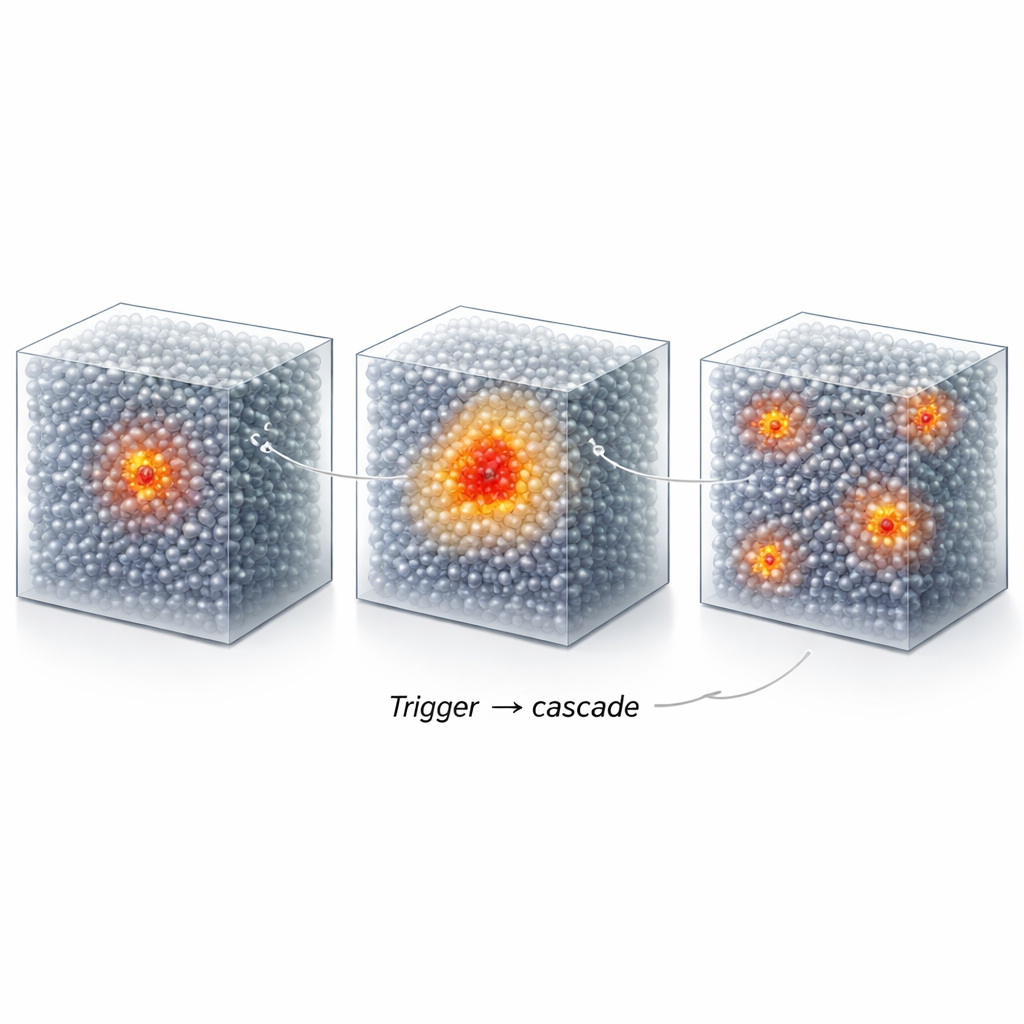
Rethinking how glassy materials fail
To a non‑specialist, the key message is that in metallic glasses, failure is not governed by pre‑existing flaws carved into the structure, as in many crystals. Instead, the material’s response is controlled by small, temporary teams of atoms that lock together elastically, move cooperatively, and then dissolve once the event is over. These trigger groups can pop up almost anywhere and sometimes nudge one another into action, producing sudden, avalanche‑like slips. Recognizing cooperative atomic motion as the true “switch” behind deformation helps explain why different metallic glasses behave so similarly and connects their behavior to other systems—like earthquakes or granular flows—where small triggers can lead to big events.
Citation: Shiihara, Y., Iwashita, T., Adachi, N. et al. Cooperative atomic motion during shear deformation in metallic glass. Nat Commun 17, 1604 (2026). https://doi.org/10.1038/s41467-026-68308-4
Keywords: metallic glass, shear transformation zones, cooperative atomic motion, plastic deformation, avalanche dynamics