Clear Sky Science · en
Non-polar nanocluster confinement engineering realizes high capacitive energy storage in Pb-free high-entropy relaxors
Powering Tomorrow’s Electronics
From electric cars to medical defibrillators, many modern devices rely on ceramic capacitors that can charge and discharge electricity in a flash. But engineers face a stubborn problem: how to pack more usable energy into these components without wasting much as heat, and without using toxic lead. This study presents a new way to build safer, lead‑free ceramic capacitors that store a lot of energy while remaining highly efficient, opening doors for more compact and reliable power electronics.
Why Storing Electric Energy Is So Hard
Ceramic capacitors store energy by shifting tiny electric dipoles inside a crystal when a voltage is applied. To get high energy storage, these dipoles must align strongly, but when they do, they often resist switching back, causing energy loss every time the device charges and discharges. This loss appears as a wide, “fat” loop when plotting polarization against electric field, and it limits both performance and lifetime. For real‑world systems like electric vehicles and pulsed power supplies, designers want capacitors that hold a lot of energy, waste very little, and keep working over billions of rapid cycles.
A New Way to Tame Tiny Electric Regions
The researchers tackle this challenge using a special class of materials known as high‑entropy relaxor ceramics. In these crystals, five different elements share the same atomic site, creating a patchwork of local environments that naturally break up long‑range order. On top of this, they introduce a small amount of tin (Sn) into another part of the crystal lattice. Because tin responds weakly to electric fields, tiny tin‑rich areas behave as non‑polar “dead zones.” Computer simulations show that these zones become stable, field‑resistant nanoclusters that sit among many small polar regions and act like pins, preventing the polar areas from merging into large, strongly locked‑in domains under high voltage. 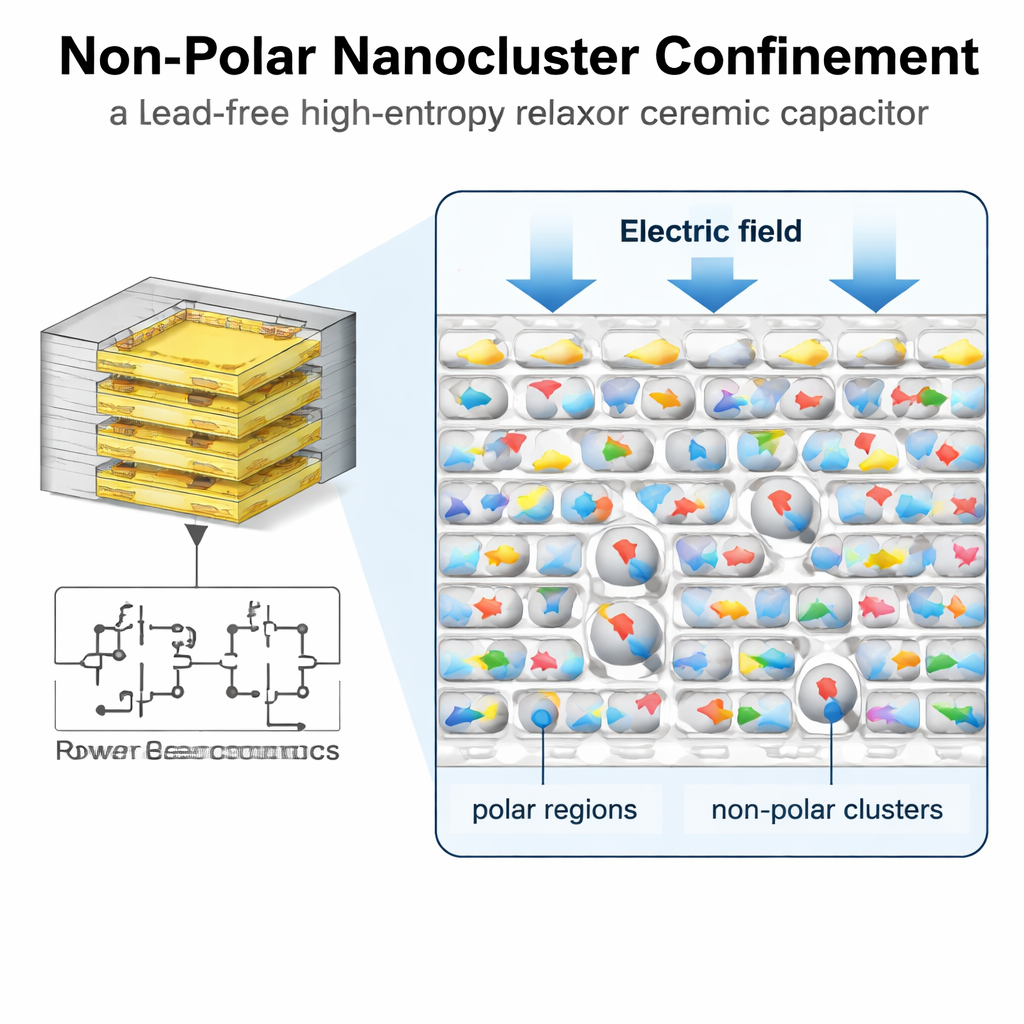
From Computer Design to Real Ceramic Parts
Guided by these simulations, the team made a family of ceramics based on the composition (Bi0.2Na0.2Ba0.2Sr0.2Ca0.2)(Ti1−xSnx)O3 and varied the amount of tin. Microscopy measurements confirmed that adding tin keeps the polar regions very small, even when the material is driven by strong electric fields. Electrical tests showed that a particular tin level (x = 0.06) is optimal: the material still polarizes strongly, but its polarization–electric field loop becomes slim, meaning very little energy is lost per cycle. In bulk ceramic form, this composition already delivers higher stored energy and efficiency than the undoped version, proving that the non‑polar nanoclusters are working as intended.
Building Better Multilayer Capacitors
The researchers then turned this optimized ceramic into multilayer ceramic capacitors similar to those used in circuits. Each device contains several thin ceramic layers sandwiched between metal electrodes, which raises the breakdown strength and usable energy per volume. These capacitors reached a recoverable energy density of about 18.5 joules per cubic centimeter with an energy efficiency of roughly 92 percent—values that place them among the best lead‑free capacitors reported so far. The devices also maintained stable performance over a wide temperature range, from near freezing to around 250 °C, and across different operating frequencies, all while supporting ultrafast, nanosecond‑scale discharge suitable for pulse‑power applications. 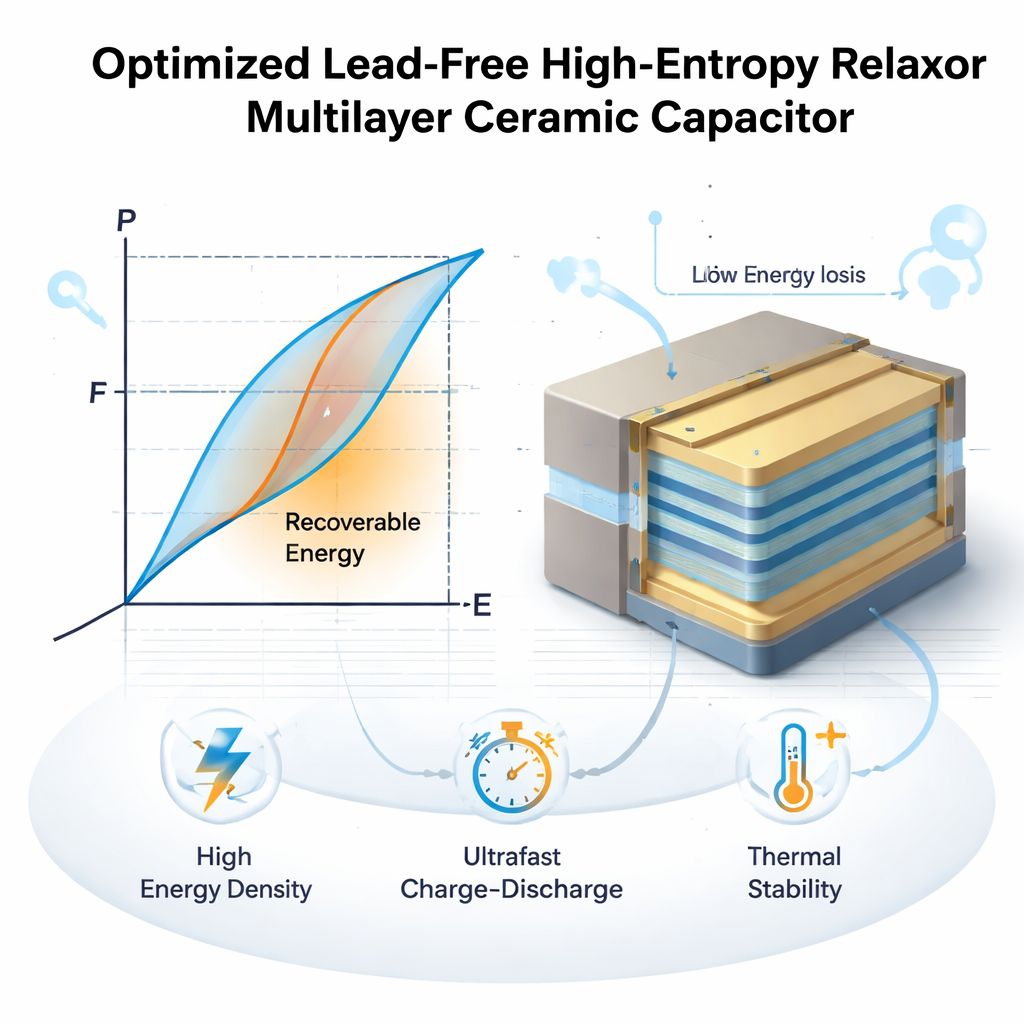
What This Means for Future Devices
In simple terms, this work shows that intentionally adding tiny, non‑responsive islands inside a complex ceramic can keep its active regions under control, allowing the material to store more energy while wasting less. By using a high‑entropy, lead‑free composition and carefully tuning the amount of tin, the authors created capacitors that are powerful, efficient, and robust under demanding conditions. This “nanocluster confinement” approach offers a new design rule for next‑generation capacitors that could make future power electronics smaller, cleaner, and more reliable.
Citation: Xie, A., Li, Z., Wu, X. et al. Non-polar nanocluster confinement engineering realizes high capacitive energy storage in Pb-free high-entropy relaxors. Nat Commun 17, 1584 (2026). https://doi.org/10.1038/s41467-026-68301-x
Keywords: ceramic capacitors, energy storage, lead-free materials, relaxor ferroelectrics, power electronics