Clear Sky Science · en
Near field optical visualization of the nanoscale phase percolation dynamics of a VO2 oscillator
Why tiny electronic flickers matter
Modern computers burn vast amounts of energy shuttling electrons through billions of transistors. Scientists are exploring new materials that could think and process information more like the brain—using quick, low‑energy electrical pulses instead of rigid on/off switches. This paper looks inside one such candidate material, vanadium dioxide (VO2), and shows, with nanoscopic “eyes,” how its internal landscape of metallic and insulating regions gives rise to self‑sustained electrical oscillations that could power future neuromorphic, brain‑inspired circuits.
From solid switch to nervous system
VO2 is remarkable because it can flip between an insulating state, where it barely conducts electricity, and a metallic state, where it conducts very well. This change can be triggered by modest heating or electrical current and involves both the electrons and the crystal lattice. When a constant current is applied in a certain range, a VO2 device does something surprising: instead of settling into one state, its resistance oscillates rhythmically, producing voltage spikes reminiscent of nerve impulses. Until now, however, researchers mostly inferred what was happening inside from electrical measurements alone—they could not directly watch how the metallic and insulating regions formed, moved, and disappeared during these oscillations.
Imaging the hidden heartbeat of a device
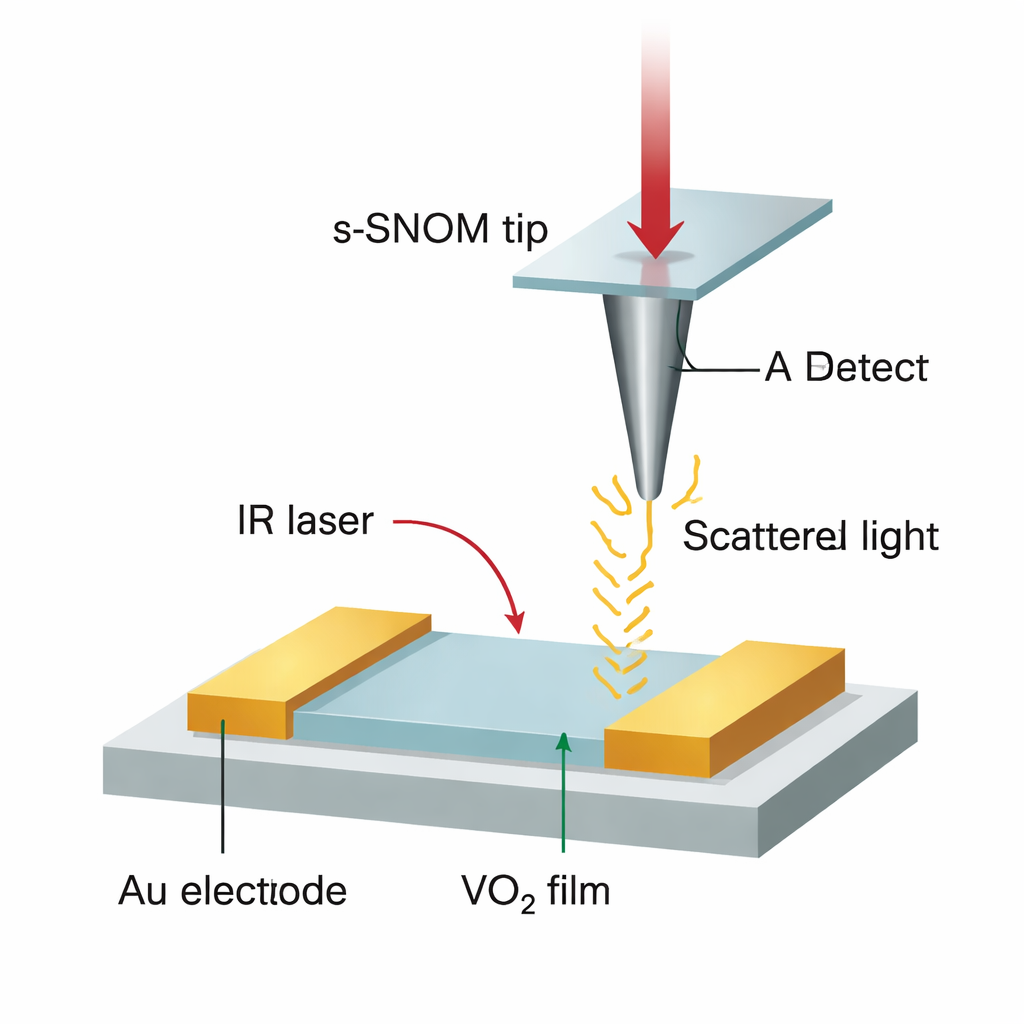
The authors used a powerful technique called scattering‑type scanning near‑field optical microscopy (s‑SNOM) to see inside working VO2 devices at the scale of tens of nanometers—thousands of times smaller than a human hair. A sharp metallic tip, illuminated by mid‑infrared light, scans across the surface and senses local optical reflections that are strongly linked to whether the material beneath is metallic or insulating. By cooling and warming thin VO2 films equipped with gold electrodes, and by carefully ramping the current through them, the team built up a movie‑like view of how the material switches during operation, while simultaneously tracking electrical resistance.
Metallic islands and flickering filaments
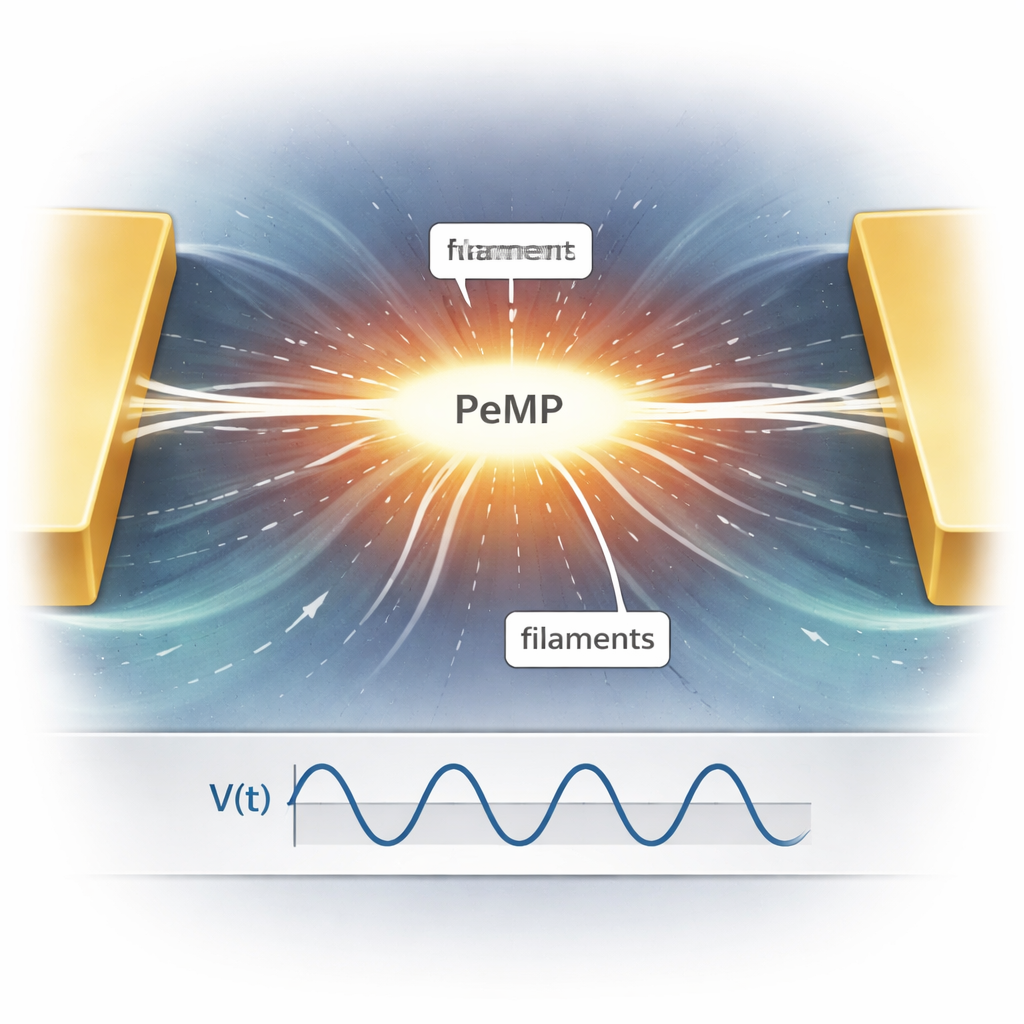
The images reveal that oscillations do not simply come from the entire region between electrodes flipping back and forth. Instead, a key player emerges: a “persistent metallic patch” (PeMP) that forms only after a sufficiently high current is first applied. This patch appears in the middle of the active region and stays metallic even when the current is later reduced, acting as a long‑lived island of good conductivity in an insulating sea. During oscillations, ultrathin metallic filaments—some only about 140 nanometers wide—flicker in and out of existence, briefly bridging this central patch to each electrode and then vanishing. The combination of a stable metallic island and rapidly reconfiguring filaments controls whether the device sits in a high‑ or low‑resistance state at any instant.
A built‑in memory node
Further measurements show that the PeMP is slightly oxygen‑deficient compared with the surrounding VO2, a sign that local heating and current flow permanently modify the material in that region. Simulations of the temperature distribution match this picture: the device heats most strongly in the center, where the patch forms, while the areas near the electrodes remain cooler and more insulating. This behavior resembles a form of long‑term potentiation known from neuroscience, where a strong stimulus leaves a lasting change in synaptic strength. Here, a single strong electrical pulse imprints a metallic “memory node” in VO2 that later guides where filaments form and where oscillations occur. The electrodes act like artificial neurons, the filaments like synapses, and the PeMP like a stabilized hub in this tiny network.
Ripples that reach beyond the circuit
By analyzing not just the average near‑field signal but also its full frequency spectrum, the researchers detected subtle optical sidebands—signatures that the local reflectivity itself is being modulated at the oscillation frequency. Strikingly, these oscillation‑linked signals spread up to about two micrometers beyond the nominal active region between electrodes, implying that the thermal and electronic ripples from each VO2 oscillator extend into its surroundings. Such long‑range influence is promising for building networks of coupled oscillators that communicate not only through wires, but also through shared heat and fields in the underlying film, enabling richer collective behavior for sensing or computation.
What this means for future electronics
By directly visualizing how metallic patches and nanoscopic filaments appear, disappear, and pulsate inside VO2, this work turns an abstract electrical effect into a concrete picture of moving phase boundaries. For a layperson, the key message is that these devices behave less like rigid switches and more like living circuits with memory and internal dynamics, closer in spirit to neural tissue than to silicon logic. Understanding and controlling this hidden landscape will be crucial for designing reliable, low‑power VO2‑based oscillators that can be wired into large networks for brain‑inspired computing, advanced sensors, and other unconventional electronics.
Citation: Tiwari, K., Wang, Z., Xie, Y. et al. Near field optical visualization of the nanoscale phase percolation dynamics of a VO2 oscillator. Nat Commun 17, 600 (2026). https://doi.org/10.1038/s41467-026-68300-y
Keywords: vanadium dioxide, phase transition, neuromorphic, nano-oscillator, near-field imaging