Clear Sky Science · en
Constructing superrelaxor critical state towards giant energy storage in lead-free dielectric ceramics
Powering Future Electronics
Modern electronics and power grids need components that can store energy and release it in an instant—think electric cars, pulsed lasers, or protection circuits that react faster than a blink. This paper describes a new way to design ceramic materials that act like tiny, super-fast rechargeable capacitors. The authors show how a carefully engineered, lead-free ceramic can pack a lot of energy into a small volume while wasting very little as heat, potentially enabling smaller, safer, and more efficient power systems.
Why Storing Energy in Ceramics Is Hard
Ceramic capacitors store energy by lining up electric dipoles—small charge separations inside the material—when a voltage is applied. To get a high energy density, you want strong polarization (many dipoles pointing the same way) and a high breakdown strength (the material can survive large electric fields). But there is a catch: when the voltage is removed, many materials do not fully relax. Their dipoles stay partly aligned, creating hysteresis, where some of the input energy is lost as heat. For decades, improving polarization usually meant more hysteresis and lower efficiency, making it difficult to combine high energy density with high efficiency in a single ceramic.
A Sweet Spot Between Order and Disorder
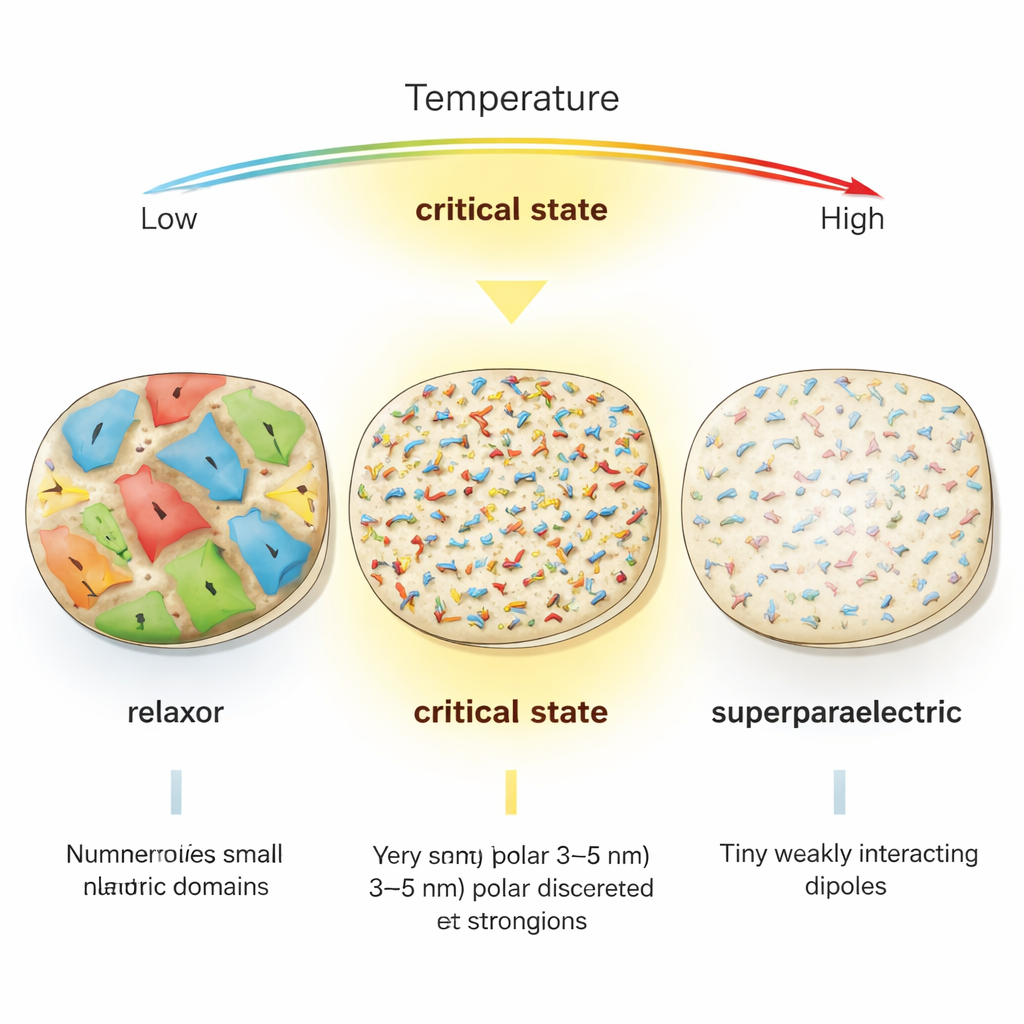
The authors tackle this trade-off by deliberately creating an in-between state they call a “superrelaxor critical state.” In conventional relaxor ceramics, tiny polar regions fluctuate but still interact strongly, boosting polarization while also causing losses. In a superparaelectric state, the dipoles move freely with almost no loss, but the overall polarization is weaker. The team’s idea is to tune the ceramic so that, at room temperature, its internal dipoles sit exactly at the crossover between these two extremes—dynamic enough to switch easily but still strong enough to store a lot of energy.
Designing the Material from Atoms Up
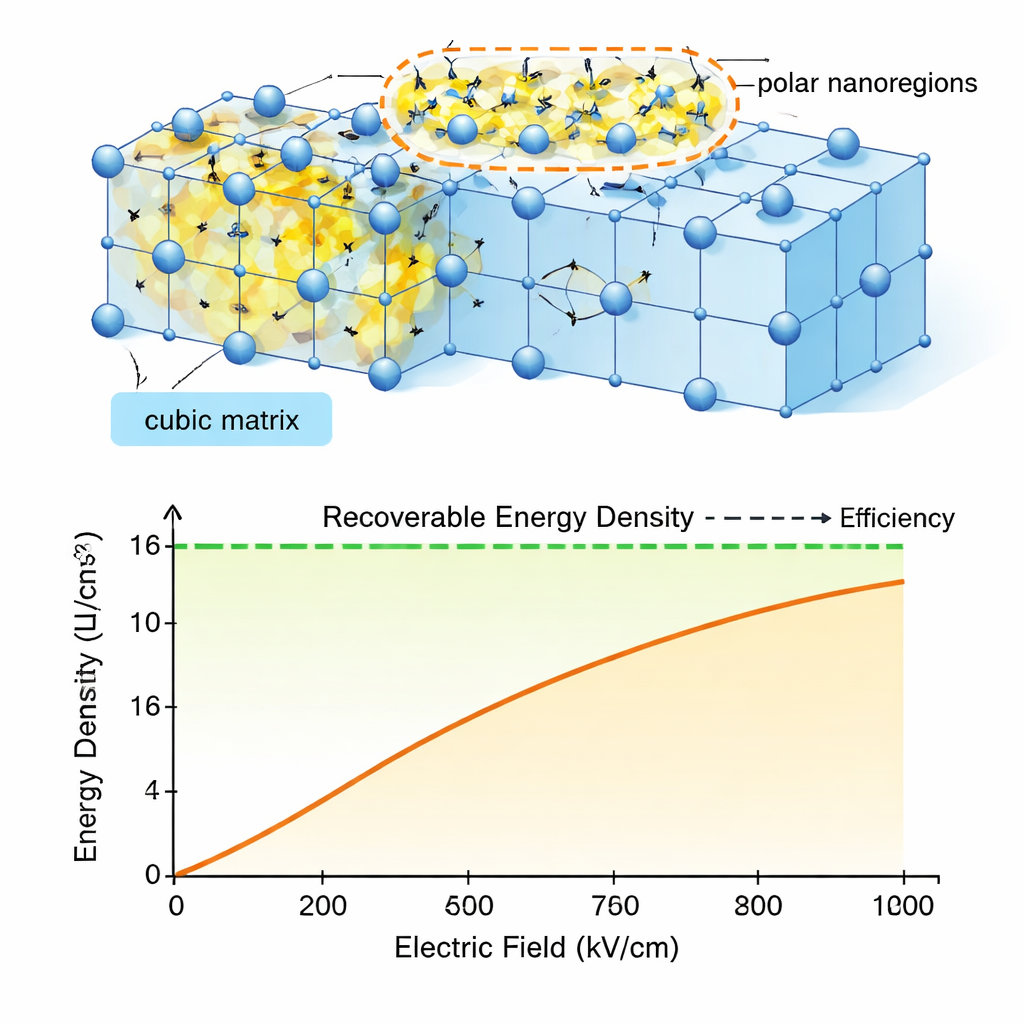
To realize this state, the researchers started with a known relaxor, Sr0.5Bi0.25Na0.25TiO3, and mixed in a paraelectric compound, BaHfO3. Using computer simulations and quantum mechanical calculations, they predicted that adding BaHfO3 would expand and distort the crystal lattice, breaking up large polar regions into many smaller ones only about 3–5 nanometers across. Experiments on synthesized ceramics confirmed this picture: X-ray diffraction showed a mix of polar and nonpolar crystal phases, while high-resolution electron microscopy revealed dense, nanoscale polar clusters embedded in a more neutral background. These clusters still carry strong local polarization, but their interactions are weakened and more isotropic, so they can reorient easily under an applied field.
Record Energy Storage in a Lead-Free Ceramic
These structural changes translate directly into performance. When the composition is tuned so that 30 percent of the material is BaHfO3, the ceramic exhibits nearly rectangular, very slim polarization–electric field loops, meaning little energy is lost each cycle. At high electric fields near its breakdown limit, this optimized composition achieves a recoverable energy density of 16.2 joules per cubic centimeter with an efficiency of 92 percent—numbers that place it at the top tier of reported lead-free bulk ceramics. Careful measurements show why: the material combines a large difference between maximum and remnant polarization, high electrical resistance, a wide bandgap that suppresses leakage currents, and fine grains that block breakdown paths.
Built for Speed and Reliability
Beyond raw capacity, the ceramic also performs well under realistic operating conditions. It maintains stable energy storage and efficiency over a wide frequency range and from room temperature up to 150 °C. In rapid charge–discharge tests, it can release most of its stored energy in tens of nanoseconds, corresponding to power densities of hundreds of megawatts per cubic centimeter. Even after one hundred million charge–discharge cycles, its performance remains essentially unchanged. This robustness stems from the highly dynamic polar nanoregions: they switch readily without causing large-scale structural fatigue, limiting heat generation and damage.
What This Means for Future Devices
In simple terms, the authors show how to engineer a ceramic whose internal dipoles are strong but not stubborn—easy to switch on and off without wasting energy. By carefully tuning composition and atomic structure to place the material at a superrelaxor critical state at room temperature, they break the usual compromise between energy density and efficiency. This approach offers a blueprint for designing a new generation of compact, lead-free capacitors for pulsed power, electric vehicles, and high-performance electronics, bringing faster and more reliable energy storage technologies a step closer to everyday use.
Citation: Xie, B., Li, Z., Luo, H. et al. Constructing superrelaxor critical state towards giant energy storage in lead-free dielectric ceramics. Nat Commun 17, 1583 (2026). https://doi.org/10.1038/s41467-026-68299-2
Keywords: dielectric energy storage, relaxor ceramics, lead-free capacitors, polar nanoregions, high-power electronics