Clear Sky Science · en
Design framework for programmable three-dimensional woven metamaterials
Stretchy materials built from tiny woven frameworks
Imagine a material as light and airy as a sponge, but strong, stretchy, and able to fail in ways we choose ahead of time. This paper shows how engineers can design such materials by weaving microscopic fibers into intricate three-dimensional patterns, opening possibilities for flexible electronics, soft robots, and tissue-friendly medical implants.
From rigid scaffolds to soft, programmable networks
For years, researchers have built “mechanical metamaterials” by arranging solid beams and plates into repeating 3D patterns. These architectures can be incredibly stiff and strong for their weight, but they do not like to stretch: pull them too far and they snap. The authors argue that an equally important goal is to make materials that are highly compliant—able to bend and elongate dramatically without breaking—because such behavior is vital for applications that must flex with bodies, cushions, or machines.
Weaving fibers in three dimensions
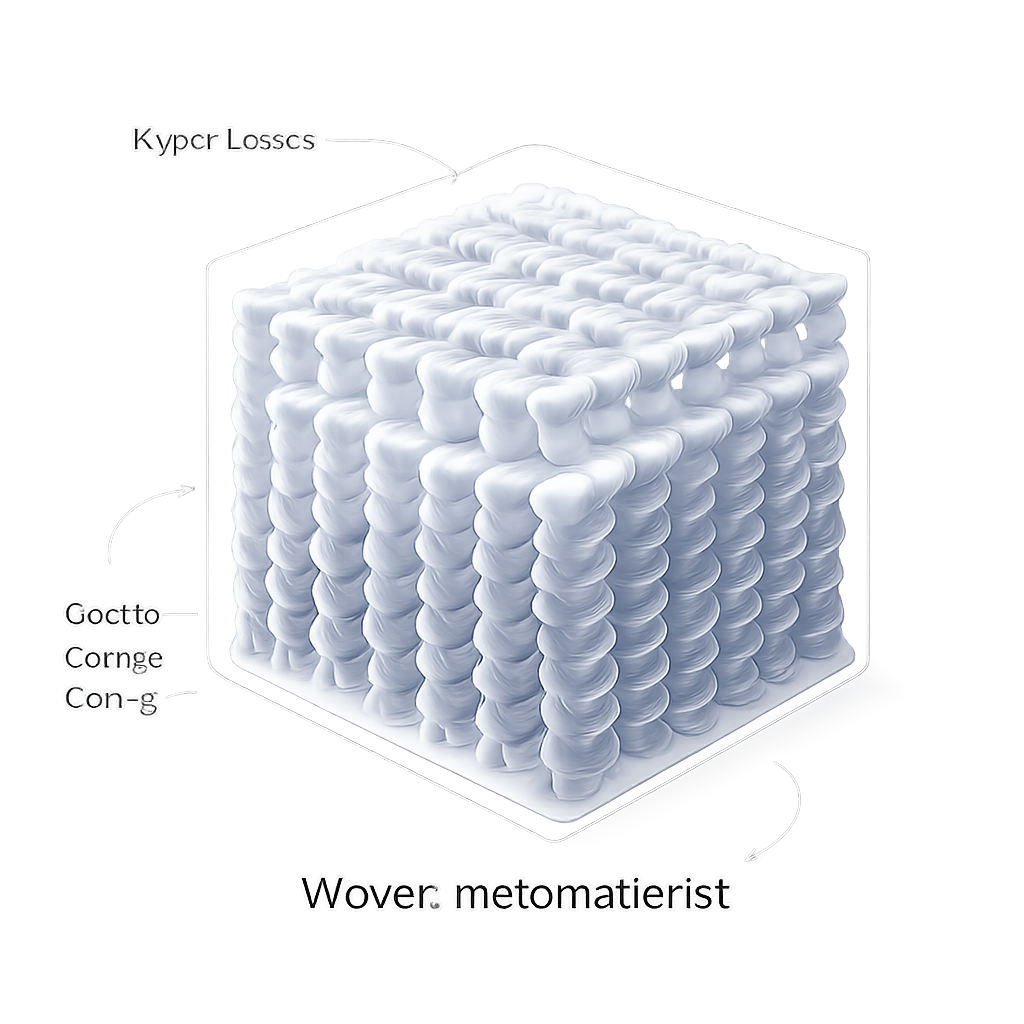
Instead of relying on straight beams that meet at rigid joints, the team focuses on woven lattices: networks of slender fibers that curve, twist, and wrap around one another at smooth junctions. At the points where fibers cross, they do not form sharp corners; they gently curve and slide, which reduces stress concentrations and allows large deformations, much like a braided rope. Until now, designing these structures was largely a hand-crafted art in computer-aided-design software, limited to just a few repeating patterns. The authors introduce a systematic recipe that starts from any conventional beam lattice and converts it into a woven version using a mathematical “graph” that records how beams connect. Each beam in the original structure is replaced by a bundle of intertwined helical fibers, and special twisted nodes ensure that fibers link up smoothly throughout the 3D network.
Dialing in stiffness, directionality, and stretch
The framework boils the complex geometry down to just two key knobs per beam: the effective radius of the helix (how far fibers spiral out from the center) and the number of turns they make along the beam’s length. By adjusting these two numbers, designers can control how densely fibers pack, how strongly they interlock, and how far an individual fiber travels through the lattice. Computer simulations show that the same basic pattern can be tuned from relatively stiff to very soft, and that stiffness can be made strongly directional—firm in one direction and flexible in another—simply by changing these fiber parameters. Because the method works at the level of individual beams and unit cells, it becomes easy to build lattices where properties vary smoothly from place to place, creating functionally graded materials that bend, stretch, or resist loads in precisely chosen regions.
Experiments on microscopic woven structures
To test the predictions, the team used high-resolution 3D printing to manufacture tiny samples with unit cells about the width of a human hair and fibers just a micrometer thick. Inside an electron microscope, they stretched these lattices while recording their shapes and measuring their forces. They found that increasing the helix radius generally made the material softer but more stretchable, while changing the number of fiber turns altered how gradually the material failed. Some designs behaved in a brittle fashion, with a sudden drop in load, whereas others showed a more graceful, ductile-like failure with long stretches before rupture. In all cases, the woven lattices could stretch two to four times their original length—far beyond what similar, non-woven architectures usually survive.
Simulations that reveal how fibers move and fail
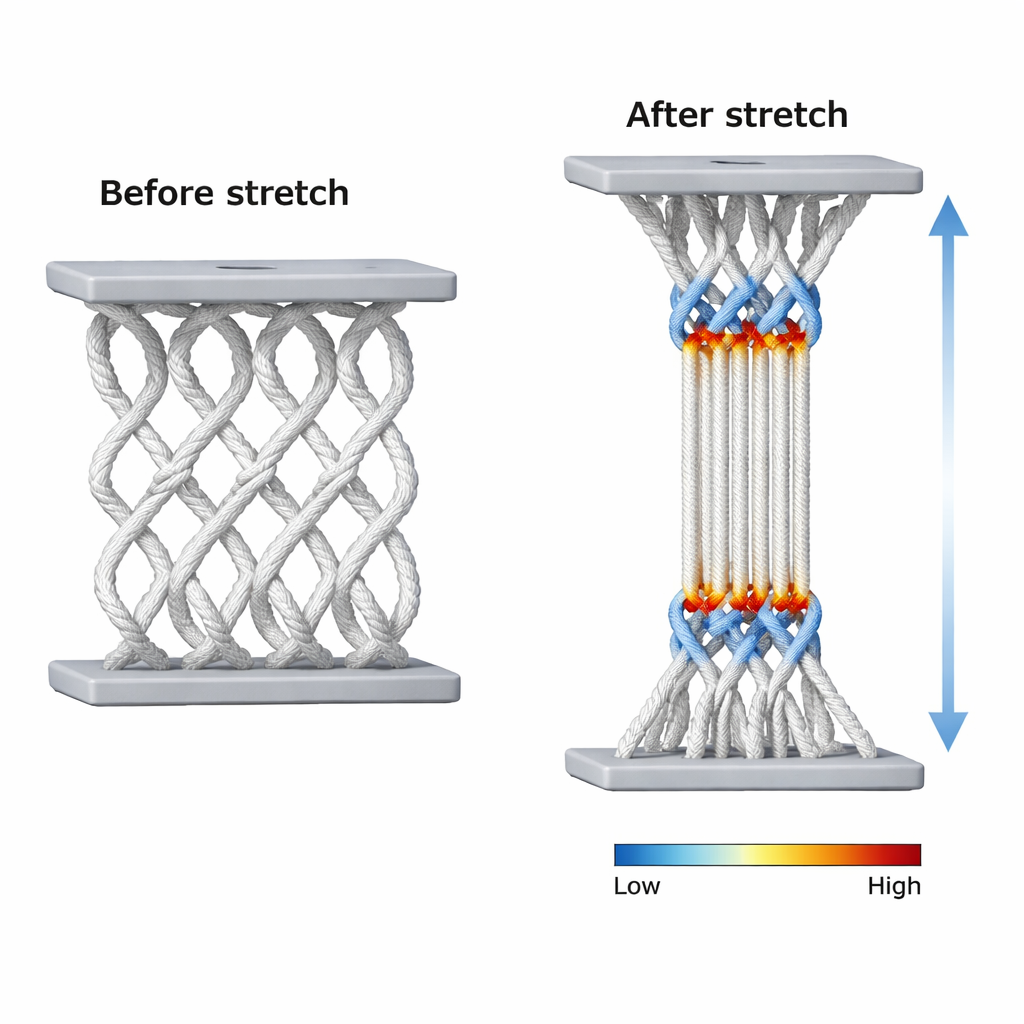
Because directly simulating every tiny detail of these woven networks would be computationally expensive, the authors developed a more efficient computer model that treats each fiber as a flexible beam that can bend, twist, and slide against its neighbors with friction. This reduced model closely matches both high-fidelity simulations and real experiments, yet runs thousands of times faster. It reveals how fibers initially straighten under load, then develop tight entanglements at the nodes where contact pressures and bending become concentrated. These hotspots govern how the lattice carries loads, dissipates energy, and eventually breaks, giving engineers clear targets for tuning performance by rearranging fiber paths.
Writing with strain and guiding where things break
Because the method lets designers vary fiber parameters from cell to cell, the authors demonstrate eye-catching examples of “programmable” deformation and failure. In one case, a flat woven sheet is patterned so that under tension the word “MIT” appears as certain regions stretch more than others. In another, a sinusoidal path of weaker cells is embedded in an otherwise stronger sheet, causing the material to tear along that predesigned curve. These examples show that woven metamaterials can be engineered not only for overall stiffness or stretchability, but also for where they bend and how they fail, potentially allowing safer, more predictable behavior in applications ranging from protective gear to biomedical devices.
Why this matters
To a non-specialist, the key message is that the authors have turned a complex weaving problem into a simple, programmable design toolkit. By describing 3D woven lattices with just a few geometric knobs and validating them through experiments and simulations, they open up a new family of materials that are lightweight, highly stretchable, and customizable in how they deform and break. This could ultimately enable soft yet tough structures that adapt to their environment—materials that do not just passively bear loads, but are carefully choreographed to move, protect, and even fail in ways we can design in advance.
Citation: Carton, M., Surjadi, J.U., Aymon, B.F.G. et al. Design framework for programmable three-dimensional woven metamaterials. Nat Commun 17, 1581 (2026). https://doi.org/10.1038/s41467-026-68298-3
Keywords: mechanical metamaterials, 3D woven lattices, stretchable materials, architected materials, material design toolkit