Clear Sky Science · en
Ultrahigh energy storage density and efficiency in AgNbO3-based ceramics by percolating interaction between antipolar regions and defect pairs
Why Better Capacitors Matter
From electric vehicles that need rapid bursts of power to miniature electronics that must stay cool and reliable, modern technology depends on capacitors that can store and release energy both quickly and efficiently. Today’s best dielectric capacitors trade off between how much energy they can hold, how much they waste as heat, and how well they work across a wide range of temperatures. This study reports a way to push past those limits using a carefully engineered, lead‑free ceramic based on silver niobate, potentially enabling smaller, safer and more robust power components.
Turning Atomic Order into Useful Energy
At the heart of the work is a class of materials called antiferroelectrics. In these crystals, tiny electric dipoles inside the lattice line up in opposite directions so that, overall, the material appears non‑polar. When a strong electric field is applied, these opposing dipoles can suddenly snap into alignment, producing a large jump in polarization and, in turn, a large amount of storable electrical energy. However, this switching is usually abrupt, lossy and sensitive to temperature, which limits practical applications. The authors focus on a well‑known lead‑free antiferroelectric, AgNbO3, and ask whether its atomic structure can be redesigned so that it stores more energy, wastes less and remains stable from deep cold to high heat.
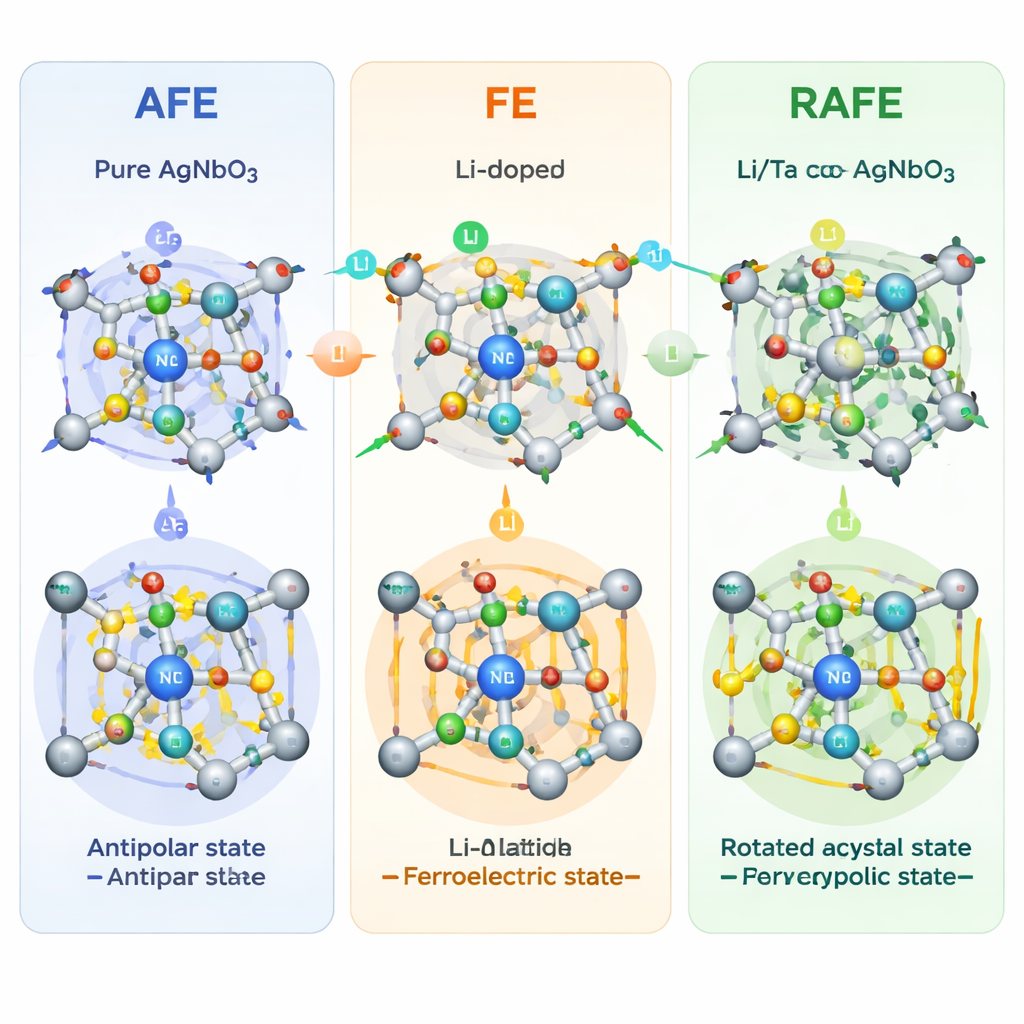
Designing Helpful Defects at the Atomic Scale
The team combines quantum‑mechanical calculations and mesoscale simulations to explore what happens when small amounts of lithium (Li) and tantalum (Ta) are introduced into the AgNbO3 lattice. Lithium replaces some of the silver atoms, while tantalum replaces some niobium atoms. The calculations show that when Li and Ta sit near each other, they form strongly coupled “defect pairs” that tug on the surrounding oxygen octahedra and rotate nearby electric dipoles. Rather than destroying order, this rotation breaks the long, continuous antiferroelectric stripes into a finely divided mixture of tiny antipolar and polar regions. The result is a new state the authors call a rotated antiferroelectric (RAFE) state, which forms a percolating network throughout the crystal.
Simulating a Path to High Density and Low Loss
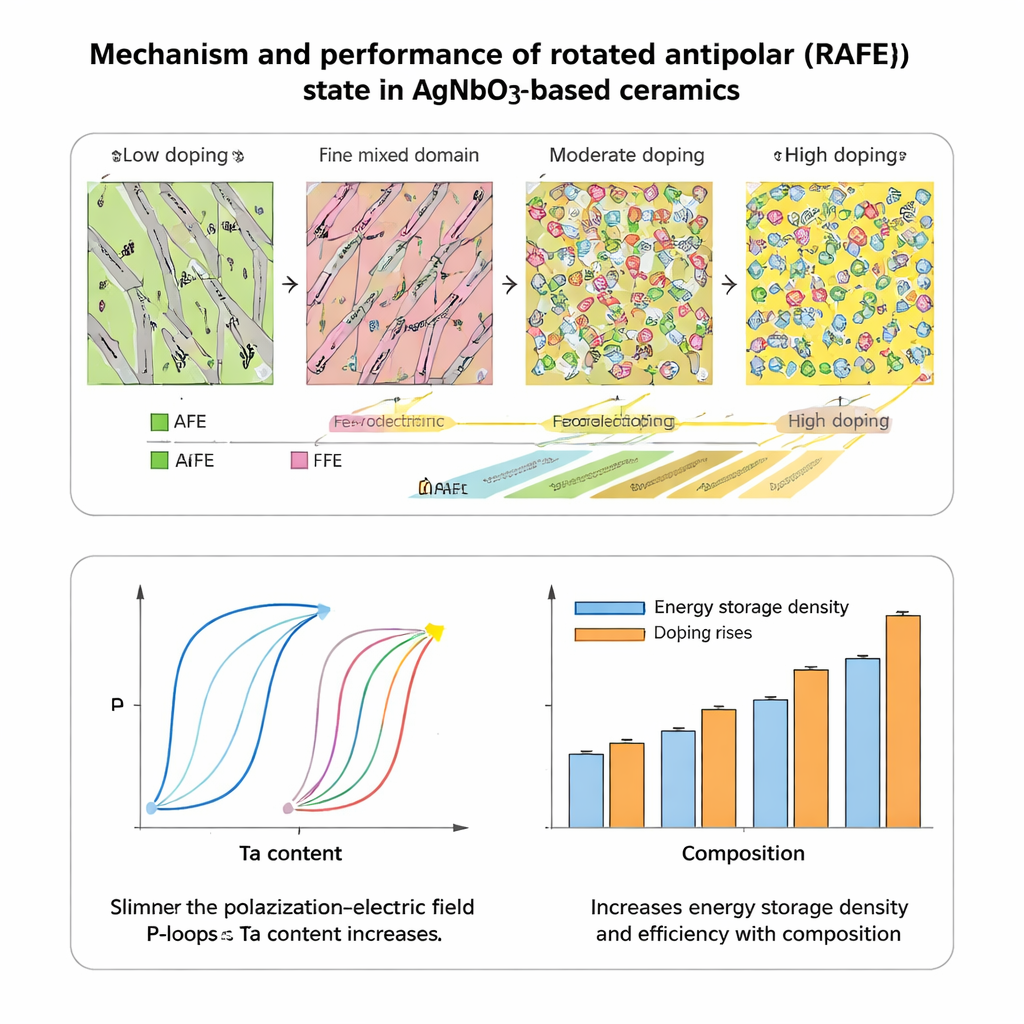
Using phase‑field simulations, the researchers then examine how this RAFE network responds to electric fields. As the concentration of Ta is increased in Li‑doped AgNbO3, the simulations predict that antiferroelectric and ferroelectric domains shrink to the nanoscale and their motion is increasingly constrained by the rotated regions. This has two key consequences: the hysteresis in the polarization–electric field loop becomes much smaller, meaning less energy is lost as heat, and the material can withstand much higher electric fields before breaking down. In the optimal composition, the model predicts a recoverable energy storage density approaching 16 J/cm³ with efficiencies above 95%, while maintaining strong polarization at high fields.
Building and Testing the Optimized Ceramic
Guided by these calculations, the authors synthesize a series of ceramics with formula (Ag0.95Li0.05)(Nb1−xTax)O3, varying the Ta content. Electrical measurements confirm many of the simulated trends. As Ta content rises, the characteristic double‑loop behavior of antiferroelectrics becomes slimmer, and the electric field required for switching increases, while the energy loss (measured as loop area and electric hysteresis) drops dramatically. The champion composition, Ag0.95Li0.05Nb0.35Ta0.65O3, achieves a recoverable energy storage density of 12.8 J/cm³ with 90% efficiency at room temperature—among the best values reported for any lead‑free bulk ceramic. Crucially, the breakdown strength also climbs, reaching roughly 760 kV/cm in experiments, which enables operation at such high energy densities.
Staying Stable from Deep Cold to High Heat
Beyond peak performance, capacitors must work reliably under changing temperatures. Dielectric and structural measurements show that in the highly Ta‑rich compositions, the coexistence of antiferroelectric and ferroelectric nanoregions persists over a broad temperature window instead of collapsing through sharp transitions. The freezing temperature, where these nanodomains become sluggish, shifts far below room temperature, meaning that the dipoles remain dynamic and respond quickly to fields even in the cold. In the best composition, the recoverable energy only changes slightly between −70 °C and 170 °C, maintaining about 90% of its maximum value across a span of roughly 240 °C—far wider than in most comparable lead‑free materials.
What This Means for Future Devices
For non‑specialists, the main outcome is that a lead‑free ceramic has been engineered to store large amounts of electrical energy, release it efficiently and keep doing so reliably from sub‑arctic to engine‑bay temperatures. By deliberately placing specific dopant pairs inside the crystal and exploiting their long‑range influence on tiny electric dipoles, the researchers create a finely tuned “frustrated” state that combines high polarization with low loss. This design strategy—using targeted defect networks to reshape nanoscale domain patterns—could be extended to other oxide ceramics, offering a general route toward compact, high‑power capacitors for electric vehicles, pulsed power systems and advanced electronics.
Citation: He, L., Zhang, L., Ran, Y. et al. Ultrahigh energy storage density and efficiency in AgNbO3-based ceramics by percolating interaction between antipolar regions and defect pairs. Nat Commun 17, 1582 (2026). https://doi.org/10.1038/s41467-026-68297-4
Keywords: lead-free capacitors, antiferroelectric ceramics, energy storage density, silver niobate, dielectric materials