Clear Sky Science · en
Microwave-alkali co-activated persulfate enables minute-scale fertilization of food waste with high fulvic-like acid yield
Turning Leftovers into Plant Food
Every day, mountains of food scraps are thrown away, where they quickly rot and create odors, greenhouse gases, and disposal costs. This study explores a way to turn those leftovers—starting with waste potatoes—into a liquid fertilizer in just minutes instead of weeks, using a household-like microwave and small amounts of common chemicals. For a lay reader, the appeal is clear: instead of food waste being a smelly problem, it could become a same‑day resource that helps grow new crops and improves soil health.
A Faster Path Than Traditional Compost
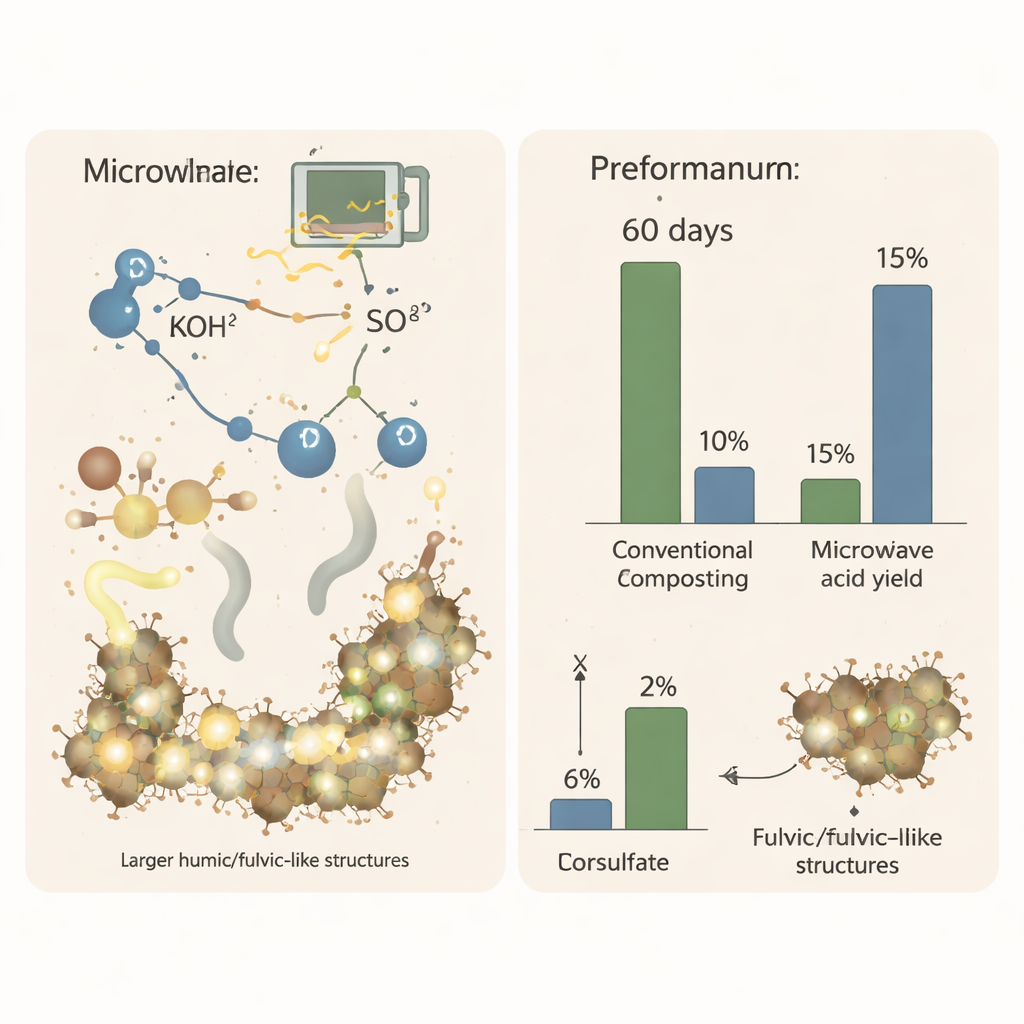
Conventional composting, where microbes slowly break down food and yard waste, typically takes 20–60 days and needs space, careful mixing, and the right balance of ingredients. Even then, much of the carbon is lost as gas, and only a small fraction ends up as water‑soluble, plant‑boosting substances known as fulvic‑like acids. The authors asked whether chemistry and microwaves could dramatically speed up this “humification” process—the transformation of fresh organic matter into darker, more stable, soil‑friendly materials—while preserving more nutrients.
Microwaves, Kitchen Chemicals, and a Ten‑Minute Reaction
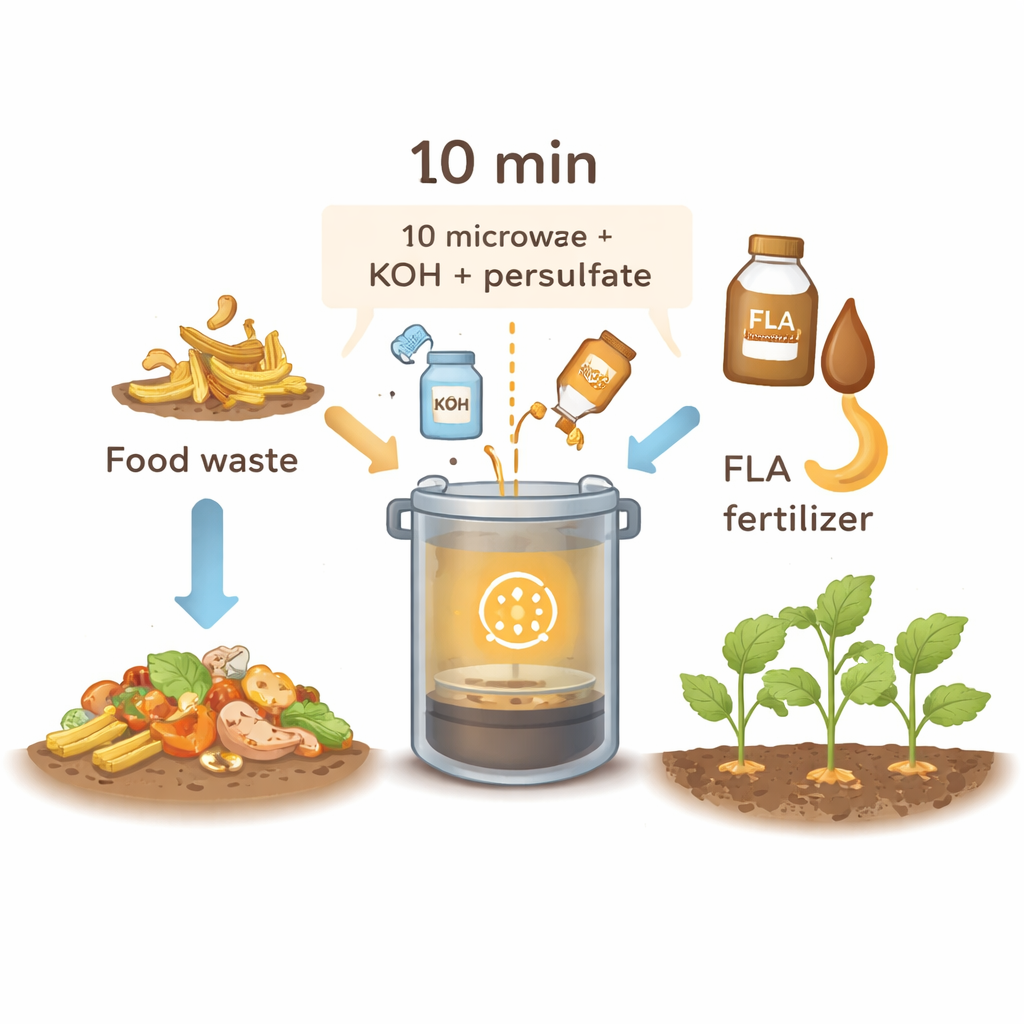
The team used chopped waste potatoes as a stand‑in for typical food scraps and added low doses of potassium hydroxide (a common alkali) and persulfate (an oxidant). When this mixture was exposed to microwave energy at modest power for about ten minutes, the persulfate was “activated” to form highly reactive short‑lived species. These species broke large, messy food molecules into smaller building blocks and then helped stitch them back together into fulvic‑like substances. At the same time, the microwave heating made the mixture hot and well mixed, further speeding up the chemistry without relying on slow‑growing microbes.
From Potatoes to Powerful Fertilizer
Under optimized conditions, the process produced a liquid rich in fulvic‑like acids (about 15 percent by weight) and potassium ions (around 7.6 percent by weight), both prized ingredients in many commercial fertilizers. Detailed chemical tests showed that the product contained more aromatic and carboxyl‑rich structures—hallmarks of stable, humus‑like material—than the original potato waste. When this liquid was combined with a clay mineral and formed into granules, it became a slow‑release fertilizer that steadily leaked both fulvic‑like acids and potassium into water over a month, rather than all at once, mimicking premium controlled‑release products.
Helping Plants and Soil While Saving Resources
Pot experiments with Shanghai cabbage revealed that soils treated with the humified product yielded larger, healthier plants than soils given either raw potato waste or a simple potassium salt alone. The slow‑release granules performed best of all, likely because they provided a steady trickle of nutrients and organic matter rather than a sharp spike. Soils receiving the new fertilizer accumulated more organic matter, more available nitrogen and potassium, and showed signs of a healthier microbial community, including more beneficial decomposer bacteria and fewer potential plant‑disease groups. Importantly, the process caused less loss of carbon and nitrogen than a more chemical‑intensive version without microwaves and far less than typical composting.
Scaling Up from Kitchen to Park
To test whether this idea could extend beyond potatoes in a lab, the researchers processed larger batches of mixed vegetable residues and cooked kitchen waste in an industrial microwave system. In just six minutes, these real‑world wastes were transformed into brown, humified liquids with fulvic‑like acid levels far above their starting values. Field plots fertilized with the resulting products grew amaranth plants better than with standard potassium fertilizers, and a basic economic analysis suggested that costs are similar to or lower than composting, especially when savings in time, space, and transport are considered.
What This Could Mean for Everyday Waste
In simple terms, the study shows that food scraps do not need to spend weeks in a compost pile to become useful fertilizer. With the help of microwaves, a mild alkali, and a persulfate oxidant, leftover potatoes and other food wastes can be turned into a concentrated, plant‑friendly liquid within minutes, with much of their carbon and nutrients retained. If adapted safely and affordably for homes, restaurants, and urban parks, this approach could let people convert their daily food waste into local fertilizer on the same day, closing the loop between plate and soil while cutting odors, emissions, and hauling costs.
Citation: Zhu, Y., Qiao, Y., Wang, D. et al. Microwave-alkali co-activated persulfate enables minute-scale fertilization of food waste with high fulvic-like acid yield. Nat Commun 17, 1575 (2026). https://doi.org/10.1038/s41467-026-68295-6
Keywords: food waste recycling, microwave treatment, organic fertilizer, fulvic acid, soil health