Clear Sky Science · en
Quantum boomerang effect of light
A strange return journey for light
Imagine throwing a boomerang down a cluttered hallway and watching it curve back to your hand instead of getting stuck or flying off. In this study, scientists show that something similarly surprising can happen to light itself: when a tightly packed pulse of light is sent into a tiny, disordered optical chip, it first travels away, then slows, turns around, and heads back toward where it started. This counterintuitive "quantum boomerang" motion reveals new ways to tame light in complex materials and could inspire future tools for precision manipulation, imaging, and even cloaking.
How light usually gets lost in disorder
Our everyday experience tells us that waves—like ripples on water or beams of light—spread out as they travel. But in a messy, disordered environment, multiple reflections can interfere in such a way that waves become trapped instead of diffusing. This phenomenon, called Anderson localization, has been known for decades in electronic and optical systems. In a localized state, light forms a stationary, exponentially decaying pattern rather than streaming freely. The authors first use their chip-based optical lattice, made of many closely spaced waveguides etched into glass, to demonstrate this trapping of light and confirm that their device behaves as a well-controlled disordered medium.
Building a tiny maze for photons
The optical chip acts as a one-dimensional playground for light. A laser is injected into a line of microscopic glass channels, each separated by just 15 micrometers. By slightly varying how these channels are written into the glass, the researchers create a pseudo-random landscape that scatters light strongly, ensuring localization. They verify this numerically and experimentally: when a stationary beam is launched into the central channel, the light profile quickly settles into a stable, tightly peaked shape instead of broadening. This provides the crucial background: in this engineered maze, light should not roam freely—it should stay put once localization takes over. 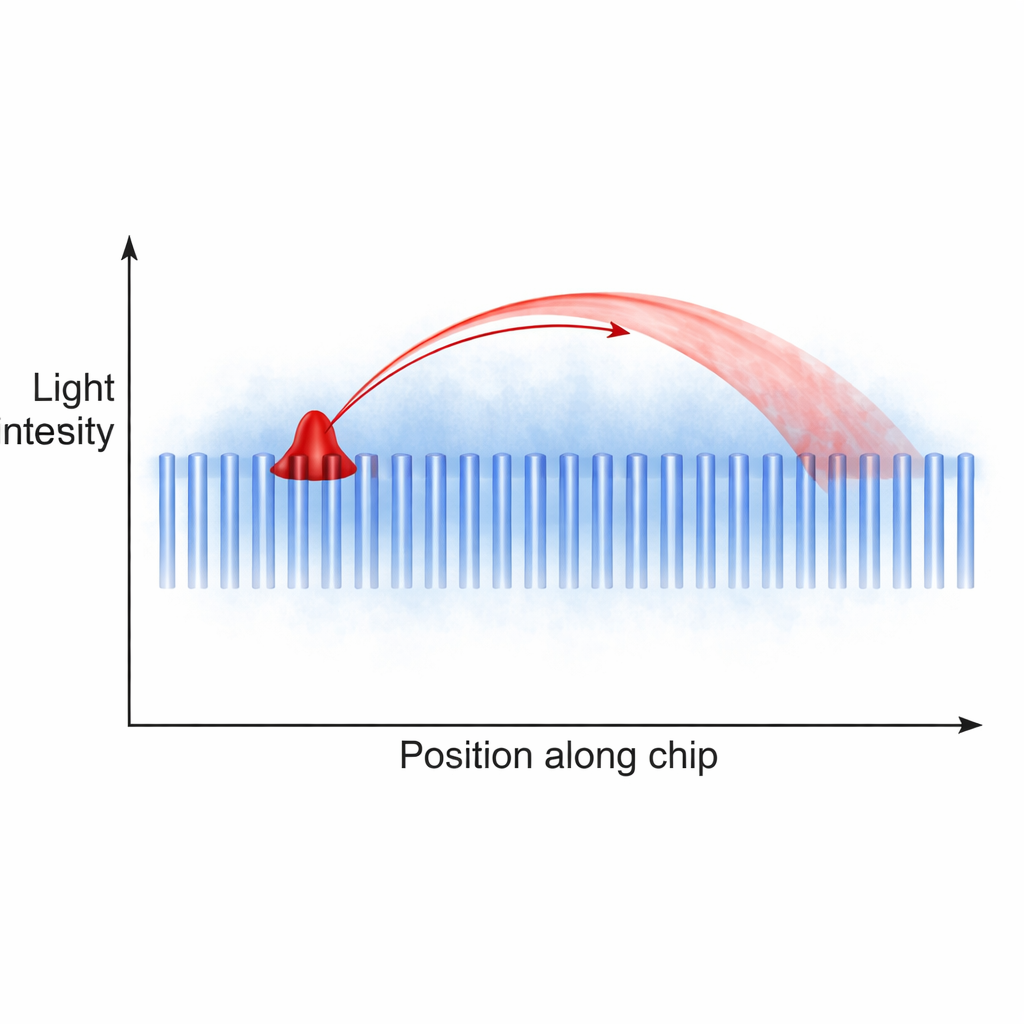
When a moving beam comes back home
The real twist comes when the team launches not a static beam, but a carefully shaped moving wave packet—essentially a pulse of light with a controlled sideways kick. At first, most of the light behaves like a traveling wave and its center of mass shifts across the chip. As the pulse encounters disorder, scattering gradually drains energy from the moving part into localized, standing patterns. The researchers track the center of mass along the chip and find a distinctive trajectory: it drifts away from the launch site, reaches a maximum displacement of about two lattice spacings, and then slowly returns toward the starting point. This drift–turn–return path is the hallmark of the quantum boomerang effect, now observed directly in real space for light.
Speeding up the boomerang
To make this subtle effect more practical and easier to detect, the authors explore ways to accelerate the return without spoiling it. Counter to intuition, they show that adding loss—carefully—can help. They introduce a symmetric gradient loss, where waveguides farther from the center are made slightly more lossy than those near the middle, by inserting tiny breaks into the channels. This arrangement acts like a gentle, restoring friction: it leaves the maximum excursion intact, but pulls the center of mass back to the origin faster than in a lossless chip. Simulations and experiments agree: with gradient loss, the light boomerang completes its return more quickly, and further tuning of the coupling between channels can speed it up even more. 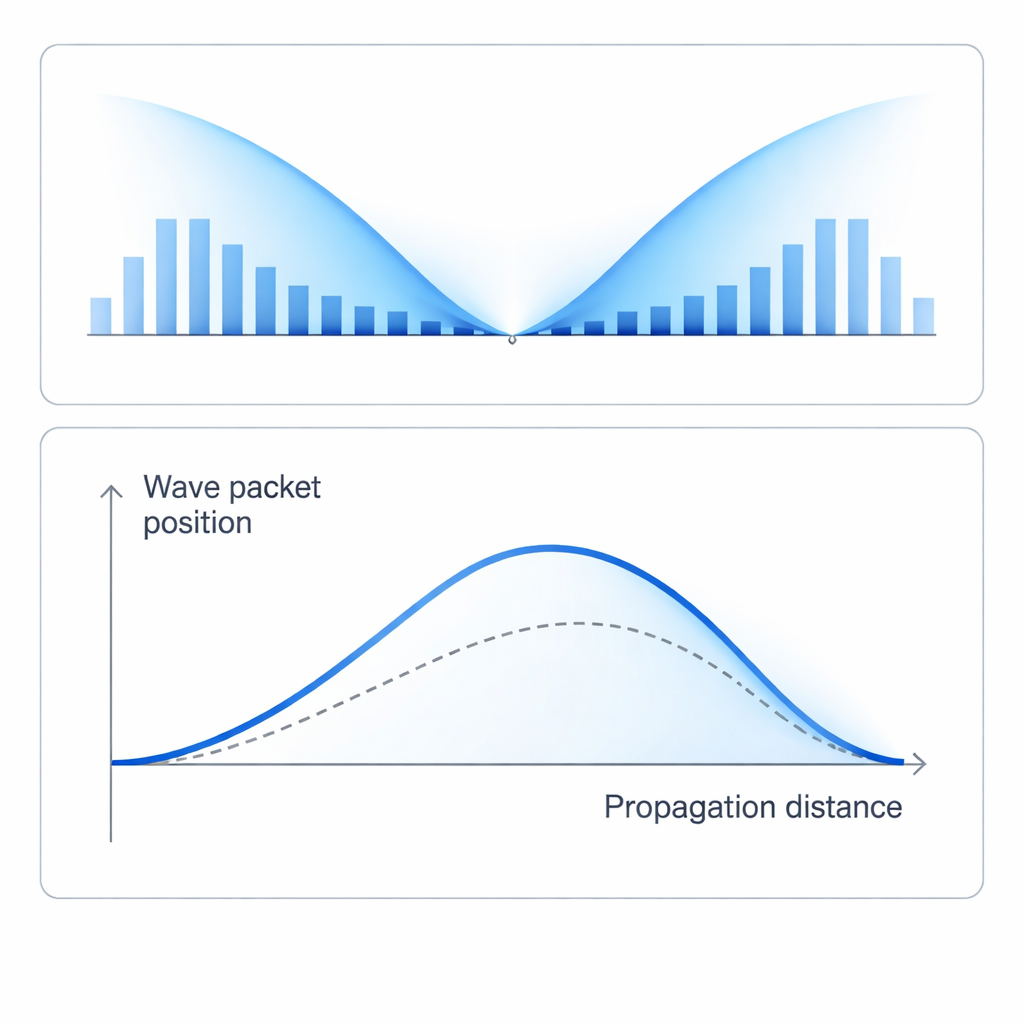
Why this matters beyond curiosity
For a non-specialist, the key message is that light in a messy environment can behave in a surprisingly orderly way: even when launched with a push, it can return to where it began thanks to a delicate balance between quantum interference and disorder. By realizing and controlling this quantum boomerang effect on a compact photonic chip, the work turns an abstract theoretical prediction into a practical platform. Such control over how light moves and comes back in complex media could inform future technologies, from devices that hide objects by steering light around them to optical tweezers that precisely nudge microscopic particles, and may also shed light on how more exotic quantum systems behave.
Citation: Hou, X., Wu, Z., Wang, F. et al. Quantum boomerang effect of light. Nat Commun 17, 1579 (2026). https://doi.org/10.1038/s41467-026-68293-8
Keywords: quantum boomerang, disordered photonic lattices, Anderson localization, integrated photonics, light transport