Clear Sky Science · en
A wideband tunable, nonreciprocal bandpass filter using magnetostatic surface waves with zero static power consumption
Why smarter wireless filters matter
Our phones, Wi‑Fi routers, satellites, and future 6G networks all share a crowded invisible highway: the radio spectrum. As more devices talk at once and across more frequencies, it becomes harder to keep wanted signals while blocking interference and echoes. This paper presents a tiny, energy‑saving radio filter that can both pick out a narrow slice of frequencies over a very wide range and strongly enforce one‑way traffic—capabilities that could make future wireless systems faster, more reliable, and more power‑efficient.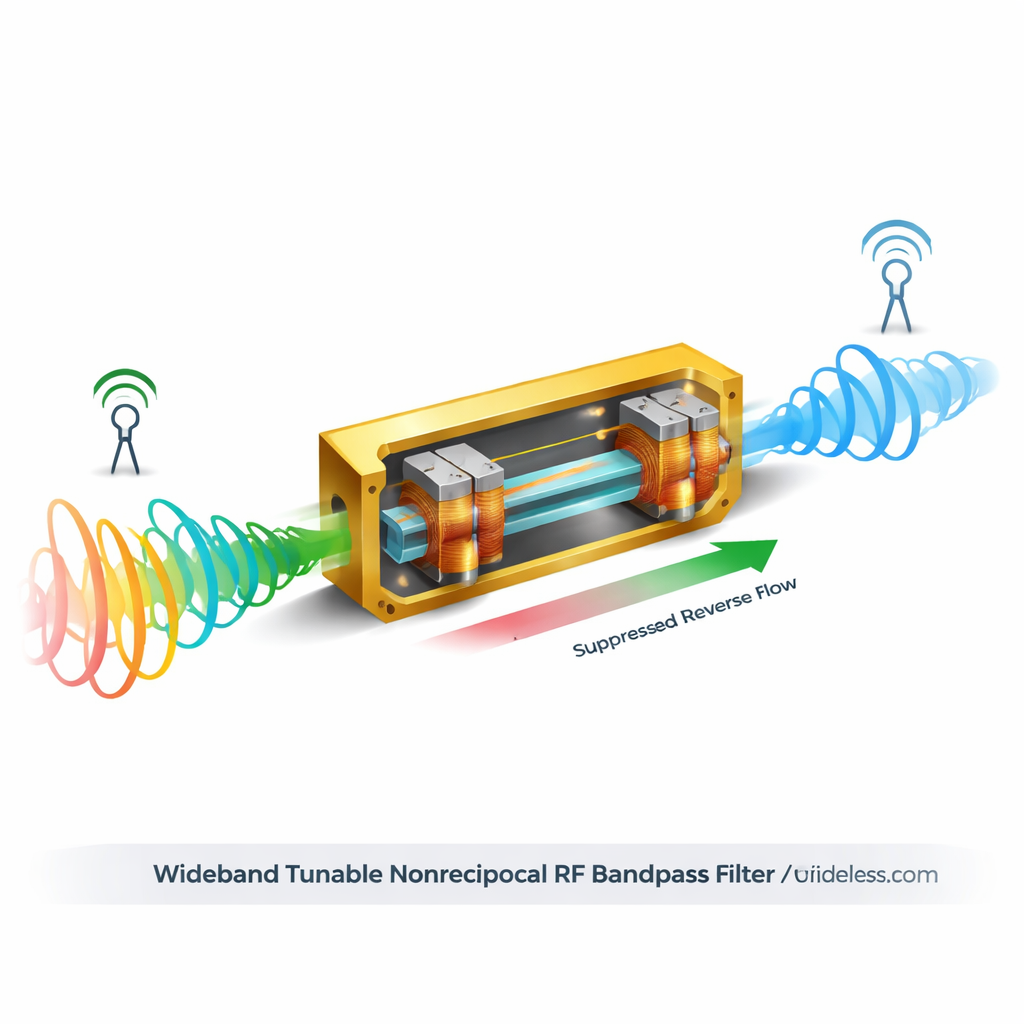
Packing many filters into one tiny part
Conventional radios often rely on banks of fixed filters and separate “isolators” to prevent signals from bouncing back into sensitive electronics. These pieces take up space, add signal loss, and waste power, especially when built from traditional magnetic components or active transistor circuits. The device described here replaces that cluster with a single compact module, about the size of a small sugar cube (roughly 1 cm³). It can be smoothly tuned from 4 to 17.7 gigahertz—a range that spans today’s sub‑6 GHz 5G bands, satellite downlinks, and much of the proposed 6G “FR3” spectrum—while maintaining low loss, strong rejection of unwanted frequencies, and more than 25 decibels of one‑way isolation.
Guiding tiny magnetic ripples
The filter works by turning an electrical signal into a special kind of magnetic ripple, called a magnetostatic surface wave, that travels along a strip of a crystal known as yttrium iron garnet (YIG). Aluminum “meander‑line” patterns at the input and output act like miniature antennas that launch and capture these waves. A key innovation is using a much thicker YIG film—about 18 micrometers instead of the few micrometers used in earlier chips—together with a clever planarization step that flattens the steep edges of the etched crystal so metal lines can be fabricated reliably. This thicker medium lets waves travel faster and with lower loss, and it naturally sharpens the edge of the passing band, producing a steep, nearly “brick‑wall” cutoff that quickly suppresses nearby unwanted channels.
Shaping waves for cleaner, one‑way signals
Beyond thickness, the team carefully sculpts how waves are launched and confined. The meander‑line transducers are designed to prefer certain wavelengths and cancel others, which flattens the filter’s passband and cuts down on spurious peaks. Using two such transducers in parallel improves the electrical match to standard 50‑ohm circuits, cutting signal loss to around 3–5 decibels and further boosting how strongly out‑of‑band signals are rejected, often by more than 30 decibels. The YIG strip itself is carved into a dual‑hexagon shape rather than a simple rectangle. These angled edges discourage internal echoes and standing waves that would otherwise allow signals to sneak backward, thereby enhancing the device’s one‑way behavior without extra components.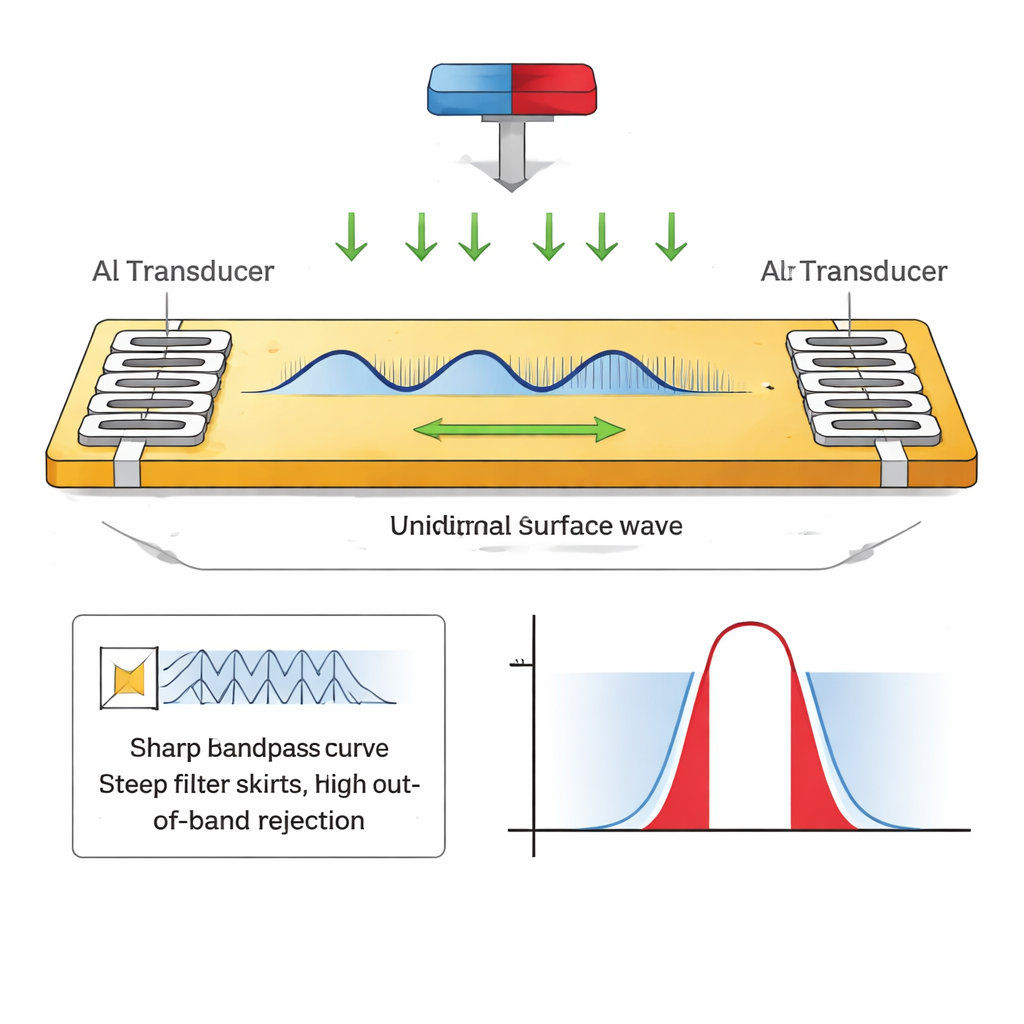
Magnetic tuning with almost no power drain
To tune the center frequency, the filter relies on an integrated magnetic bias circuit made from permanent magnets, soft magnetic “yokes,” and programmable magnets wound with coils. Short current pulses briefly magnetize or demagnetize the adjustable magnets, changing the magnetic field that threads the YIG strip and shifting the filter’s operating frequency. Crucially, once set, the magnets hold their state without any continuous power, unlike the bulky electromagnets often used with YIG devices. The improved magnetic design focuses more flux into the tiny gap where the filter sits, achieving fields up to about 5700 Gauss in a volume of only 1.07 cubic centimeters and enabling the broad tuning range with zero static power consumption.
What this means for future wireless gear
In practical terms, this work demonstrates a single, miniature filter that can slide across many important wireless bands, tightly select narrow channels, strongly block interference, and enforce one‑way flow—all while drawing power only when its frequency is adjusted. That combination has not been achieved before at frequencies reaching 18 gigahertz. Such devices could simplify radio front‑ends in 5G, 6G, satellite links, radar, and sensing equipment by replacing multiple fixed filters and bulky isolators, cutting size, loss, and energy use. For non‑experts, the takeaway is that the authors have shown a new way to build “smarter” filters that give radios finer control over where signals go in frequency and in direction, helping future communication systems stay fast and reliable in an ever‑more crowded airwaves environment.
Citation: Du, X., Ding, Y., Yao, S. et al. A wideband tunable, nonreciprocal bandpass filter using magnetostatic surface waves with zero static power consumption. Nat Commun 17, 1574 (2026). https://doi.org/10.1038/s41467-026-68289-4
Keywords: wireless filters, magnetostatic surface waves, yttrium iron garnet, nonreciprocal devices, frequency tunability